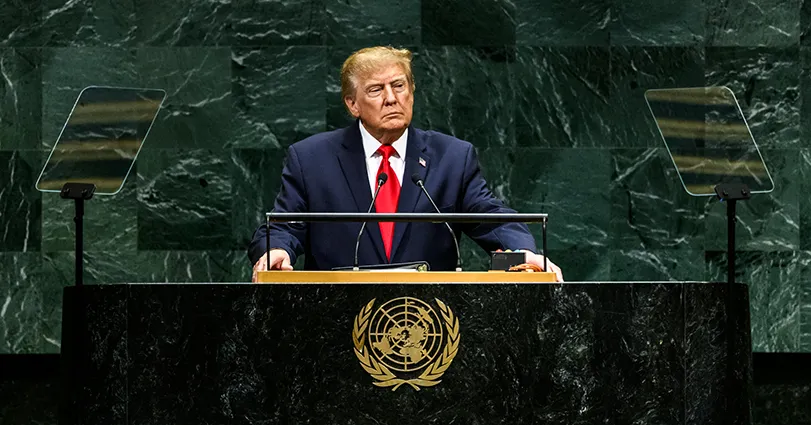
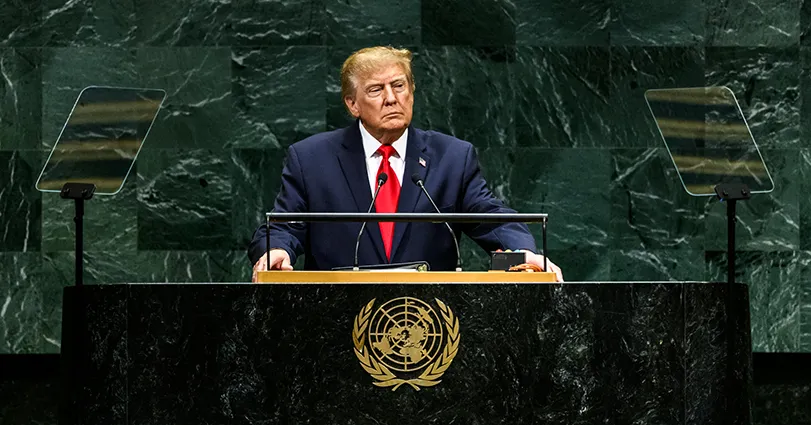
Trump at the U.N.: A Deal With Iran or Annihilation

U.S. President Donald Trump told the U.N. General Assembly in New York on 22 September 2026 that Washington faced a choice on Iran between striking a deal with Tehran and 'annihilating' it. The New York Times
In the same Tuesday address, he defended recent U.S. military action against Iran and Venezuela. U.N. News He later said the United States and Iran met after his General Assembly speech. AP
The September 2026 gathering was the 81st session of the General Assembly. ABC News Nearly 130 heads of state gathered in New York for the week. Reuters The General Debate, the period when national leaders give formal speeches, opened on Tuesday, 22 September and was scheduled to continue through Saturday, 26 September, with proceedings listed for Wednesday, 23 September 2026. U.N. Web TV
The Trump administration said it would allow top Iranian officials to attend the Assembly in New York. Reuters Iranian Foreign Minister Abbas Araghchi attended at U.N. Headquarters in New York City on 22 September 2026. ABC News Iranian President Masoud Pezeshkian was scheduled to address the Assembly on 23 September 2026. The New York Times
Ukraine's president and Argentina's president were scheduled to address the Assembly on the same day, 23 September 2026. Sky News Diplomats said the U.N. Security Council, the smaller U.N. body that handles peace and security, might hold an informal meeting with Arab leaders during Assembly week with Iran expected as the key topic. Reuters The New York Times presented its 22 September live coverage under the title 'As Trump Threatens Iran, Other Leaders Warn of Deep Divisions'. The New York Times
The broader context here is how General Assembly week usually works. Public speeches set out starting positions, like opening offers in a negotiation. Private meetings in hallways test whether those positions can shift. A reported meeting right after a tough speech fits that pattern. It creates a second track to watch next to the public statements.
Looking at what this means for diplomats in the building, the schedule matters. Back-to-back speeches on 23 September place Iran, Ukraine and Argentina close together. An informal Council discussion with Arab leaders would offer a smaller, closed setting where the tone is less public. Pressure builds at the podium. Testing happens behind closed doors. The question is whether the two connect.
In my view, the practical question is narrow. Strong language can do two jobs at once. It speaks to audiences at home. It puts pressure on the other side. The risk is misunderstanding. What Washington means as leverage, Tehran may hear as an ultimatum. That is why diplomats will watch mechanics more than words. Who met whom. At what level. Whether follow-up contacts were named.
Looking at what this means for the week ahead, attention will divide. The General Debate gives the public record. Informal talks give a private place to test ideas. When both cover the same issue, control of the message gets hard. A line meant for one audience reaches the other instantly. That friction does not rule out agreement. It shapes how any agreement would need to be ordered and explained.