Trump's Iran Warning and U.N. Walkouts: What Happened and Why It Matters

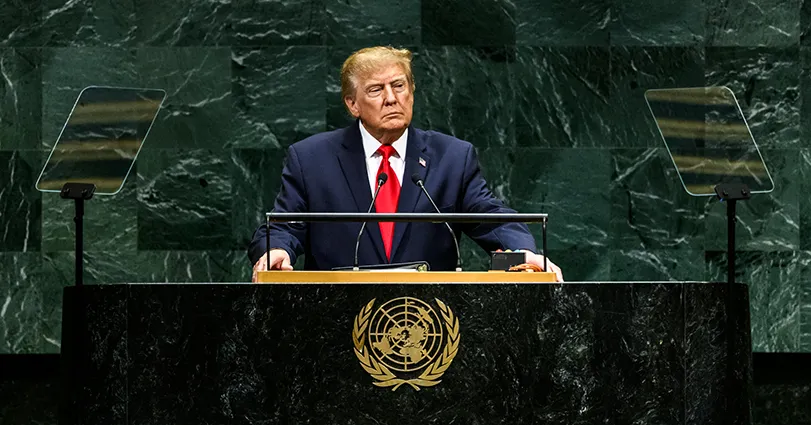
President Trump told the U.N. General Assembly on Sept. 22, 2026 that he faced a choice to make a deal with Iran or to 'annihilate' Iran. The New York Times He said it during his appearance before the Assembly.
Cuban officials walked out following President Trump's remarks. The New York Times
The General Assembly, the main gathering where all U.N. member countries meet, opened its 81st session at U.N. Headquarters. UN News Syrian President Ahmad Al-Sharaa told the Assembly that Syria "is rising" on many levels, crediting the strength of its people. UN News
Delegates walked out during Israeli Prime Minister Benjamin Netanyahu's speech to the U.N. in September 2025. Reuters Delegates walked out as Netanyahu addressed the U.N. General Assembly in 2024. Reuters
Iranian President Mahmoud Ahmadinejad's address to the U.N. General Assembly triggered a walkout by U.S. delegates and other diplomats. PBS In his address, Ahmadinejad called the September 11 attacks the "mysterious September 11th incident" and accused the United States of using it as a pretext to invade Iraq and Afghanistan. PBS
The broader context here is that the Assembly works like two meetings at once. Leaders speak to the room. They also speak to voters and governments back home. A two-option warning, deal or destruction, simplifies difficult talks into a short public message. For experts, the words count less as law and more as a starting point for bargaining.
In my view, the walkout needs the same careful reading. It is quiet and orderly. No one interrupts. Disapproval is still on camera, even if it never enters the official record. Smaller delegations have few chances to be seen in a large body like this, so absence becomes the message. That helps explain why the same tactic appears over years, from U.S. diplomats in 2011 to delegations during the Netanyahu addresses in 2024 and 2025 to Cuban officials on Sept. 22, 2026.
Looking at what this means for the weeks ahead, attention moves from speeches to hallways. Strong public language can build support at home. It can also make open compromise harder abroad. Intermediaries may still test ideas quietly. The Assembly allows contact without requiring agreement.
What matters next is what envoys are told to do. They return to missions. Capitals update guidance. Drafts circulate. For those following Iran, Syria and the wider Middle East, these speeches and walkouts show current positions. They do not decide results.