Europe's Summer 2024 Heat Wave: What the Record Temperatures Mean

Europe's Summer 2024 Heat Wave: What the Record Temperatures Mean
Temperatures topped 40°C (104°F) across parts of Europe during summer 2024, pushing France, Spain, and Italy to issue red-alert emergency warnings. It was one of the hottest seasons the continent has experienced on record.
What Happened on the Ground
France faced the most immediate pressure. Authorities placed roughly half the country under red alert as temperatures climbed past 40°C in multiple regions, according to ABC News Australia. Parts of France and Spain reached 104°F, per CBS News. France took an unusual step: it banned outdoor drinking in the hardest-hit areas. That may sound odd, but alcohol speeds up dehydration — a critical risk when your body is already struggling with extreme heat.
Italy issued red alerts for multiple cities once temperatures hit the same threshold, AFP reported.
These warnings weren't casual cautions. Red alerts in Europe's weather systems trigger real, binding rules for hospitals, workplace safety, and how emergency services deploy their resources. When three major European economies activate them simultaneously, it stretches health systems and labor protections across borders all at once.
The Bigger Picture: Why This Matters
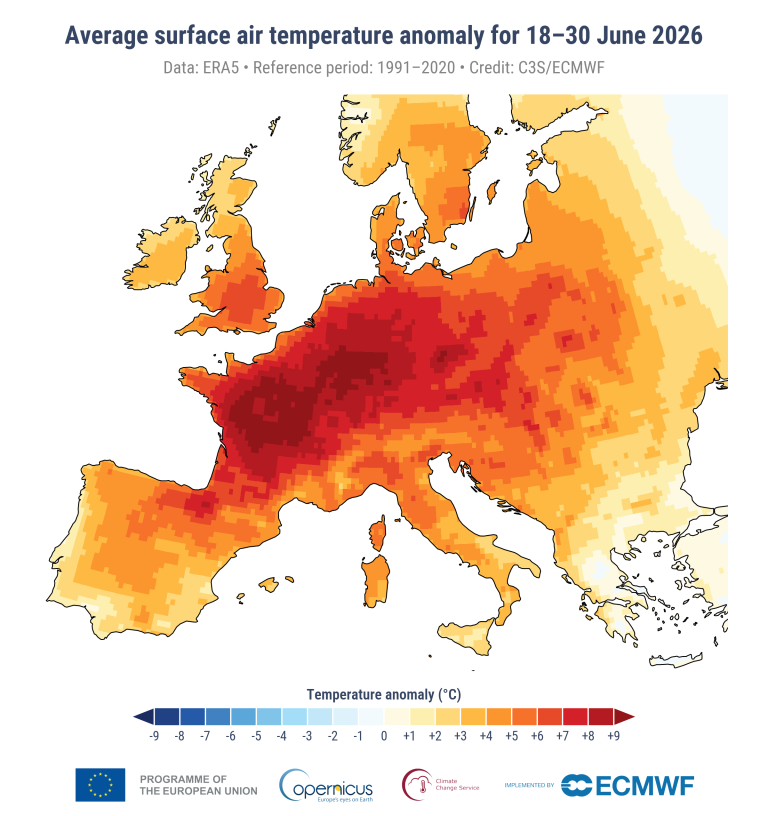
The heat in summer 2024 was not just extreme — it was measurably unusual against the historical record. The average surface temperature over European land from June through August ran 1.54°C above what scientists call the "baseline" — the average temperatures from 1991 to 2020 — marking the highest seasonal departure ever recorded for Europe, according to the Copernicus Climate Change Service. The European State of the Climate 2024 report, produced jointly by Copernicus/ECMWF and the World Meteorological Organization, formally named summer 2024 as the warmest on record for the continent. ECMWF's own seasonal forecasts had predicted warming of 1–2°C — a range the actual outcome exceeded.
To put this in perspective: that 1.54°C figure is not small. The baseline itself already reflects two decades of accelerating warming, so the anomaly is measured against an already-warm reference period, not against pre-industrial times. The practical effect is that alert systems — designed based on how often extreme heat historically occurred — are now being triggered far more often. Governments are being asked to run emergency-level operations almost constantly, instead of treating them as rare exceptions.
Spain, France, and Italy collectively produce a large share of Europe's food, welcome millions of summer tourists, and employ huge outdoor workforces. When temperatures stay above 40°C for extended periods, people and productivity suffer directly. That damage multiplies when it hits all three countries simultaneously. What France and Italy are reaching for now — drinking bans, red-alert rules — are behavioral and regulatory tools rather than infrastructure fixes, because real solutions like expanded cooling systems and urban shade require years to build.
What makes summer 2024 significant for policy is this: independent measurement systems all told the same story. National weather services, satellite-based data analysis, and international climate assessments all converged on the same conclusion. For government officials working on heat-preparedness plans, climate adaptation funding, or workplace safety rules, that agreement removes a common excuse for delay — the argument that uncertainty means we should wait and see. The data is now too consistent for that.