OpenAI Adds $500 Pro 500 Tier With Ultrafast Speed, Trims the $200 Plan
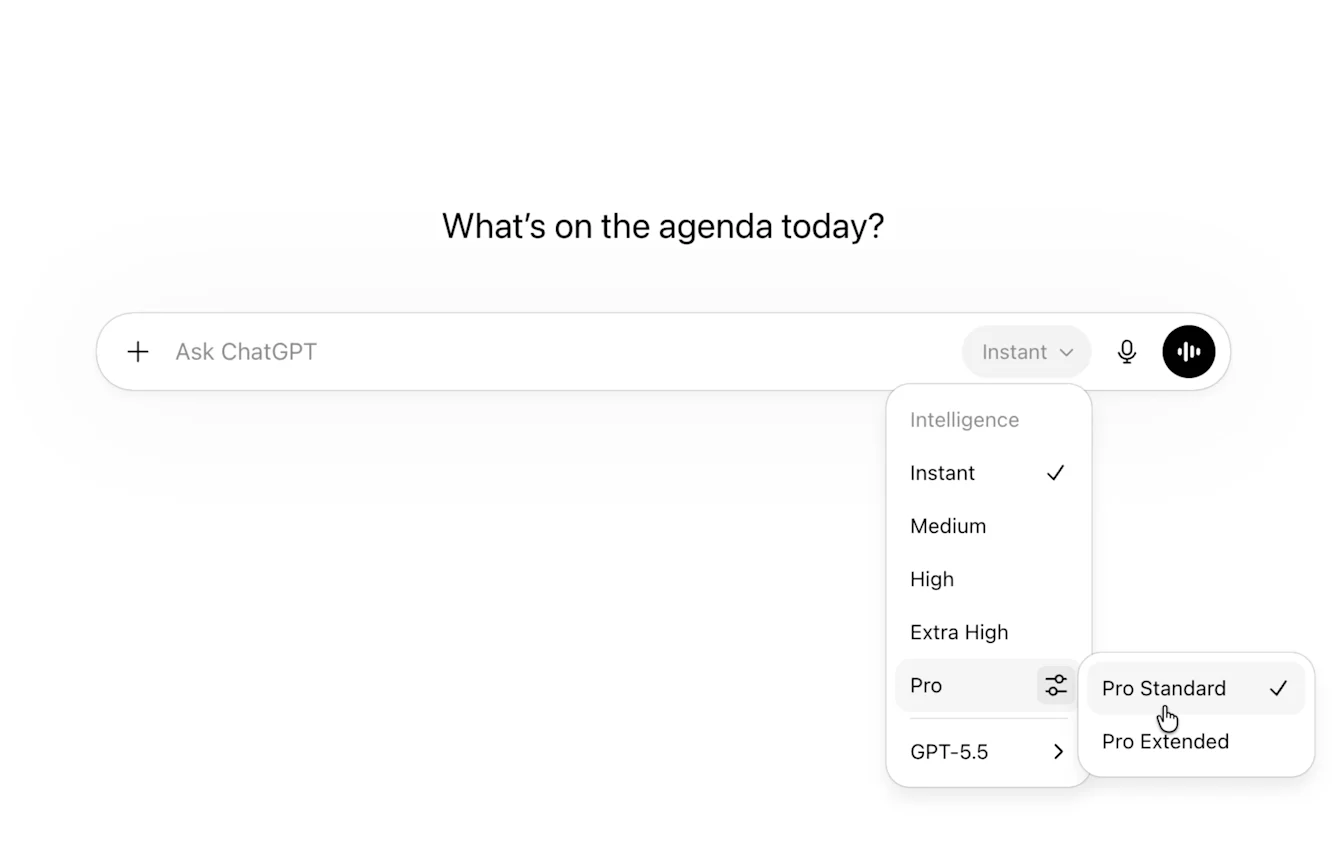
OpenAI announced a $500-per-month Pro 500 subscription at its DevDay event on Sept. 29, 2026. It is now the top ChatGPT Pro plan for included usage and the only Pro plan with access to a new Ultrafast speed option. Engadget
Ultrafast is selected in the model picker on Pro 500. With it on, Codex and Work can generate up to 300 tokens per second. Tokens are the small chunks of text a model reads and writes, so the number measures steady output speed. Codex is OpenAI's coding tool, Work is its tool for multi-step computer tasks. The same speed tier is also available to API users, who call models from their own software on a pay-per-use basis.
On Pro 500, Ultrafast use draws from included usage first, then from the credit balance once that allowance is used. Buying credits on Pro 100 or Pro 200 does not unlock Ultrafast at launch. OpenAI Help Center
To place that speed limit in context, steady output matters most for long, looping jobs. Agentic coding in Codex, multi-step computer use in Work, and iteration over large context benefit more from sustained tokens per second than from a faster first word. Keeping the 300-token-per-second mode on Pro 500 and API keeps it as a premium inference class, the paid capacity for running models, rather than a general speed gain for everyone.
Pricing and limits
OpenAI introduced the $200 Pro plan at the end of 2024. Under the new structure, included usage in Codex and Work for $200 subscribers falls from 20 times the Plus allowance to 10 times. Message caps for GPT-6 Pro in ChatGPT fall from 200 to 100 per week. Engadget
The monthly price for Pro 200 stays at $200. New Pro 200 subscriptions carry the lower allowance. Subscriptions active at the eligibility cutoff, or during the seven days before it, keep the previous allowance through Oct. 29, 2026 while the subscription stays active. A subscription that lapsed during those seven days can still keep the previous allowance through Oct. 29, 2026 if renewed. After that date, those accounts move to the lower included usage at the same $200 price.
OpenAI said existing $200 subscribers will keep current limits for a time and later receive a one-time credit. Keeping the previous Pro 200 allowance does not move the account to Pro 500 and does not add Ultrafast.
The full Pro range now covers three monthly plans: Pro 100, Pro 200 and Pro 500. Pro 200 includes more usage than Pro 100. Pro 500 offers the highest included usage. New Pro 200 subscriptions are available again from the pricing page. Across Pro, the bundle includes Pro models, Codex, deep research, image creation, memory and file uploads. OpenAI Help Center
Plus remains the entry point in that lineup. Pro 100 and Pro 200 raise the quota. Pro 500 adds both quota and speed.
Agents and distribution
All Pro subscribers will get a single Dot, OpenAI's new personal AI agent. Conversations with Dot will not count toward the ChatGPT usage limit.
The context for that metering choice is how quickly always-on agents use quota. An agent that runs in the background can use weekly message caps quickly. Excluding Dot traffic from ChatGPT limits separates testing a personal agent from regular use of GPT-6 Pro, Codex and Work.
OpenAI also said it is partnering with 16 companies, including Notion and Cognition, to let Plus and Pro customers run OpenAI models inside those services through Sign in with ChatGPT, without setting up an API key. Engadget
For enterprise developers, the background here is simpler access control. OAuth-style sign-in replaces per-service keys, per-seat secrets rotation, and separate billing for casual use. Centralized ChatGPT entitlements travel into third-party tools. It also keeps usage accounting inside OpenAI's allowance and credit system rather than splitting it across vendor API contracts.
Speed and models
Alongside the packaging changes, OpenAI announced GPT-6.1 Sol. The company positions Sol as offering nearly the same performance as GPT-6.0 Astra in coding and computer use while costing one-fifth the price.
Plus, Pro, Business, Enterprise and Education users can use GPT-6.1 Sol in Codex and Work starting Sept. 29, with availability in ChatGPT to follow later.
That rollout order makes sense when token volume is considered. Codex and Work are where token volume concentrates. Shipping the cost-efficient model there first lowers the blended cost per agentic task before exposing it to broad conversational load.
The broader context here is inference economics catching up with product packaging. Model providers spent two years competing on context window, the amount of text a model can consider at once, benchmark scores and multimodal inputs. Quota multiples, message caps, credit overages and speed tiers are now the control plane. OpenAI is segmenting less by which model you can touch and more by how much you can run and how fast it returns.
In my view, that is a rational response to how power users actually spend. A small fraction of developers and researchers drive a large share of tokens through agents that loop, retry and self-critique. A flat $200 unlimited-style tier never mapped well to that distribution. A $500 tier with the highest allowance plus a metered 300-token-per-second mode does. The tradeoff is explicit. Heavy Codex and Work users either accept 10x Plus on Pro 200, buy credits, or step up to Pro 500.
Worth flagging for teams is the need to audit where tokens go before choosing. If the bottleneck is agent iteration speed in Codex, Ultrafast on Pro 500 may reduce wall-clock time per task even if total token count stays flat. If the bottleneck is weekly GPT-6 Pro messages in ChatGPT, the cut from 200 to 100 changes review and deep research workflows more than coding throughput. And if you standardized on Astra for coding reliability, test Sol against your own evals and tool traces before assuming parity translates to your repository.
Looking at the longer arc, capability per dollar continues to rise. A model with near-Astra coding performance at one-fifth the price, available across consumer and enterprise tiers on day one in developer surfaces, extends what small teams can automate without extending budget. The new ceiling costs more. The floor just got cheaper to run.


