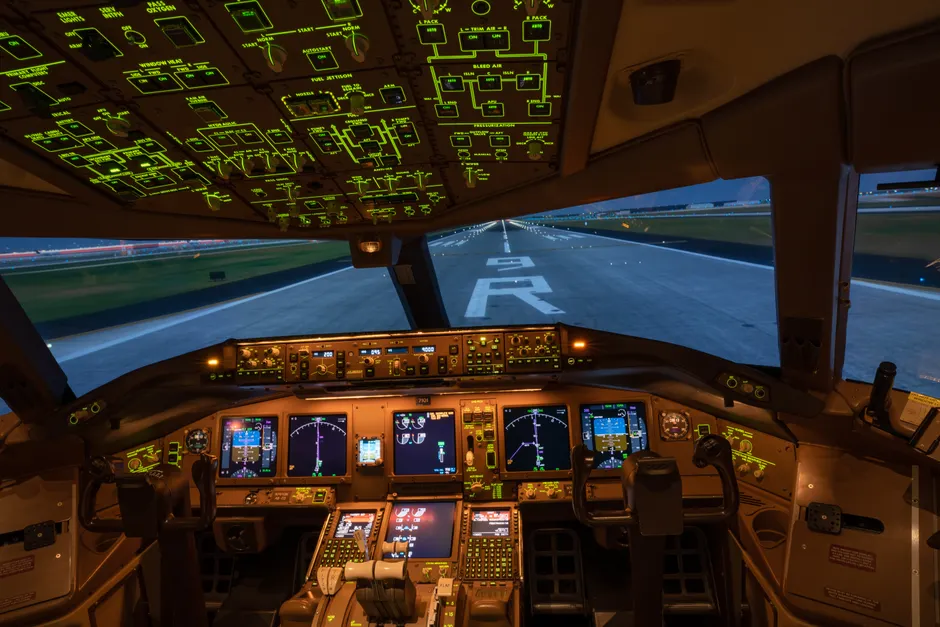
Flydubai Co-Pilot Attack Forces Emergency Landing in Saudi Arabia

A Flydubai co-pilot stabbed the captain in the cockpit during Flight FZ1073 from Dubai to Tel Aviv on Wednesday, forcing an emergency diversion to Saudi Arabia with more than 170 people on board.
The aircraft was approaching Jordanian airspace when the attack occurred, according to live reporting. The jet lost half its altitude within a minute during the struggle. Earlier flight-tracking summaries cited a 14,000-foot plunge before control was regained Reuters. The aircraft also emitted an emergency distress signal, the formal call pilots use to report life-threatening danger Al Jazeera.
Despite being stabbed, the captain unlocked the cockpit door. Passengers and crew then entered and overpowered the attacker, who was reportedly attempting to damage the aircraft controls at the time. Another qualified pilot who was on board took control and landed the aircraft safely in Tabuk, Saudi Arabia.
The injured captain was identified as Capt Smit Machchhar, an Indian national BBC. He was taken to hospital after landing. The co-pilot accused of the stabbing was arrested after landing and remains in Saudi custody, where Saudi authorities are questioning him.
The United Arab Emirates, as the state of the operator, has opened an investigation. Israel has described the event as a terrorist attack and an attempt to crash the aircraft. The majority of passengers were Israeli. Israeli Prime Minister Benjamin Netanyahu said Israel would follow the investigation and possibly participate.
The broader context here is jurisdictional and diplomatic as much as operational. A UAE-registered aircraft, commanded by an Indian national, carrying a predominantly Israeli manifest, diverting into Saudi airspace after cockpit violence, places at least four governments in the investigative chain. Custody sits in Tabuk. Regulatory responsibility sits in Abu Dhabi. The destination state asserts a direct interest and a terrorism framing. That distribution shapes everything from access to the cockpit voice and flight data recorders, which log crew audio and flight inputs like a memory bank, to questioning protocols and information release.
Looking at aviation security, the central question is insider access. Reinforced cockpit doors, two-person rules that keep two crew members in the cockpit, and screening regimes are built to block external intrusion, like a vault door keeping intruders out. They function differently when the threat originates at the controls. Safety regulators and operators will study how a wounded commander opened the door to enable cabin intervention, followed by control assumed by another pilot. It raises precise issues about crew vetting, procedures for in-flight incapacitation when a pilot cannot fly, and the narrow margin for recovery at cruise altitude when control inputs are contested.
For diplomats, the immediate task is procedural coordination. Investigators will need to establish a factual sequence for the altitude excursion, the distress call, the struggle for controls, and the landing. Political characterizations will run in parallel. They do not replace that technical work.