Live Video vs. On-Demand Exercise for Chronic Back Pain: What a New Trial Will Test
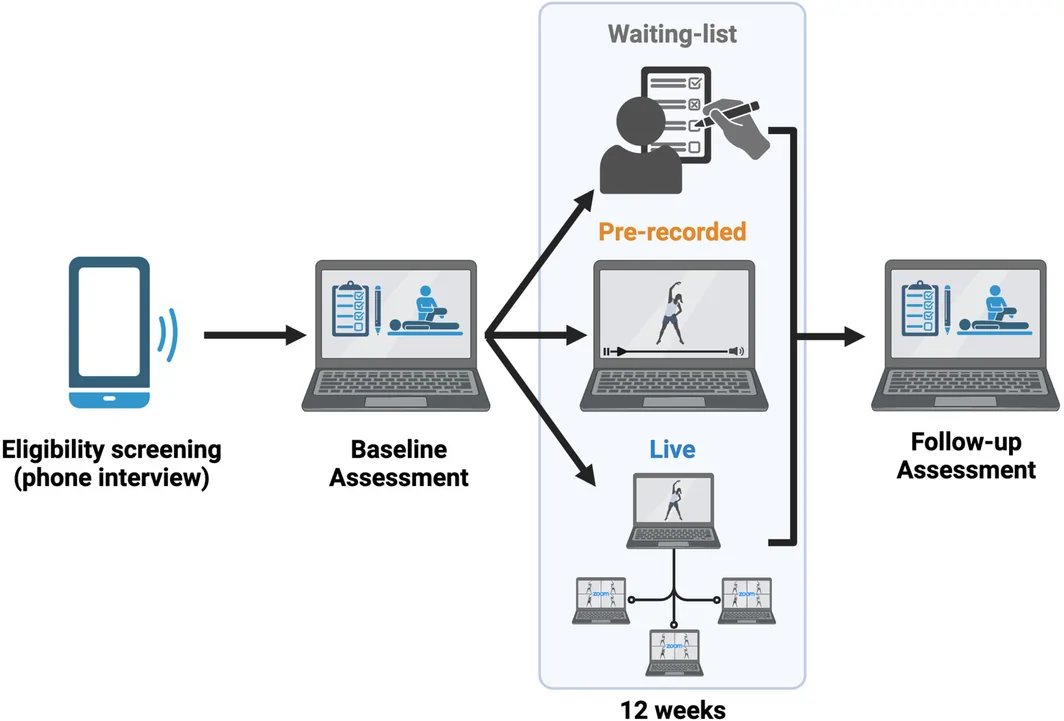
A protocol published Oct. 6, 2026 will compare two remote exercise programs for chronic low back pain: live group sessions and pre-recorded sessions done alone. It will test comparative effectiveness and study mediators and moderators, or why each method works and which patients it helps most.
The question is large in scale. More than 800 million people worldwide are projected to experience low back pain each year by 2050, and exercise is often recommended as a front-line treatment for chronic cases PMC. At that volume, cost is central.
Remote delivery is presented as a lower-cost option with similar results. The protocol notes remote exercise appears to provide similar effectiveness, safety and patient satisfaction as in-person training at lower cost PMC. Earlier work points in the same direction. A 2023 randomized controlled trial by D. Cui found a remote digital care program supported the same level of recovery as evidence-based in-person care, while a 2021 review by J.A. Hayden found moderate-certainty evidence that exercise is probably effective for chronic low back pain compared with no treatment, usual care or placebo.
The trial isolates delivery mode, not exercise itself. Pre-recorded sessions are typically delivered through smartphone apps and let patients self-manage on their own schedule. Live training uses videoconference systems and adds peer support and real-time supervision. A 2026 article by C. Fan describes the asynchronous pattern in detail, with patients following pre-recorded sessions independently and receiving periodic evaluations from clinicians.
Other researchers have mapped the nearby design space. A 2024 study by J. Sivertsson mapped how telerehabilitation, or rehab delivered with phones and video tools, is used in studies of exercise for chronic low back pain. A 2021 study by B. Brea-Gómez found virtual reality reduced pain intensity and kinesiophobia, or fear of movement, in adults with chronic low back pain both after treatment and at follow-up.
Trial registries show how those ideas become specific programs. Trial NCT05895630 uses interactive group sessions live on Zoom alongside pre-recorded video sessions. Trial NCT07208435 is an 8-week web-based program delivered through Physitrack, with 30-45 minute sessions twice per week focused on core strengthening. Trial NCT07700589 uses stretching, core stabilization and motor control exercises performed 3 days a week for 8 weeks. Trial NCT06821607 assigns patients at random to an 8-session evidence-based physical therapy program delivered in person or by telehealth. Trial NCT06491121 looks at short- and long-term effects of time-contingent individualized high-intensity training, where dose is set by schedule rather than pain.
The broader context here is a tradeoff familiar in systems design. Synchronous group video preserves supervision, social accountability and immediate correction. Asynchronous video preserves scheduling flexibility, repeatability and lower cost per patient. Adherence is the difficult part.
In my view, the most useful part for technologists is the focus on mediators and moderators rather than a simple efficacy contest. If live supervision improves outcomes, is the mechanism form correction, scheduled commitment, or peer interaction. If on-demand video works as well for some groups, is it autonomy, higher session frequency, or less friction to start. Those distinctions shape telemetry, reminder logic, clinician-in-the-loop thresholds, and how to sort patients between high-touch and self-managed paths.
Worth flagging for platform builders, the endpoint that matters is sustained self-management at population scale. Exercise for back pain fails more often because people stop than because the biomechanics are wrong. An architecture that matches supervision intensity to patient need, without defaulting everyone to the most expensive live slot, would widen access while keeping clinical time for cases where live oversight changes the result.


