GPT-6 Expands to Everyone in ChatGPT, With Interfaces That Build as They Answer

OpenAI expanded GPT-6 to more people through ChatGPT on October 7, 2026, moving beyond the paid customers who received the first GPT-6 models. The company states that more than 1.2 billion people use ChatGPT each week, which frames the scale of the rollout described in its Product announcement titled "GPT-6 and Intelligent UI for everyone" OpenAI.
The headline change is Intelligent UI, a capability that lets ChatGPT answer with fully interactive user interfaces. Instead of returning only a text block, GPT-6 in ChatGPT can compose a response that blends text, visuals and interactive elements, choosing how they fit together based on the question.
Responses can include graphics, tappable buttons, forms, charts, and interactive experiences usable directly in the conversation. The interaction stays in the thread. There is no redirect to a separate view to complete a step.
Interfaces that stream with tokens
OpenAI built a library of native, streamable components with a compiler that processes the interface as the model generates it. The compiler allows the interface to appear progressively as the model writes, without waiting for the entire response to complete.
For builders, the practical point here is that traditional rich answers wait for a full payload, then render. Here the interface is tied to token generation, the small chunks the model produces in sequence. Layout arrives bit by bit, so users can orient early.
With GPT-6, ChatGPT can also begin answering while it continues to think by interleaving thinking with answering. The model does not finish a hidden reasoning pass before emitting the first visible chunk. It starts the response and keeps reasoning in parallel.
Latency and reasoning effort
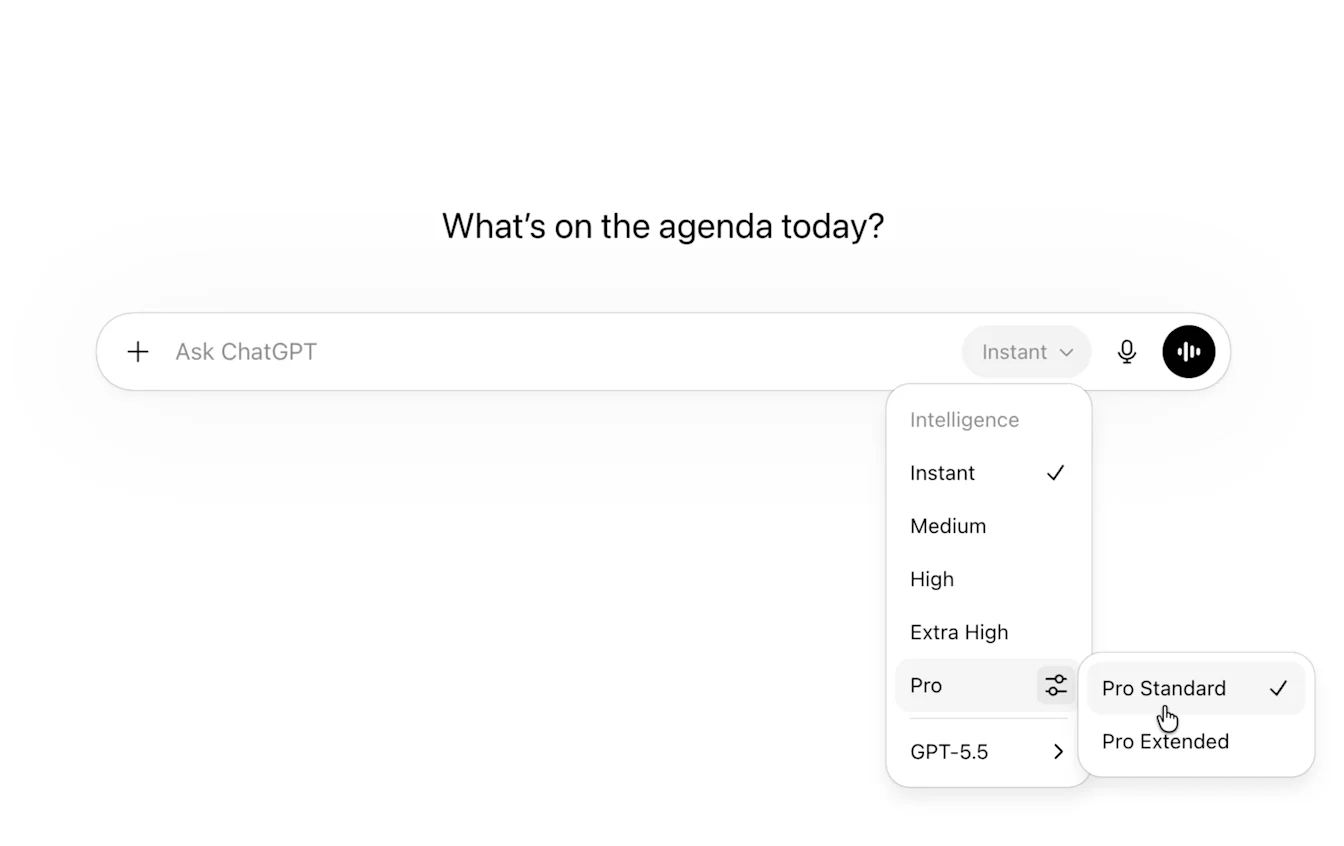
OpenAI quantified that behavior with an internal evaluation of high-value everyday agentic tasks, meaning tasks where the AI takes steps on its own. In that test, GPT-6 Extra High begins answering in the same amount of time as GPT-5.6 Medium while achieving a better overall score than GPT-5.6 Extra High.
Time to first token, the delay before the first words appear, and task score are usually traded against each other. Higher reasoning effort, or more internal work before answering, improves reliability for multi-step jobs but increases perceived waiting time. The claim here is that interleaving loosens that tradeoff. Delay matches a medium-effort setup. Quality beats the earlier extra-high setup.
In practical terms for teams running support, operations, or research assistants, first-token delay affects whether people abandon the task, and final-answer quality affects whether the issue is resolved. If both improve together, there is less need to tune effort settings by hand for each task.
The rollout followed documentation for builders. OpenAI published a Product announcement titled "A practical guide to building with GPT-6" on October 2, 2026, five days before the broader ChatGPT expansion.
A crowded GPT-6 lineup
The October 7 expansion sits alongside several other model releases. OpenAI launched two new models named GPT-6 Sol and Luna on September 22, 2026 TechCrunch. GPT-6 Sol will cost $2 per million input tokens Reuters.
OpenAI then introduced GPT-6.1 Sol as an upgrade to GPT-6 Sol, stating that it nearly matches GPT-6 Astra's intelligence on agentic coding, computer use, and professional work. Separately, GPT-6 Astra's listed skills include tax preparation, game development, architectural rendering, and legal memo preparation Reuters.
Two other items provide context for the pace. OpenAI scrapped the release of GPT-6.1 Astra, a next-generation AI model planned for an October debut, after internal safety testing Reuters. It was also set to preview a cybersecurity-focused AI model named GPT-6 Cyber within days, according to a September 24 report.
The broader context here is a shift from chat as transcript to chat as runtime. Text remains useful for explanation. It is inefficient for selection, comparison, data entry, and iteration. Native buttons, forms, and charts compress those loops without forcing users to learn query syntax.
In my view, the development worth watching is not visual polish but state handling. Interactive responses create intermediate state inside a conversation: a checked option, a half-filled form, a filtered chart. That state must persist across turns, survive regeneration, and remain auditable for enterprise use. I have watched my own children breeze past manual-style instructions when an interface let them tap and correct directly, and enterprise users behave the same way. They tolerate a wrong paragraph. They act on a wrong control.
Worth flagging for builders, the compiler model implies new failure modes. Streaming UI means partial renders, revoked options, and reasoning updates that alter controls mid-stream. Teams will need patterns for versioning interface state, logging what the user saw when they clicked, and testing agentic tasks end to end rather than scoring final text alone. If OpenAI's latency and quality numbers hold outside internal evaluations, the payoff is a ChatGPT that feels less like a document generator and more like software that assembles itself per question.