Spotify Turns Its Internal Developer Toolkit Into Products for Sale
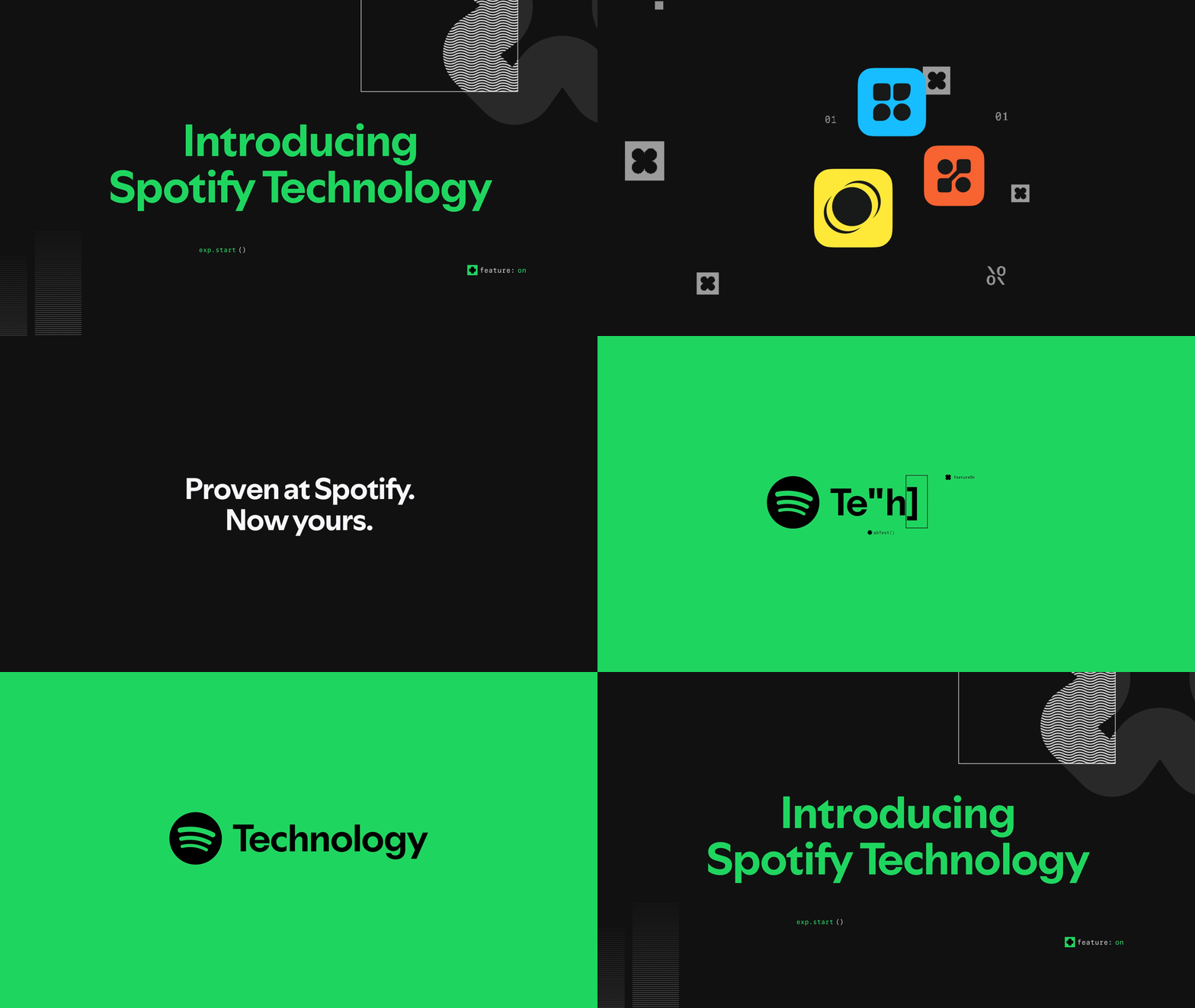
Spotify launched technology.spotify.com on Oct. 8, 2026 as a consolidated storefront for tooling built inside its engineering organization. The catalog offers infrastructure used at consumer streaming scale as enterprise and developer products.
The site is introduced as Spotify Technology, described as a home for everything the company built to help R&D organizations build, ship, and learn, according to Spotify Engineering. It holds open source projects and paid services built to serve 777 million monthly active users, according to TechCrunch.
The portfolio centers on four systems with staggered release histories. Backstage was open sourced in 2020 and is a platform and framework for building customizable developer portals, central hubs where engineers find services, docs, and tools. Confidence has been sold since 2023 as an enterprise-focused software experimentation platform, software for testing which product changes work with real users. Portal has been sold since 2024 as an enterprise software development platform. Xirp, a developer tool for managing AI coding agents, began selling earlier in 2026.
For product and experimentation work, the site describes its product intelligence loop as "putting every product signal in one place," according to Spotify Technology. It says Confidence "surfaces what to build next and shows its work." The guardrails are stated directly. Its automated system "requires a person's approval before anything ships." The loop requires that "every change closes with a statistically rigorous experiment," meaning each change is checked with careful statistical testing.
No pricing is listed. Companies fill out a form to contact sales. Spotify has not disclosed revenue from enterprise sales in its financial reporting. Tyson Singer is SVP of Technology & Platform.
Spotify cites 300 million subscribers and operations in 184 markets. The 777 million monthly active user figure describes the load, concurrency, rollout safety, and telemetry volume the tooling was built to handle. Telemetry here means measurement data flowing back from software in use.
Spotify Technology S.A. trades on the New York Stock Exchange under the ticker SPOT. It will post its third-quarter 2026 results and shareholder deck on Thursday, October 22, 2026, followed by a question and answer session at 8:00 a.m. Eastern Time.
The broader context here is familiar to platform engineering teams. Internal developer portals, feature management, and experimentation infrastructure tend to start as glue code. Over time they harden into internal platforms with owners, SLAs, and dedicated roadmaps. Productizing that platform is a different discipline. It requires multi-tenancy, packaging, documentation, support, and a commercial operation that consumer subscription businesses do not maintain by default. Multi-tenancy means serving many business customers securely from shared systems.
In my view, the sequencing is the tell. Backstage established distribution and credibility through open source. Confidence and Portal tested willingness to pay for hosted, enterprise-scoped versions. Xirp extends the same pattern to agent orchestration, where enterprises now need auditability, approval gates, and measurement around non-deterministic tooling, tools whose outputs can vary. For buyers already running Backstage, the incremental evaluation cost is low. For Spotify, each deployment feeds operational feedback from environments it does not control.
Worth flagging for practitioners is what to diligence. Ask how Confidence isolates experiment assignment across services, how Portal composes with existing identity, CI, and service catalogs, and how Xirp scopes permissions and records human approvals for agent actions. The answers will determine whether this is tooling reuse or a durable enterprise software business. Either way, more production-hardened options for building, shipping, and learning is a useful outcome for engineering organizations.