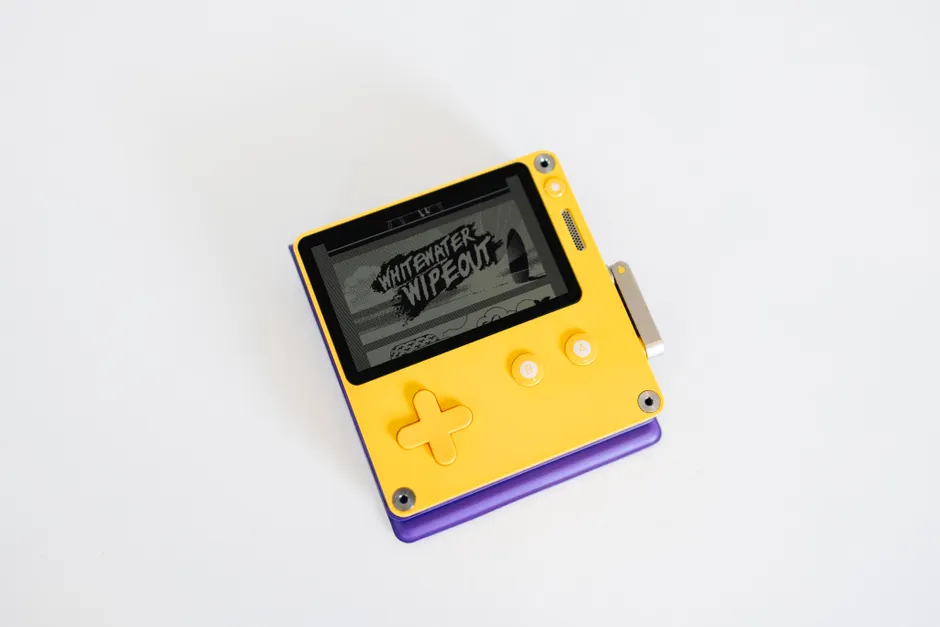
Playdate Season 3: Eight Games for $39 Built Around the Crank

Panic has set Playdate Season 3 at $39 for eight games. The games arrive two per week over four weeks.
The package continues the seasonal model for Panic's tiny yellow handheld, which launched in 2022. The hardware is built around a black-and-white screen and a crank on its side, a mechanical input that still sets limits for developers The Verge. Season 3 works within that limit instead of avoiding it.
Soggy Froggy is an arcade game about keeping a frog alive in a cauldron by managing water temperature, with the crank used to cool the water. It uses a short loop where one turn of the crank gives one clear result on screen. That design needs only a small game state and simple feedback, which suits the Playdate well.
Gloom Gate is larger in scope. It is described as a dungeon-crawling RPG, a role-playing game, with 3D graphics, built around arena battles that require dodging, parrying, attacking and stamina management. That is a demanding fit for a low-resolution display with no backlight and a modest processor. Clear enemy warnings and careful use of memory and processing power will matter more here than raw graphics power.
The rest of the season, as detailed on Oct. 9, 2026, includes a word game, a two-player hide-and-seek game played on the same handheld, and a point-and-click adventure in the style of the classic Mac. Panic has not called Season 3 a genre sampler, but the mix works as one. Arcade rules, RPG combat, word play, local multiplayer on shared hardware, and pointer-driven story each test a different part of the SDK, the software toolkit for building Playdate games.
Distribution stays three-tiered. Playdate supports seasons, the on-device Catalog store, and sideloading games from platforms like Itch.io, which means loading games directly without going through a store. The Catalog is a game store located right on the Playdate device Playdate. Season One included 24 unique games. Season 3 is smaller at eight titles, which changes the per-game cost for buyers used to bundled seasons.
The Playdate hardware received a $30 price increase due to increased production costs. Its original $179 price included 24 games WIRED. For software, Playdate Catalog game prices are set by developers, and have ranged from as low as $1 to as high as $15, with an average price of $5.36 reported in 2024 Panic.
The broader context here is pricing and sustainability for niche hardware. In this author's view, a fixed-price season at $39 sits well above the Catalog average, so it has to earn its price through careful selection and pacing rather than volume. Two games per week brings back the original Season One drip-feed, which worked because it gave a small community the same two games to discuss at the same time.
Worth flagging for developers is the crank, which remains an unsolved design problem in the best sense. Four years after launch, no single standard use has emerged for what it should do. Cooling water in Soggy Froggy is literal and easy to read. Using it for camera, timing, or resource control in larger games like Gloom Gate is harder. The platform rewards experiments that treat the crank as a continuous analog control with detents, small clicks you can feel as you turn, not as a novelty button. That setup also explains why sideloading still matters. Seasons give editorial focus. The Catalog gives lasting store presence. Itch.io gives fast iteration. For a handheld with narrow hardware limits, keeping all three paths open lowers the cost of trying a strange control idea without needing store approval or season selection.
In my view, after watching my two children grow up through consoles, phones, and app stores, scarcity helps here. A black-and-white screen removes a whole contest over graphics quality. A four-week window removes pressure to binge. Eight games is a number a busy person can actually finish. The long-term hope for this kind of device is not that it replaces anything else. It is that limited systems keep producing control ideas that later appear everywhere else.