Meta's Non-Invasive Brain-Reading System Decodes Full Sentences with 78% Accuracy
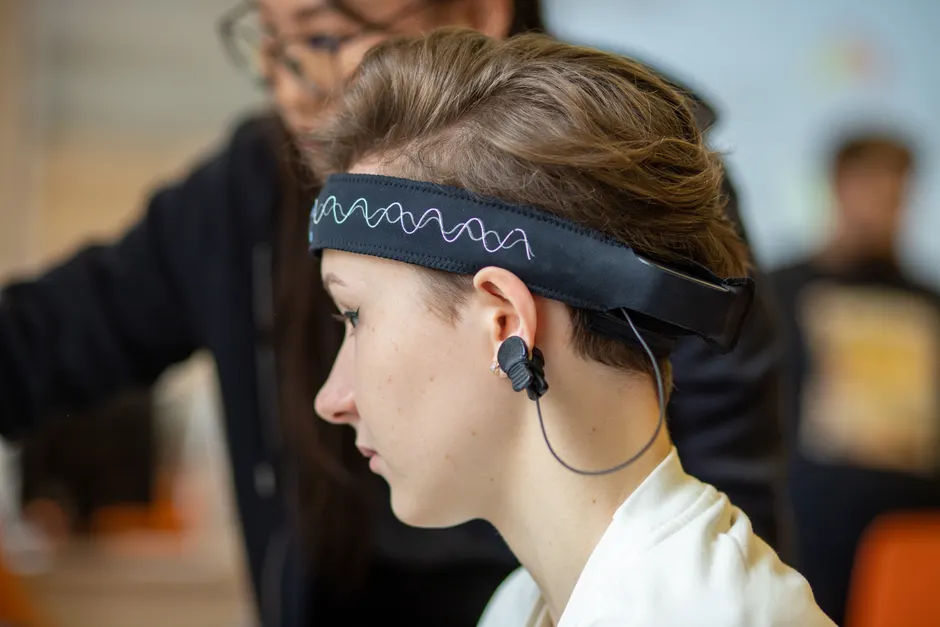
Meta AI has successfully decoded complete sentences directly from brain activity recorded without any surgical implants, according to research published on 29 June 2026. The system, called Brain2Qwerty v2, achieved 78% word accuracy by analyzing magnetoencephalography (MEG) recordings — a non-invasive technique that measures the magnetic fields produced by brain activity — from healthy volunteers.
Participants wore MEG sensor arrays while a deep learning pipeline translated their brain signals into text. The underlying architecture, described in an earlier Meta publication from February 2025, is designed to work with both EEG and MEG recordings. MEG offers superior spatial and temporal resolution — finer location and timing information — which makes it better suited for decoding connected sentences rather than isolated words.
To understand what 78% accuracy means: decoding individual words from brain signals is well-established work. Decoding continuous sentences, where meaning flows across multiple words and grammatical structure matters, is substantially harder. The v2 update appears designed specifically to handle that challenge — moving from discrete words to full linguistic sequences.
MEG hardware carries significant practical constraints. The machines are large, expensive, and require magnetically shielded rooms to function reliably. This technology is not heading toward consumer wearables anytime soon. The realistic near-term population who would benefit from such a system is clinical: people with severe motor impairments — locked-in syndrome, ALS, advanced spinal injury — for whom even a lab-based communication channel would meaningfully improve their ability to interact with others.
A parallel field deserves mention here. Invasive brain-computer interfaces, like Neuralink's electrode arrays, achieve higher data throughput because implanted electrodes sit directly on neural tissue, capturing stronger signals. Brain2Qwerty represents a different engineering choice: use non-invasive detection combined with powerful machine learning to close the accuracy gap without the surgical risk and ethical weight of implantation.
What does 78% word accuracy mean in real-world use? It is high enough to be corrected by a language model — software that understands grammar and context can fix many errors — but it also means roughly one word in five is initially wrong. For fluent conversation, error rates still matter significantly. The critical questions the research now faces are whether accuracy holds up when vocabulary expands beyond the lab experiment, when sentence structures become less constrained, and how much the current figure depends on the controlled conditions of the study.
Meta's investment in this space is worth context. The company has funded non-invasive brain-computer interface research for several years, partly motivated by its augmented and virtual reality roadmap — the possibility that future headsets might respond to thoughts rather than hand gestures. The scientific work, including Brain2Qwerty, is published openly. Whether this research eventually becomes a product, remains a lab tool, or leads somewhere else depends on regulatory approval, clinical viability, and commercial decisions that extend well beyond current accuracy metrics.
The wider field of non-invasive neural decoding is advancing on multiple fronts. Several academic labs and startups are working on similar EEG and fNIRS (near-infrared spectroscopy) approaches. Meta's work stands out for the scale of the deep learning models applied to the decoding problem and the focus on full-sentence output rather than isolated words or phonemes. Whether 78% represents a meaningful threshold or simply a step toward clinical viability remains an open question — the next version will likely provide clearer answers.


