Canada Buys 12 German Submarines for Arctic Patrols: What It Means
Canada has awarded a contract for 12 new submarines to ThyssenKrupp Marine Systems (TKMS), a German-Norwegian shipbuilder, Prime Minister Mark Carney announced on July 6, 2026, in Halifax before heading to a NATO summit. This is the first time Canada has ordered brand-new submarines from scratch. The initial cost will exceed $12 billion US, but when you factor in maintenance and support over roughly 50 years, the total bill could reach $70 billion US, according to The Guardian.
TKMS beat out South Korea's Hanwha Ocean, which had proposed the KSS-III Batch-II submarine. The competition narrowed to these two firms in August 2025, and both submitted formal bids in March 2026. Carney's personal tour of TKMS's shipyard in Kiel and a completed Hanwha submarine in South Korea signalled how much political weight Canada's government placed on this decision from the start.
The Two Competing Submarines
The two submarine designs reflect different strategic approaches. TKMS's Type 212CD is compact and engineered for stealth in shallow, confined waters — it uses air-independent propulsion (AIP), a system that lets it run underwater for days without surfacing, making it extremely quiet. Norway has operated similar vessels for years in the challenging North Sea and North Atlantic. The KSS-III Batch-II, by contrast, is substantially larger and built for long-range patrols in open ocean with heavier weapons loads — capabilities better suited to blue-water operations than covert surveillance in tight passages.
Canada's primary mission is sovereignty and surveillance in the Arctic, especially the Northwest Passage. On that map, the 212CD's combination of stealth and endurance in shallower waters aligns more closely with what Canada needs than the KSS-III's ocean-crossing range. German officials also emphasized throughout their pitch that their submarine would integrate smoothly with NATO's existing anti-submarine systems — a significant advantage, since South Korea is not a NATO member and Canada's naval strategy is tightly woven into the alliance's shared defences.
Both companies sweetened their bids with industrial offsets—jobs and investment back in Canada. Hanwha committed to sourcing steel from Algoma's mill in Sault Ste. Marie for armoured vehicle production, and ran a high-profile advertising campaign featuring veteran CBC journalist Peter Mansbridge. TKMS countered by positioning itself not just as a submarine supplier but as a gateway to broader economic partnerships in rare earths, mining, artificial intelligence, and battery production, per The Guardian.
What Happens Now
The announcement is a selection, not a signed contract. Ottawa and TKMS will spend the next two to three years negotiating the fine details: exact pricing, how much of the work happens in Canada, which technologies get transferred here, and how many Canadian workers will be involved. As recently as October 2025, Canada's internal planning expected the award no earlier than 2028, so this accelerated timeline compresses the calendar but not the actual work required.
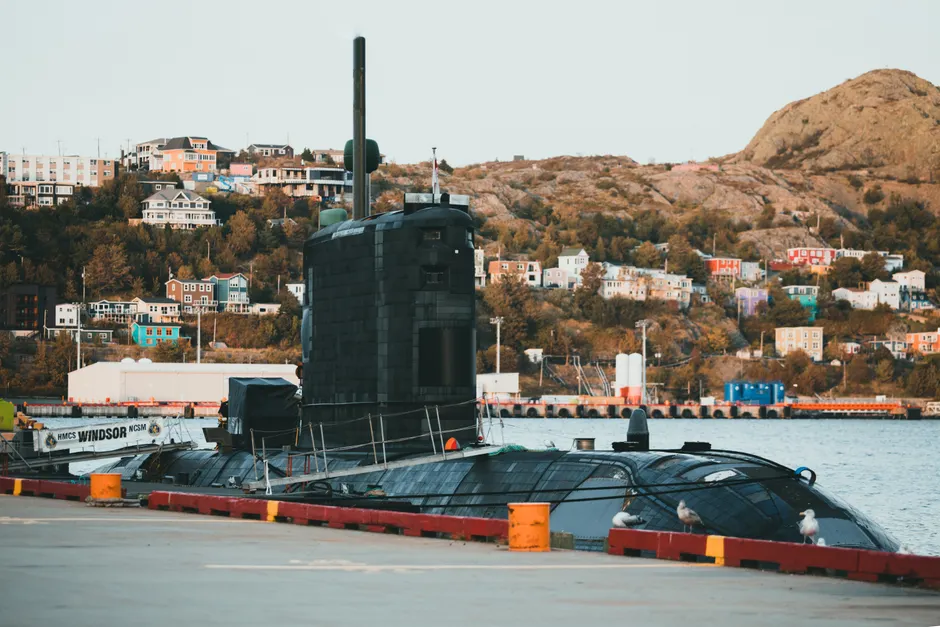
Canada's navy currently operates four Victoria-class submarines — used boats bought from the British in 1998 — and usually has only one or two available for actual missions at any given time. Twelve new Type 212CDs, arriving gradually through the 2030s and 2040s, would be a dramatic upgrade in Canada's undersea power.
Canada is in the middle of a major defence spending increase. In March 2026, the country crossed NATO's target threshold of spending 2% of GDP on defence. Prime Minister Carney's government has committed to reaching 5% of GDP by 2035, which would place Canada among the heaviest defence spenders in the Western world. The submarine programme, at up to $70 billion over its lifetime, is the single largest purchase in that spending plan.
The timing and target matter here. Carney announced a German submarine contract, then immediately headed to a NATO summit in a deliberate sequence. Choosing a NATO-member supplier over a capable non-allied competitor — and publicly making that choice before addressing the alliance — sends a message about where Canada sees its commitments. Whether that translates into concrete diplomatic gains, or whether the trade relationships Carney is separately building with South Korea prove equally valuable, will depend on the diplomacy that unfolds in the months ahead.
The broader context: Canada's undersea fleet has been a chronic weak point for decades. One operational submarine at a time leaves vast stretches of Canadian territory and Arctic waters without surveillance. A dozen new boats would transform that reality, though the catch is that they arrive slowly — the first won't deploy until the early 2030s at the earliest. The lag between decision and capability has always haunted Canadian defence planning, and this procurement is no exception.


