Lake Powell's Collapse: Why the West's Water Crisis Is Now an Emergency
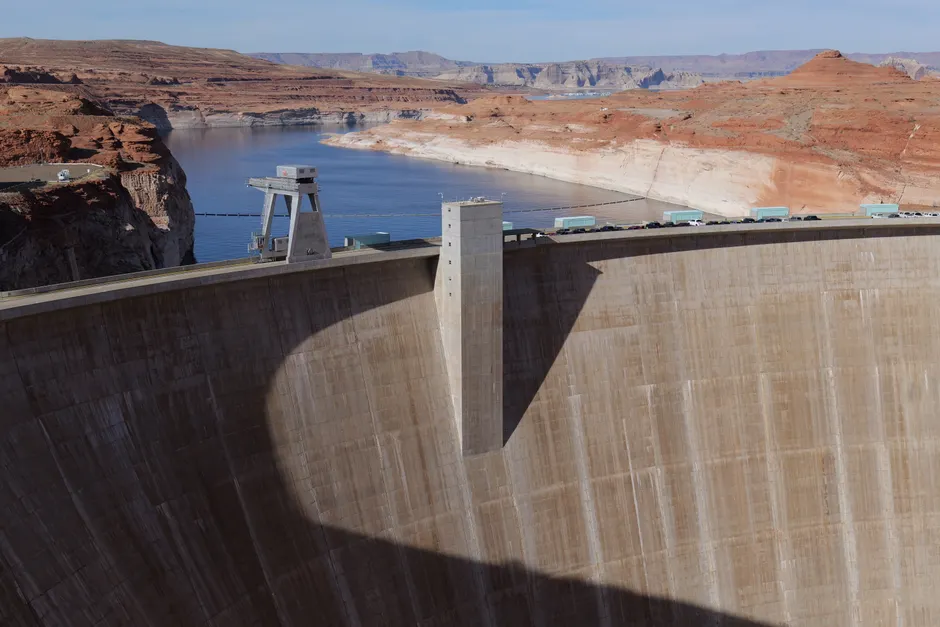
Lake Powell, the nation's second-largest reservoir, stood at roughly 23% capacity in early July 2026 — about 5.6 million acre-feet of the 26 million it can hold. Jack Schmidt, who directs the US Bureau of Reclamation's research center at Utah State University, warned that the reservoir is headed for unprecedented low conditions sometime this fall The Guardian. The 185-mile impoundment of the Colorado River, straddling the Utah-Arizona border, ended June below its annual low from May. With spring snowmelt over, Reclamation's projections show the decline continuing for roughly eight months.
Why the Reservoir Is Shrinking
The immediate cause is straightforward: a worst-on-record snowpack in the Rockies last winter, followed by a record-breaking March heatwave across the Southwest that accelerated evaporation and depleted what little snowmelt existed Reuters. In April alone, inflow to Powell was 372,000 acre-feet — only 41% of the historical average — while Glen Canyon Dam released 471,000 acre-feet that month. This meant the reservoir lost more water than it gained. By April's end, Powell's water level sat at 3,526.99 feet, 173 feet below full capacity, with storage at 24% of what it can usefully hold USBR. Reclamation has since begun cutting releases to slow the descent toward a critical threshold.
The Danger Zone: When the Dam Stops Generating Power
Glen Canyon Dam's turbines require a minimum water level to function — a threshold Reclamation calls minimum power pool, set at 3,490 feet. Powell is now only 37 feet above that line. Without major intervention, Reclamation warned in July, the reservoir could fall below that threshold as soon as August Inc.. Reclamation's June 24-Month Study projects Powell will end the water year near 3,510.85 feet, at about 20% capacity. In a worse-case scenario using a "Probable Minimum" inflow forecast — just 3.01 million acre-feet for the full water year, 31% of average — the bureau projects December 31 elevation could drop to 3,504.32 feet. To put this in perspective: Reclamation had expected Powell to sit at 3,538.47 feet on January 1, 2026, a margin of 48 feet above minimum power pool. That buffer has nearly vanished.
Except for a brief dip in winter 2023, from which spring runoff recovered the reservoir to 9.6 million acre-feet by June of that year, Powell hasn't been this low since June 1965, two years after the US began filling it behind Glen Canyon Dam. Officials are not counting on a 2023-like rebound in 2027. The snowpack deficit is already baked into spring 2026's meager runoff, and supplemental releases from the upstream Flaming Gorge Reservoir did little to arrest the slide this spring.
What happens if Powell falls below minimum power pool matters enormously. Glen Canyon's power plant supplies electricity to nearly 6 million households and businesses. Turbine failure would strip that generation from the grid in the middle of summer when demand peaks. The Colorado River system itself supplies water to 40 million people across seven states — California, Nevada, Arizona, New Mexico, Colorado, Utah, and Wyoming — plus dozens of tribal nations and Mexico itself. In Utah, the effects are already visible: the Salt Lake Tribune reported on June 24 that streams and wells across the state were running low or dry amid what officials described as unprecedented cuts Salt Lake Tribune.
Physical Damage to the Dam
Beyond supply constraints lies a second risk to the dam itself. The Colorado Sun reported July 6 that cavitation — the formation of low-pressure bubbles in fast-moving water — is threatening Glen Canyon Dam's infrastructure as the reservoir shrinks Colorado Sun. This same phenomenon damaged the dam's outlet works in 1983, but that damage occurred at much higher reservoir levels than today's. Operating near minimum power pool, where water flows through the dam's outlet works in ways the original design did not anticipate, raises the risk that prolonged low-level operation could cause further structural damage.
Reclamation has designated 2026 as a Mid-Elevation Release Tier year, fixing the annual release from Powell at 6.0 million acre-feet — a figure set before this spring's collapse became fully apparent. The bureau also continues experimental flows designed to disrupt invasive warm-water fish like smallmouth bass below the dam, a reminder that ecological management continues even as the reservoir's basic function as a water supply is in question.
The Political Standoff
Diplomatically, the crisis has outpaced the political machinery meant to manage it. Negotiators from the seven basin states missed a February 2026 deadline to agree on new conservation guidelines and remained deadlocked as of early July Reuters. Arizona officials say Washington is now weighing its own cutback proposal, and Reclamation could impose an interim plan as early as August if the states fail to agree Reuters. The interstate agreement that governs the Colorado River system expires at the end of 2026, meaning whatever framework emerges—negotiated or imposed—will have to serve both as an emergency response and as the foundation for the river's operating rules for the next era.
What's at stake in the coming months is whether the seven states can agree on how to share less water, or whether Washington will impose cuts unilaterally. The dispute has simmered for two decades as both Powell and its downstream counterpart, Lake Mead, have lost storage. This year's numbers suggest that slow decline has become an acute crisis, forcing decisions that negotiators have repeatedly deferred since talks began.


