Eka Robotics Raises $150M for Robots That Pick by Touch and Sight
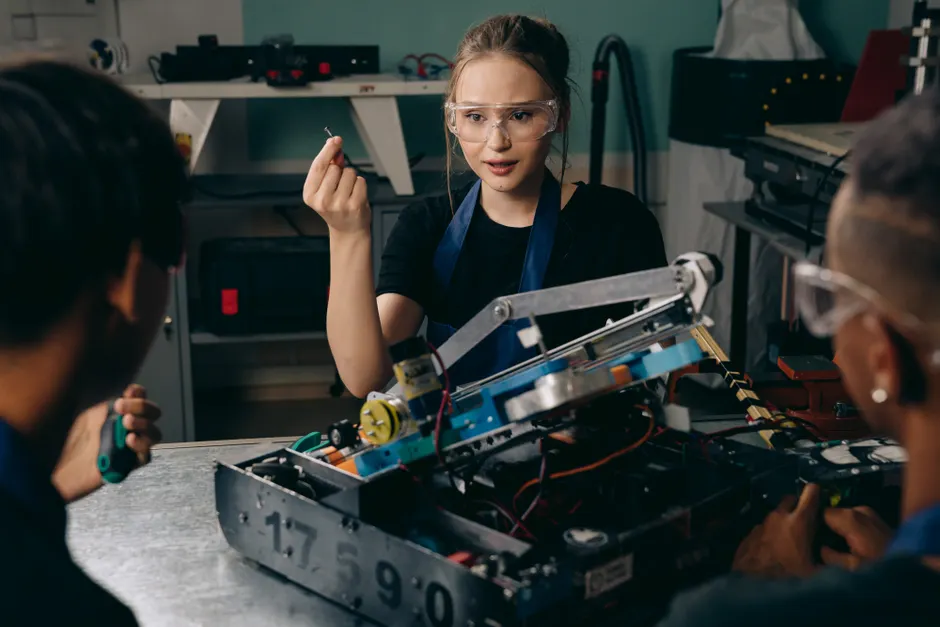
Eka Robotics has closed a $150 million Series A at a $1.45 billion post-money valuation. TechCrunch
The round was led by a16z and F-Prime. The company was founded by Pulkit Agrawal, an MIT professor, and Tuomas Haarnoja, a former Google DeepMind researcher.
Eka's system combines a gripper that senses force with a new deep-learning model. The company calls it a vision-force-action model, built around the link between language instructions, force signals, and movement. In plain terms, cameras and language set the plan, what researchers call a policy, and force sensing corrects that plan at the moment of contact.
Eka says the robot can pick about 1,500 objects weighing up to 1 kg per hour, compared with about 600 for a human, and succeed on more than 95% of picks. If those rates hold outside a curated demo cell, they would exceed manual rates for small-parcel sorting.
Outside reaction has centered on generalization and recovery. University of Illinois Urbana-Champaign professor Kris Hauser said the demo had a "wow factor" compared with other recent robot demos. He said the robot adapted to a large number of different objects without retraining. He described its persistence after a missed grasp, trying repeatedly until it secured the object, as humanness.
Eka centers its design on force. Most vision-language-action systems, often shortened to VLA, still infer contact from cameras or from a simple success-or-fail grasp signal. Eka treats force as a direct input alongside vision and language. That targets the failure modes that dominate bin picking: slip, wedging, deformation, and uncertain mass distribution.
The broader context here is a funding market that already treats physical AI as a platform layer. SiMa.ai reached a $1.45 billion valuation after a $150 million funding round to scale physical AI, bringing total funding to $500 million for its purpose-built Physical AI platform. Intelligent CIO Physical Intelligence previously raised $600 million at a $5.6 billion valuation. Bloomberg Skild AI raised $1.4 billion to develop a brain usable in robots of all shapes and sizes. Bloomberg Video Arm reorganized to create a Physical AI unit to expand its presence in the robotics market. Reuters
Looking at deployment, the questions move from demo performance to daily operation. Picks per hour only mean much with details on object mix, occlusion rate, exception rate, mean time between interventions, and how performance shifts with lighting or packaging changes. At 1,500 picks per hour, a greater than 95% success rate still means dozens of failures per hour, which makes retry behavior and fault signaling as important as the main policy.
In my view, the retry detail is the most revealing part of the report. Single-attempt grasp success has long been the standard benchmark. Production value comes from autonomous recovery. A system that senses a failed or weak grasp from force changes and tries again without a human reset or a full re-plan cuts the cost of the exception path, the costliest part of warehouse automation.
One point worth flagging is the language side. Language control in manipulation is often dismissed as demo scripting. Linked to force feedback, it has a clearer job: setting limits for softness, fragility, and where to grip that cannot be read from images alone. The test will be whether that control holds across novel SKUs, or product types, without retraining, which is what Hauser pointed to.
Looking ahead, if Eka's numbers transfer, the near-term effect is not humanoid replacement. It is higher use of existing sortation, kitting, and returns lines where pick rate and tolerance for shape differences set output. That is less dramatic than the usual robotics story, and more useful.


