Daytona Raises $60M at $1B Valuation to Give Every AI Agent Its Own Computer
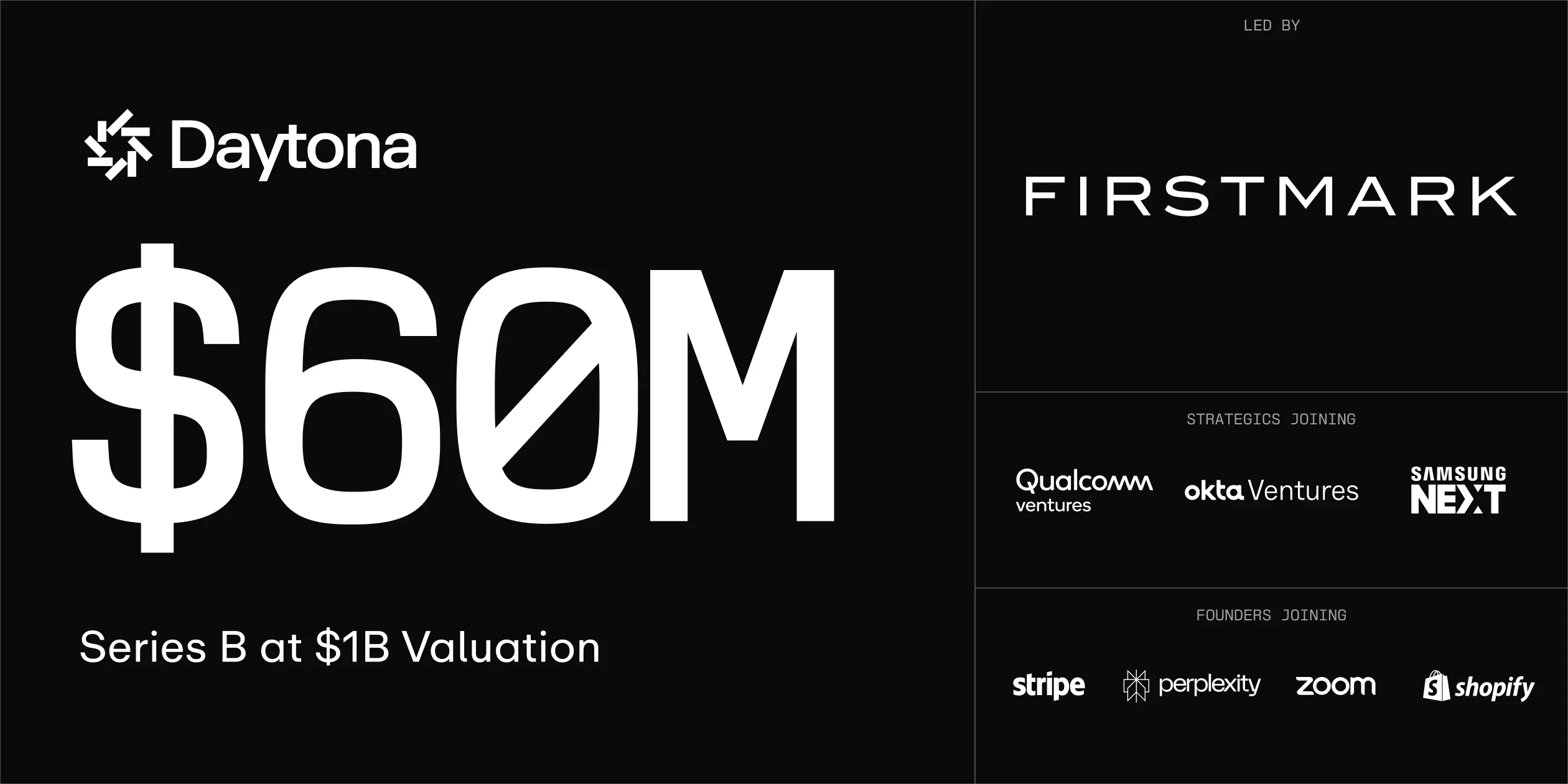
Daytona Platforms announced on October 20, 2026 a $60 million Series B round that values the company at $1 billion. Fortune reported the round the same day. FirstMark Growth led the Series B.
TechCrunch puts Daytona's total funding to date at $91 million. FirstMark also led the company's $24 million Series A, which closed in February. The Series B drew a group of individual angels that includes Patrick Collison, Tobi Lütke, Aravind Srinivas, Eric Yuan, Olivier Pomel, Adam D'Angelo and Brendan Foody. Corporate investors Qualcomm Ventures, Samsung Next and Okta Ventures also participated.
The company is building infrastructure for long-running AI agents, which it calls the Agent Cloud. Agents are programs that carry out multi-step tasks with little human input. Founder Ivan Burazin describes the product as giving every agent its own computer, with sandboxed (isolated from the rest of the system) Linux, Windows, macOS and GPU access. The framing matters for infrastructure buyers. Most agent frameworks today run inside a shared application process or a short-lived container, a packaged environment that starts, runs and is discarded. A dedicated, persistent machine per agent, with a full guest operating system, is a different unit of isolation and a different unit of cost. Think of the difference between sharing a hostel kitchen and renting your own apartment.
Daytona published the Series B announcement on its own domain under the title "Daytona Raises $60M Series B to Build the Agent Cloud." The post appears in the company's blog, which is branded DotFiles Insider, and Burazin wrote it. The post carries the tagline "Every agent needs a computer. We're building millions of them." The company's Series A post, from earlier in the year, used a nearly identical thesis under the headline "Daytona Raises $24M Series A to Give Every Agent a Computer," so the Series B announcement reads as a continuation of a single product idea rather than a pivot.
A The Recursive report, published on October 20, describes Daytona as a Croatian-American startup.
For engineers evaluating this category, the open questions are operational. Persistent per-agent environments raise practical issues: how state is snapshotted (saved at a point in time) and resumed, how GPU capacity is scheduled across agents that may sit idle for long stretches, how Windows and macOS guests are provisioned at scale, and how network egress and credentials are scoped so that a misbehaving agent cannot reach beyond its sandbox. These remain questions for prospective customers to test directly.
In my view, the more useful measure of this round will be what customers run on the platform after the funding news fades. A valuation says investors expect demand for agent infrastructure to be large. It does not show how many agents run in production, for how long, or at what utilization. Those figures will matter more to the infrastructure teams deciding whether a dedicated machine per agent is worth its overhead.
The broader context here is a shift in where agent workloads run. Early agent tooling was largely a prompt-and-tool-call pattern hosted in someone else's application. Agents that browse the web, compile code, operate desktop software or hold a task for hours need a real operating environment. If that environment becomes cheap, isolated and easy to reproduce, it opens work that is awkward today, such as long-horizon coding tasks, automated testing across operating systems and GPU-backed inference pipelines run by software on behalf of people. Daytona is making that case with this round, and the coming year of customer deployments will show whether it holds.