NASA's Artemis 3 Tests Lander Handoffs in Orbit, Not a Moon Landing
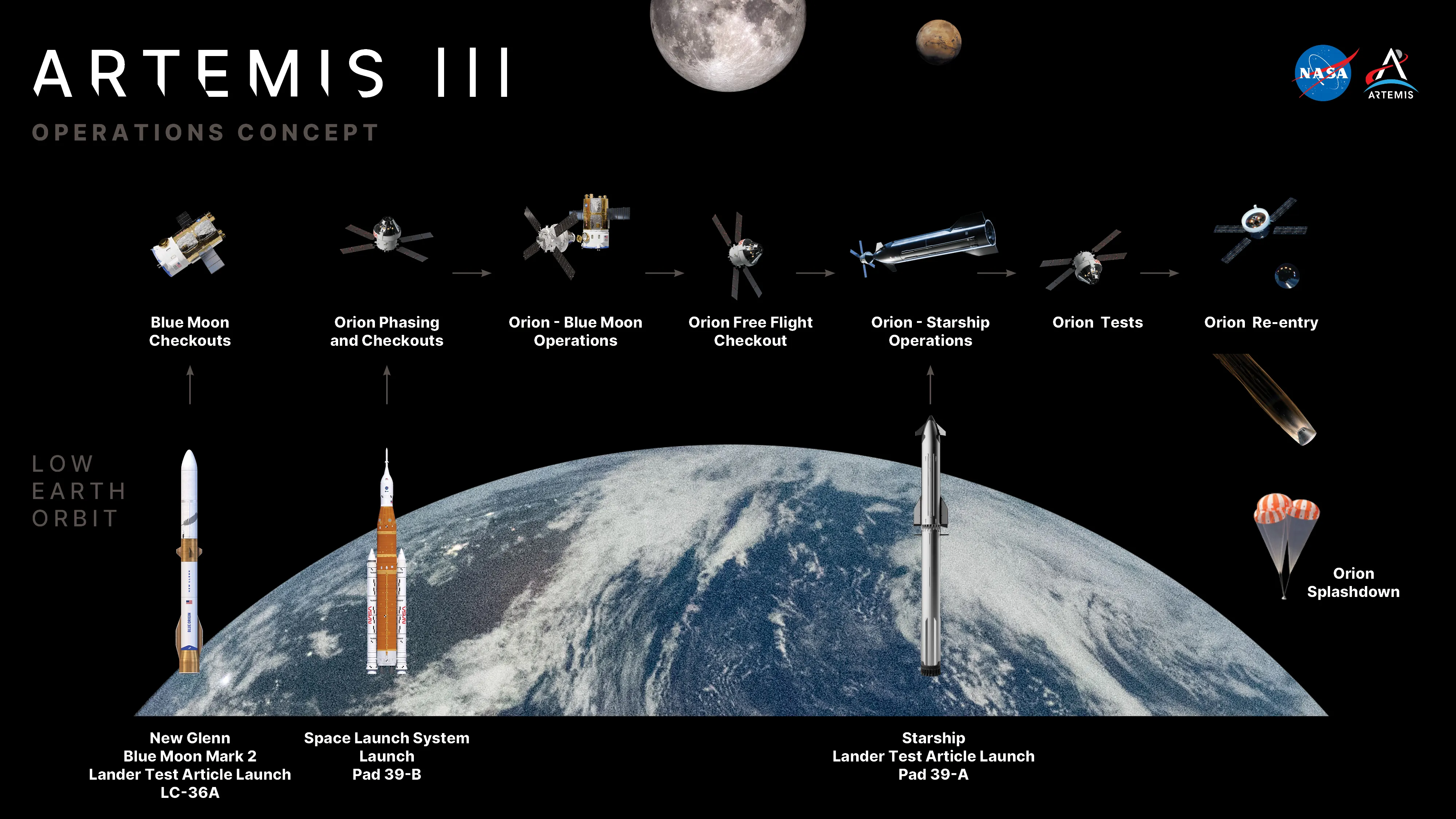
NASA plans to launch three spacecraft on three different heavy-lift rockets from Florida within a span of two weeks for Artemis 3. No exact launch date has been set, and the best-case target is summer 2027. The mission is a crewed test of lander operations in orbit, not a landing.
The sequence opens with Blue Origin's New Glenn, which would carry a test version of the Blue Moon Mark 2 lander into low Earth orbit (LEO), about 273 miles up. NASA's Space Launch System (SLS) would then launch the Orion crew capsule with NASA astronauts Randy Bresnik, Frank Rubio and Andre Douglas, along with ESA astronaut Luca Parmitano. Orion would settle into an orbit at about 345 miles and perform a rendezvous, meaning it would close the distance and match orbits with the Blue Moon Mark 2 test article. NASA's Artemis III mission description says the mission will send four astronauts to low Earth orbit to test systems needed for future lunar landings.
The final phase involves SpaceX launching Starship Version 3, which carries a forward-mounted docking system, to dock with Orion. Docking is the physical connection of two spacecraft, and the Starship-Orion rendezvous is planned to last two hours. The crew would remain inside Orion and would not enter the Starship. NASA says the separate dockings will show how Orion interfaces, or connects, with two very different commercial lander designs during a single mission.
The change in scope comes from NASA's revised Artemis program. Artemis 3 will test moon lander operations rather than attempt a crewed lunar landing, and the next crewed moon landing has been pushed to 2028. Artemis II, the first crewed flight test of the SLS rocket and Orion spacecraft, preceded this mission. NASA's Artemis III page states that the SLS will launch the four crew members from Kennedy Space Center in Florida. On January 16, 2026, the SLS and Orion were inside the Vehicle Assembly Building at Kennedy.
In my view, the most demanding element here is sequencing rather than any single launch. Three independent launch campaigns, two commercial lander interfaces with different shapes, and a crew that stays put while the vehicles connect all depend on schedules held by different providers. Each vehicle has to reach its defined orbit on time, and a slip in one campaign moves the others. Rendezvous and docking between separately built spacecraft are difficult on their own. Doing both in one mission, with the crew as passengers in one vehicle, adds a coordination layer the program has not previously had to manage in this form.
The broader context here is that a lander-operations test puts the risk in the handoffs between vehicles, not in a descent to the surface. Think of it as two boats meeting in open water: each must hit the same spot at the same moment, and neither can wait long for the other. If the sequence proceeds as planned, it provides operational experience with two commercial landers mated to the same crew vehicle before any landing is attempted. For a program that has moved its crewed landing to 2028, that experience is the practical step on the path, and the flight hardware and interface data it produces will matter to everyone building the next phase.


