Google takes Dreambeans to India, its AI app that builds personal illustrated stories from your own data
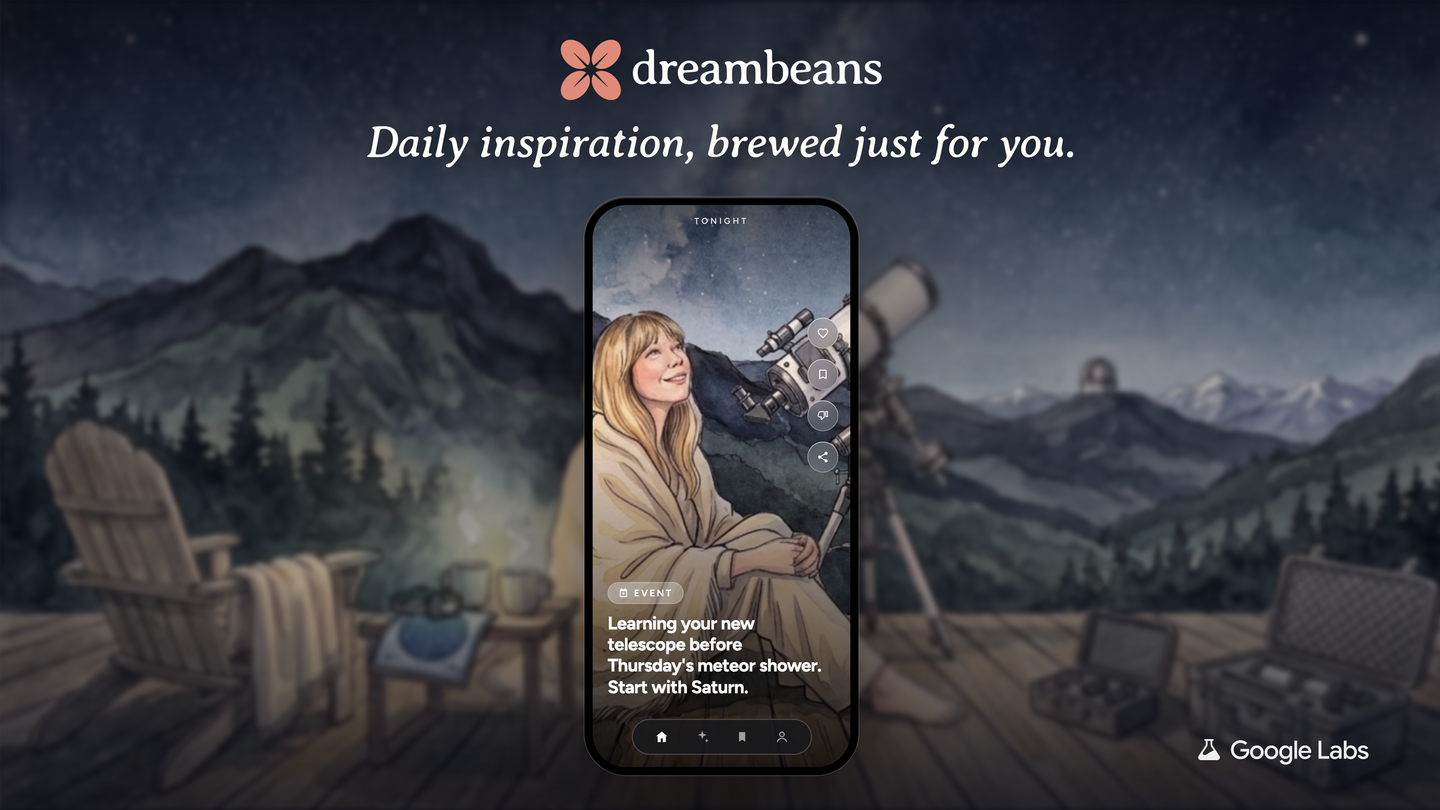
Google has launched Dreambeans, its experimental AI app that generates personalized illustrated stories, in India, the first market outside the U.S. where the product is available. TechCrunch reports that the app now runs on Android and iOS with support for 13 local languages alongside English.
Google introduced Dreambeans in June 2026. At launch, SiliconANGLE described the app as using AI to assemble a finite set of personalized daily stories drawn from a user's own Google data. Google announced on September 10, 2026 that Dreambeans was available across the U.S. The TechCrunch report says all eligible U.S. users aged 18 and older had access less than two months before the India expansion.
Among the supported Indian languages are Hindi, Punjabi, Tamil, Telugu, and Bengali. Users can select only one language at a time for their generated stories, and the app cannot currently produce stories that mix languages. It can draw on information across Google services in multiple languages, but the output is monolingual.
The app pulls from connected Google services, including Calendar, Gemini, Gmail, Photos, Search, and YouTube. It uses what Google calls Personal Intelligence to personalize the stories, and it generates them proactively, without requiring the user to write a prompt. Every story is illustrated with AI-generated artwork tailored to the user, according to Google's Dreambeans page. In select stories, Google has added a feature that uses its Veo video-generation model, a system that produces video, to animate those images.
Google describes Google Labs as its home for AI experiments, and Dreambeans sits within that program as an experiment rather than a core product line. That framing matters for how users should expect the app to behave. Features, language coverage, and the set of connected services can change between releases, and the India rollout is the first test of the product beyond the U.S. market.
The broader context here is the input model. A conventional assistant waits for a request. Dreambeans starts from signals already sitting in a user's Calendar, inbox, photo library, search history, and viewing history, then decides what to render. The quality of the output depends less on a prompt, which does not exist, and more on how well the retrieval layer, the component that searches and ranks stored data before any text or image is generated, finds and connects those data stores. The consent and control surface therefore carries more weight than it does in a chat interface. Users who connect several services grant the system a broad view of their daily life, and the product's value rises with that breadth.
In my view, the language constraint is the detail to watch in India. Everyday speech in many Indian households moves between English and a regional language within a single conversation, and a generator that writes only one language per story will produce text that reads differently from how many of its users actually talk and think. Whether Google adds mixed-language output will say a good deal about whether it treats multilingual users as a design target or as a localization checklist item.
The optimistic reading is also worth stating. A personal story built from one's own photos, calendar entries, and messages, illustrated and in some cases animated, could reach people who do not work comfortably in English on a smartphone. Thirteen languages is a broader footprint than an English-only launch would have offered. Whether that reach turns into sustained use, and whether the stories hold up as more than a novelty, will become clearer over the coming months rather than in the first week of availability.


