Paris Gathers to Pressure Russia on Ukraine—and Tests Europe's Resolve

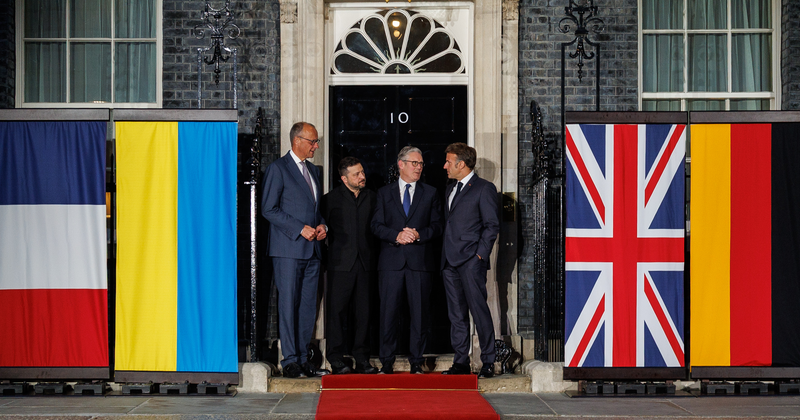
More than 25 heads of state and government met in Paris on July 13, 2026, for a Coalition of the Willing summit aimed at pushing Russia toward a ceasefire in Ukraine while expanding military support to Kyiv. President Volodymyr Zelensky attended the gathering Kyiv Post.
Hours before the summit convened, President Emmanuel Macron addressed French armed forces at the Defense Ministry. He declared that Europe was "ready to defend itself and freedom with 'blood' if necessary" France24. The Élysée's official schedule listed this as a standard "Déplacement à l'Hôtel de Brienne" at 10:30 a.m. — the traditional home of France's defense ministry Élysée.
The French-language record of the speech reveals important nuance. Macron's full statement, captured by French regional and national outlets, was that France and Europe stand ready to defend "la liberté et le droit" — freedom and the rule of law — "au prix du sang s'il le faut," at the cost of blood if necessary Sud Ouest. French broadcasters framed this within Macron's broader argument about Europeans' "réveil stratégique" — a strategic awakening he credited to leaders as they confront the reality of potentially having to defend themselves without automatic American support TV5Monde.
The difference between "freedom" and "freedom and the rule of law" matters. English-language wire services, including an Associated Press dispatch, rendered the remarks primarily around defending freedom AP via Yahoo. The Bangkok Post's headline framed it as defending freedom "at all costs" Bangkok Post. The fuller French phrasing anchors the pledge within a legal framework—international law, sovereignty, treaty obligations—that carries different weight for an audience of military officers than a stripped-down soundbite does for a global one. It exemplifies a common gap when a leader addresses two audiences simultaneously: national forces receiving a formal address, and foreign leaders arriving in the city the same day.
The timing may signal intent without being explicitly choreographed. Macron's speech preceded the coalition summit by hours, and that summit's stated goal was to push Moscow toward a ceasefire while sustaining the flow of military aid to Ukraine Le Monde. A French president invoking blood sacrifice and strategic awakening on the morning two dozen counterparts arrive in his capital functions as scene-setting, whether Élysée aides planned it that way or not.
The Paris assembly—more than 25 leaders plus Zelensky—ranks among the larger Coalition of the Willing convenings since the format emerged as a way to coordinate security guarantees and military supplies outside formal NATO or EU structures UATV. The Coalition of the Willing deliberately occupies ambiguous ground: broad enough to demonstrate unity beyond core European and North American powers, narrow enough to exclude countries wary of escalating tensions with Moscow. What matters next is whether Monday's session yields concrete pledges on air defense systems, long-range weapons, or postwar security arrangements, or instead serves as another display of political unity before harder negotiations begin. The summit's final communiqué will need to answer that question.
Macron's language about a "strategic awakening" resonates against months of European debate over who will pay for Europe's defense, how to build its industrial capacity for weapons, and whether the U.S. security guarantee can be taken for granted. To frame the moment as an awakening implies Europeans had been asleep—a claim some allied governments would reject and others would accept. The fact that Macron used this framing in a valedictory address to French forces, rather than in a policy paper or EU statement, suggests he was shaping domestic military morale and public opinion as much as addressing foreign capitals. The Paris summit provided an immediate international platform for that message, but the real test lies ahead: whether Europeans will actually spend the money, deploy the weapons, and accept the risks that their speeches describe. The weeks following Monday's gathering will reveal far more than the speeches themselves.