Physicl raises $10 million to make simulated worlds realistic enough for robots
Physicl has raised $10 million in seed funding from Inovia Capital, TechCrunch reported on 6 November 2026. The company's founder and CEO, Alex de Vigan, is pitching it as a source of synthetic training data for robots and for the world models that increasingly sit behind them. A world model is an AI system that learns how physical environments behave, so it can predict what happens next.
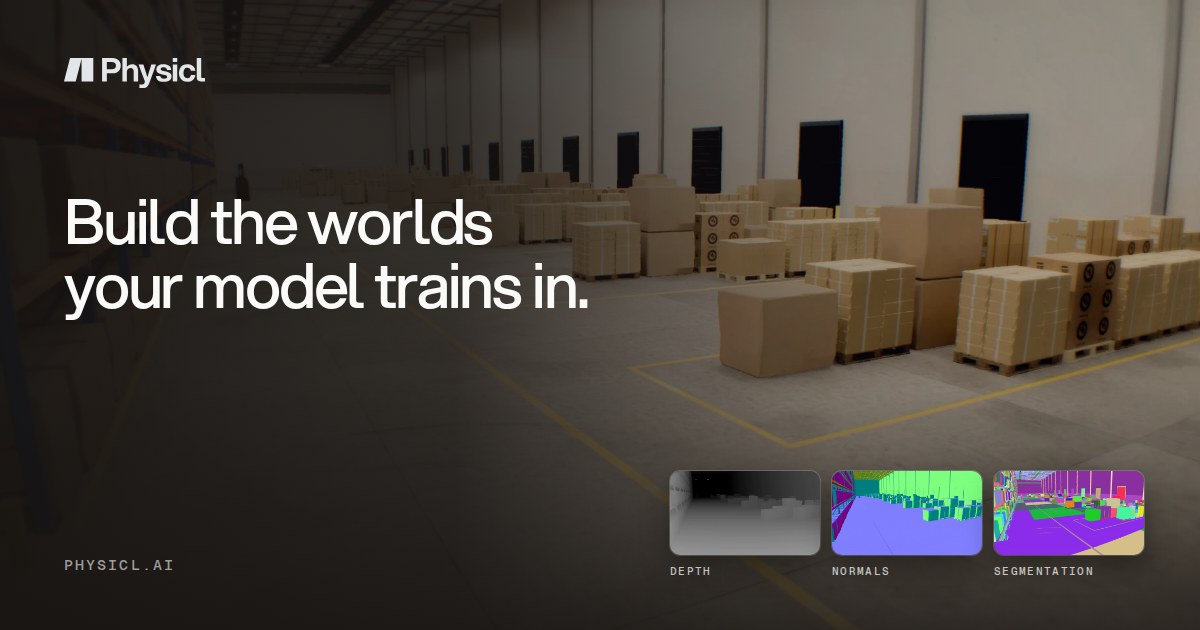
Physicl says it wants to help world model designers and robot builders solve training problems with simulations that are more realistic and more faithful to real-world physics. Its first product is Studio, which the company's website describes as in private beta. TechCrunch reports that Studio ships with 10,000 3D environments and 100,000 assets representing various objects. Users assemble scenes from these components and generate synthetic data for a specific perception problem, meaning a question about what a sensor sees. The example is a robot that must pick out a cup on a cluttered counter, or a cup sitting in shadow.
The output is labelled data. According to Physicl's website, Studio produces depth ground truth in metres in EXR format, surface-normal ground truth in RGB, segmentation ground truth with instance IDs, per-frame camera-pose ground truth, and 2D-box ground truth with classes. Ground truth here means the known-correct answer attached to each image, so a model can check its own guesses. The company describes itself as the platform physical AI teams use to generate training data. These are the annotations a perception stack typically needs. Generating them from a render, rather than from hand labelling or real capture, is the core of the offering.
De Vigan's background is in a neighbouring problem. He spent the last decade building nfinite, which enabled brands and retailers to create 3D models of goods for online display. TechCrunch reports that the same work of turning physical objects into digital assets is now being pointed at machine perception rather than product pages.
SpAItial, a world model builder, is an early customer. According to the same report, SpAItial collaborated with Physicl to improve product fidelity. SpAItial's CEO and founder is Matthias Niessner, a professor of robotics at the Technical University of Munich. SpAItial's own tool generates 3D simulations from 2D imagery, which places it closer to the generative side of the stack than Physicl's scene-authoring approach.
The broader context here is a shift in where robot training data comes from. Teams that once relied on teleoperated demonstrations (a person driving the robot by remote control while it records) or hand-annotated real footage are increasingly testing whether rendered environments can stand in for them. The open question is fidelity. A synthetic depth map or segmentation mask helps a policy only if lighting, materials and geometry match what the sensors will see on a factory floor or in a kitchen.
In my view, the claim that matters most for practitioners is not the size of the asset library but whether sim-to-real transfer (how well a model trained in simulation performs on real hardware) holds up on the hard cases the company itself names, such as occlusion on a cluttered surface and objects in shadow. Those are the conditions where synthetic pipelines have historically drifted from reality. The seed round funds the company to test that, and the SpAItial relationship offers one place to measure it. Neither the funding nor the asset count settles the question on its own.
For engineering teams, the practical question is narrower. Studio's ground-truth formats are standard, so the output can plug into existing training code. Whether it cuts the cost of collecting and labelling data depends on how much of a real-world dataset can be replaced rather than supplemented. If it can be replaced for even a subset of perception tasks, the economics of robot training change in a useful way.