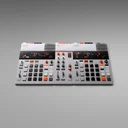
Teenage Engineering's EP/BC-1 Puts a Performance CD Deck on the Shelf for $299

Teenage Engineering has announced the EP/BC-1, a compact CD player available now through the company's online store for $299. It is the first product in the company's new broadcast series.
The unit uses a slab-like chassis that leaves the spinning disc exposed, rather than hiding it under a lid or tray. The EP/BC-1 shares its dimensions with Teenage Engineering's KO II synthesizer, which suggests the two products are meant to sit together in the same setups.
The feature set leans toward playback control rather than casual listening. The player offers variable speed playback, which changes a track's tempo and pitch, along with cue markers (saved points you can jump back to instantly) and a jog wheel for forward and reverse search. It also has built-in beat detection, which analyzes a track's rhythm. Its digital displays show track number, index, elapsed time, and audio levels. Each of these is a control a DJ or live performer would normally expect from a CD deck, and the combination is the most distinctive part of the design.
On the connectivity side, the EP/BC-1 includes a headphone jack and a USB 2.0 port, and it runs on a rechargeable battery. It supports Bluetooth connections to headphones. It also supports Auracast, the Bluetooth LE Audio broadcast feature, which lets one source stream audio to multiple receiving devices at once. That capability fits the broadcast name of the new series.
Media compatibility is conventional. The player accepts standard audio CDs and discs carrying MP3 files, so existing libraries of burned or ripped material should play without conversion.
The broader context here is the persistence of physical media among audio enthusiasts. Streaming remains the dominant way most listeners reach music, and the CD has been a secondary format for many years. A product that prioritizes tactile transport controls and a visible disc sits in a niche that has kept a following, and a $299 price places it well above a typical portable CD player. Whether that price holds the attention of the buyers Teenage Engineering is targeting will depend on how many of them already own the rest of an ecosystem built around the company's hardware.
In my view, the most useful reading of the EP/BC-1 is as a performance instrument that happens to play compact discs. The jog wheel, cue markers, and variable pitch are the vocabulary of CD decks used in live sets, and the exposed disc makes the mechanism visible in a way a lidded player never does. The Auracast support points in a different direction, toward sharing audio with several listeners in one room. Those two uses do not obviously conflict, but they suggest the product is designed for people who want to control what they play and where it goes, rather than for people who want a background player on a shelf.
What the announcement establishes is narrow and concrete: a $299 CD player with performance-oriented controls, Bluetooth and Auracast output, and a dimensional match to an existing Teenage Engineering synthesizer, available now from the company's own store. How it is used in practice, and whether the broadcast series extends beyond this first unit, will become clearer as buyers receive the hardware and as the company announces what comes next.