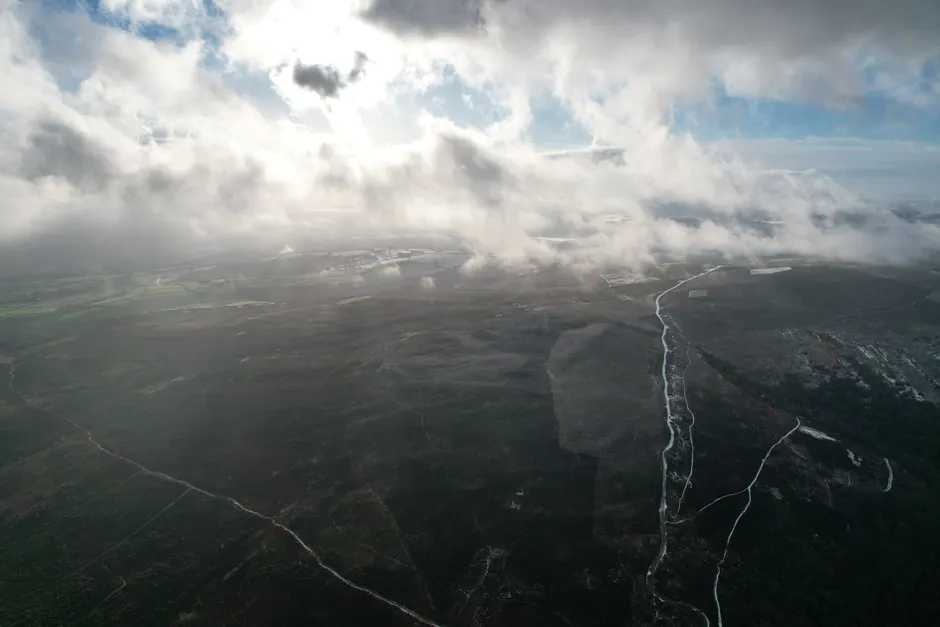
Wildfire Near Sizewell B Nuclear Plant Prompts Major Incident in Suffolk

Suffolk Fire and Rescue Service declared a major incident on 30 July 2026 for a wind-driven wildfire on Dunwich Heath, near Leiston. Roughly 90 firefighters were deployed to contain the blaze, which forced evacuations and burned about three miles from the Sizewell B nuclear power station.
The fire service received the initial call shortly after 5:30pm on Wednesday, 29 July 2026, according to The Guardian. BBC News reported the call came at 17:00 BST the same day. The "major incident" designation — a formal status that emergency services use when an event is too large or complex for normal operations — triggered a coordinated multi-agency response across several emergency services, as detailed by Suffolk County Council. Suffolk Fire and Rescue Service operates 35 stations across three geographic areas (North, South, and West), drawing on that wider footprint to staff the operation.
Station manager Dan Davis described the event as a large-scale, wind-driven forestry fire. As of the 30 July update, the fire was moving in an easterly direction. Crews focused on protecting nearby properties and prepared for the potential evacuation of roughly 200 caravans at the Cliff House holiday park. Several people had already been evacuated. Authorities urged the public to avoid the area near Dunwich Heath and keep windows and doors closed because of smoke.
Operations continued overnight, with specialist drones deployed to assess how the fire was behaving and guide tactical decisions. Ground equipment included multipurpose all-wheel-drive Unimogs and 4x4 quad bikes, used to reach difficult terrain. Suffolk's chief fire officer addressed the public regarding the major incident, as covered by BBC News. Firefighters were expected to take days to fully extinguish the fire, according to The Independent.
The fire's proximity to critical national infrastructure drew immediate attention. The blaze was located about three miles from the Sizewell B nuclear power station. Suffolk Fire and Rescue Service stated there was no danger to the plant at the time of reporting on 30 July. An EDF spokesperson confirmed the wildfire was not affecting operations and that the company was "closely monitoring the situation." EDF noted that Sizewell B maintains an emergency plan covering a range of scenarios, including a fire on site.
The broader context here involves prevailing environmental conditions. Sky News reported that a drought had been declared in the UK at the time of the fire, with warnings of a "new normal." The deployment of specialized all-terrain vehicles and drones reflects the operational difficulty of heathland fires, where dense gorse (a prickly shrub common on British heathlands) and wind can accelerate a fire's spread and block standard fire engines from reaching the flames. The major incident protocol signals that the fire exceeded what a single service could handle on its own, requiring coordinated resource allocation across multiple agencies.
For anyone tracking climate-driven infrastructure risk, the key variable is the spatial relationship between the wildfire and Sizewell B. The three-mile buffer and EDF's confirmation of unaffected operations indicate no immediate plant vulnerability. The easterly trajectory of the fire, if sustained, would move it farther from the plant, though wind-driven wildfires can shift direction with little warning. Still, the combination of drought, coastal heathland with heavy fuel loads, and proximity to nuclear infrastructure defines the core risk calculus of this incident. The presence of a functioning emergency plan that explicitly accounts for fire scenarios provides a layer of operational redundancy, but the proximity itself warrants continued monitoring.
Suffolk Fire and Rescue Service maintains a publicly accessible incidents page detailing the status, location, type, and attending stations for significant events like the Dunwich Heath fire. The service also publishes performance reports, a service plan, and an Integrated Risk Management Plan, and runs community safety initiatives including home fire safety visits, road safety partnerships, rural fire safety guidance, and a youth development programme.