A London Biotech Has Launched the First Microneedle Tattoo Patch — and a Reporter Has Tried It
London-based biotech company CipherX has launched the first commercially available microneedle tattoo patch, a disposable product called Microdot that deposits permanent pigment into the skin using biodegradable microscopic needles. The Verge conducted an exclusive hands-on demo of the technology, with CEO Ferdinand Kohle applying a permanent tattoo to a reporter's arm using a single patch roughly the size of a US quarter. The Verge
CipherX launched the product on July 24, 2026, marketing it under the tagline "A New Era of Tattooing" on its website at cipherx.tech. Dezeen The Verge's demo, published July 31, provides the first independent account of what the application process actually feels like and what it leaves behind.
Each Microdot patch contains an array of microscopic, biodegradable needles that deposit pigment into the upper layers of the skin. In The Verge's demo, the patch applied to the reporter embedded 112 microneedles. Microneedles are tiny structures — far smaller than a conventional tattoo needle — designed to dissolve after contact with skin moisture. The application is designed to be quiet, fast, and pain-free. After placement, the patch requires a 15-minute processing period during which the microneedles dissolve and release the pigment. The Verge
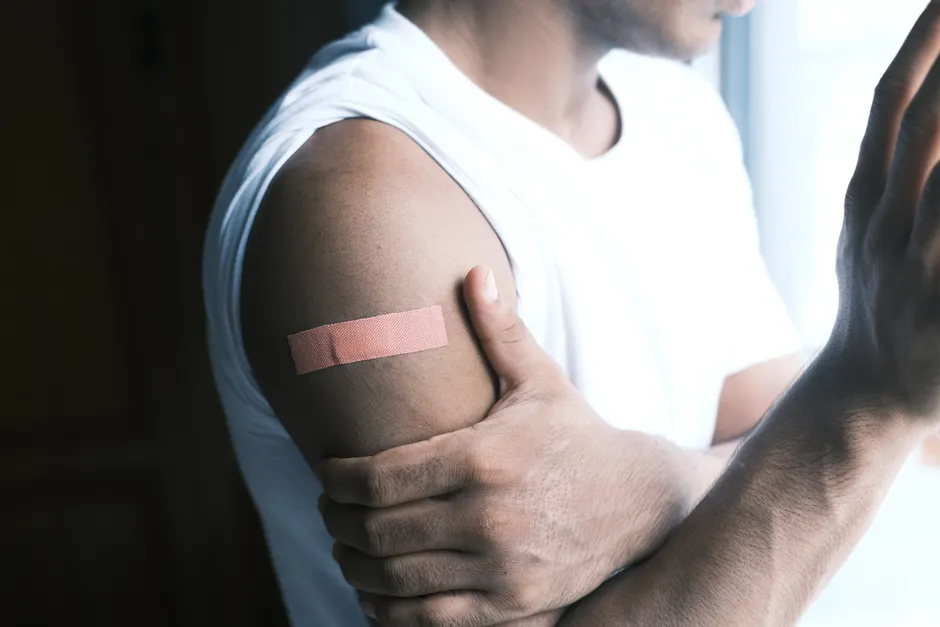
The reporter selected a design called "Bold Sparkle" for the demo tattoo. Following the 15-minute processing period, the reporter experienced no pain, no bleeding, no scabbing, and no healing time. The result is a permanent tattoo deposited without a needle machine, without puncturing the skin in the conventional tattooing sense, and without the inflammatory response that characterizes traditional tattoo healing. The Verge
CipherX's public guidance acknowledges that temporary redness or mild irritation may occur as side effects. Designboom The Verge's firsthand account, however, reported none of these.
The underlying technology is not new to academia. Microneedle tattoo patch concepts have been explored in peer-reviewed research since at least 2022, with published work examining dissolvable microneedle arrays for pigment delivery. The Verge; ScienceDirect CipherX appears to be the first company to translate this body of research into a consumer-ready product. The Verge's exclusive was based on a direct demonstration rather than a company press release, which matters in a product category where the gap between lab demonstration and reliable commercial output has historically been wide. The Verge
The broader context here is about what microneedle delivery systems make possible beyond cosmetic tattooing. The same dissolvable-microneedle architecture that deposits pigment could, in principle, be adapted for drug delivery, vaccine administration, or diagnostic biosensing — built-in sensors that read biological markers through the skin. Academic interest in microneedle patches has been driven largely by those use cases. CipherX's contribution is showing that the platform can produce a cosmetically acceptable, permanent result in a consumer setting, with a safety and comfort profile that traditional needle-based tattooing cannot match.
Worth flagging is the scale of what remains unverified. A single application on a single reporter, observed under controlled conditions by the company's own CEO, is a demonstration, not a clinical trial. The longevity of the pigment, the consistency of results across skin types, the risk of allergic reaction to the pigment or the biodegradable needle material, and the regulatory classification of the product all remain open questions. CipherX's own guidance conceding possible redness or irritation suggests the company is aware that individual responses will vary.
The tattoo industry has remained remarkably static in its core technology for centuries: a needle punctures the skin, deposits ink, and the body's wound-healing response fixes the pigment in place. Microdot replaces the mechanical puncture with a chemical dissolution. The microneedles dissolve, the pigment remains. No wound, no scab, no healing cascade. Whether the pigment retention matches that of conventionally applied tattoos over months and years is a question only broader use will answer.
What this enables is straightforward: a permanent marking technology that removes the primary barriers to entry (pain, healing time, and the noise of a tattoo machine) without requiring the user to visit a studio. The implications for accessibility are real. The implications for safety oversight, pigment regulation, and age verification in a product that can be applied at home are equally real, and deserve attention before the technology reaches scale.
CipherX maintains a public presence on Instagram at @cxmicrodottattoos. Instagram
In this author's view, the instinct to be cautious here is warranted but should not overshadow what was demonstrated. A permanent tattoo, applied in minutes, with no pain and no healing, verified by an independent reporter, is a genuine technical milestone. The questions that follow (durability, safety at scale, regulatory classification) are the right ones to ask. They are not reasons to dismiss what CipherX has built. They are the standard checklist for any medical-adjacent consumer product moving from prototype to market, and CipherX will need to answer them convincingly to move beyond early adopters.