Peter Gill, British Theatre Director and Playwright, Dies at 86
Peter Gill, the British director and playwright whose career spanned nearly seven decades and some of the country's most influential stages, has died at the age of 86. His death was reported on 4 August 2026 (The Guardian).
Born on 7 September 1939 in Cardiff, Wales, Gill was the son of George John Gill and Margaret Mary (née Browne). He was appointed OBE (Officer of the Order of the British Empire, a state honour recognising service to the arts) during his lifetime, and his official résumé carried the honorific. He was represented by the talent agency Casarotto Ramsay & Associates, with Mel Kenyon serving as his agent.
Gill's entry into professional theatre came in 1958, when he joined London's Royal Court as an actor while still in his teens. The Royal Court was at that time the epicentre of the "new wave" in British theatre — a movement that championed working-class stories and socially engaged writing over the drawing-room dramas that had dominated the stage. His acting credits included the role of Silvius opposite Vanessa Redgrave's Rosalind in Michael Elliott's RSC (Royal Shakespeare Company) production of As You Like It, and several roles in the British premiere of Brecht's The Caucasian Chalk Circle. The transition from acting to directing came at the encouragement of Royal Court artistic director George Devine, who took Gill on as an assistant director.
Gill's first directing production was A Collier's Friday Night by D.H. Lawrence in 1965. He revived it in 1968 as part of a trilogy of Lawrence's neglected mining plays, adding The Daughter-in-Law and The Widowing of Mrs Holroyd. In 1973 he staged The Merry-Go-Round. Over the course of his career, Gill directed as many as 100 productions.
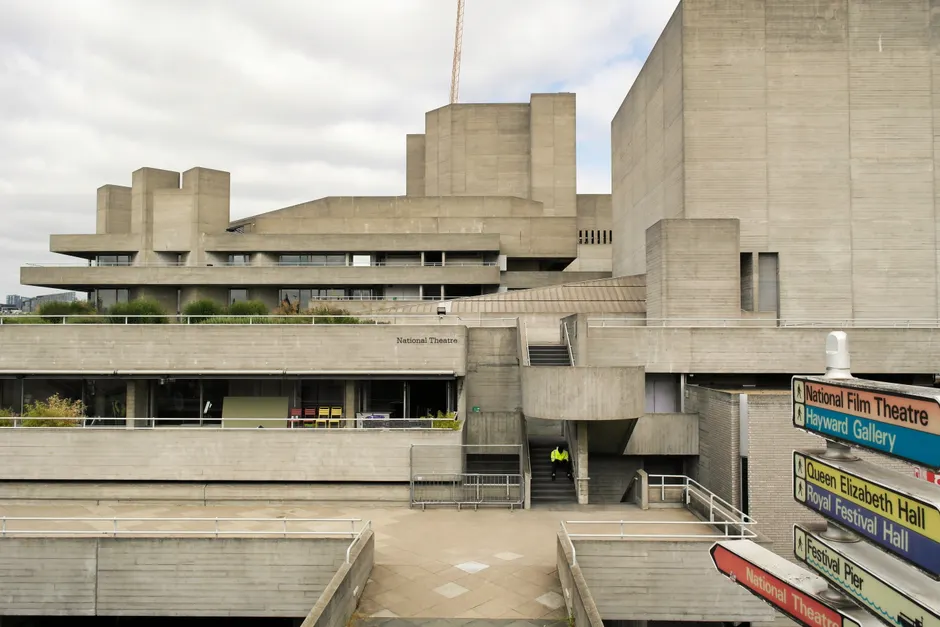
In 1976, Gill became the first artistic director of Riverside Studios in Hammersmith, London. There, his productions included The Cherry Orchard with Eleanor Bron, Julie Covington, and Michael Elphick, and The Changeling with Brian Cox and Robert Lindsay. In 1980 he moved to the National Theatre as associate director, a position he held until 1997. In 1984 he established the National Theatre Studio, an institution that became a significant resource for developing new work and supporting writers outside the pressures of a full production schedule.
At the National, Gill directed productions including Christopher Hampton's Tales from Hollywood (with Michael Gambon, Billie Whitelaw, and Ian McDiarmid), Thomas Otway's Venice Preserv'd (with Ian McKellen, Michael Pennington, and Jane Lapotaire), and Harley Granville-Barker's The Voysey Inheritance (with Dominic West and Julian Glover). His casting brought together performers who collectively represent a roll-call of post-war British acting talent.
As a playwright, Gill's output was closely tied to his origins. His first play, The Sleepers Den, produced in 1965, centred on a family disintegrating in a claustrophobic Cardiff slum and starred Eileen Atkins. Subsequent plays included Over Gardens Out, Small Change, and In the Blue. He returned repeatedly to the working-class Catholic Wales of his childhood, drawing material from a world that British mainstream theatre had largely overlooked.
Recognition of Gill's playwriting came in concentrated form. In 2002, director Michael Grandage, then at Sheffield's Crucible theatre, devoted a month-long season to Gill's work. The season included the premiere of Original Sin alongside revivals of Small Change, Kick for Touch, Mean Tears, and Friendly Fire. That same year, English Touring Theatre staged The York Realist, which subsequently transferred to the West End (London's mainstream commercial theatre district). Grandage, reflecting on Gill's legacy, said his contribution to British theatre "will come to be regarded as quietly seismic."
The broader context here is that Gill's career sits at the intersection of several currents in post-war British theatre. His presence at the Royal Court as actor-turned-director placed him inside the institutional engine of the "new wave" shift. His championing of D.H. Lawrence's mining dramas was characteristic: he had an eye for neglected texts that spoke to working-class experience, and the authority to mount them. The National Theatre Studio he founded in 1984 extended that instinct institutionally, giving writers and directors space to develop work without the commercial pressures of a main-house production.
His own plays, though less frequently revived than those of some contemporaries, were sustained by advocates like Grandage, who recognised in them a vein of autobiographical specificity that gave them durability. The 2002 Sheffield season was as much an act of advocacy as of curation, assembling a body of work that had been scattered across decades and venues into a single, focused retrospective.


