S&P 500 Rallies on Strong Earnings and Falling Oil Prices

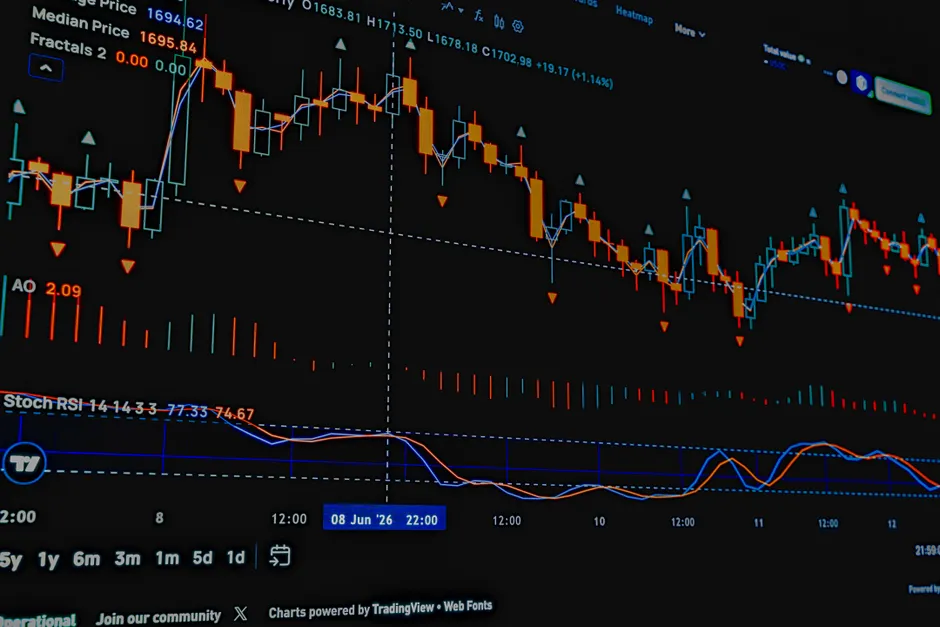
The S&P 500 rose 1.8% on Tuesday, August 4, 2026, as companies posted strong profits and Brent crude prices eased, extending a rally that has lifted the index nearly 6% since the prior week's Federal Reserve meeting (AP News). The Technology sector led the advance, with the Nasdaq Composite up nearly 5% over two days (CNBC).
S&P Dow Jones Indices listed the S&P 500 at 7,736.52, up 1.79%, while the Dow Jones Industrial Average sat at 54,085.88, up 1.71%. The Dow had already closed at a record high on August 3, 2026, as U.S. equities rallied on signs of de-escalating U.S.-Iran tensions (Reuters). The S&P/TOPIX 150 gained 2.12% to 3,543.09, the S&P Europe 350 rose 0.73% to 2,670.60, and the S&P/TSX 60 added 1.26% to 2,109.58. The S&P GSI was the lone decliner among major benchmarks, falling 0.39% to 5,183.03.
After Tuesday's session, the S&P 500 was up 3.3% for August 2026 (CNBC). The index had entered the month roughly 1% below its record closing high of June 2, 2026, and as of early July was up about 10% year-to-date (Reuters). At one point during the summer rally, the S&P 500 jumped 1.5% and stood just 0.1% below that record (AP News).
Brent crude sank 4.7% during the summer rally, giving stocks a boost by lowering input-cost pressures across energy-intensive sectors (AP News). The pullback in oil aligned with broader de-escalation in geopolitical tensions that had flared earlier in the summer.
The key driver underneath the rally is an earnings story rather than a multiple-expansion story. Putnam's midyear analysis found S&P 500 earnings jumped 30% while valuations contracted, meaning the 2026 advance was driven by companies actually making more money rather than by investors simply paying more for the same earnings (The Street). In plain terms: a multiple-expansion rally happens when investors bid up stock prices relative to underlying profits, often on optimism alone. An earnings-driven rally, by contrast, is supported by rising cash flow.
That distinction matters. Earnings-driven rallies can sustain through volatility shocks more readily than liquidity-driven ones, because the price floor is anchored in actual cash flow rather than sentiment.
The S&P 500 Growth index price return stood at 5,453.28, with a 1-day return of 1.45% and a 1-year return of 18.71% (S&P Dow Jones Indices). The Growth index's trailing 12-month figure, combined with the Putnam earnings data, frames the current advance as a continuation of a profit-led cycle in which mega-cap technology and growth names carry disproportionate weight in index-level returns.
Historical precedent offers a measured read on what comes next. The S&P 500 has often extended gains after making new highs following pullbacks of 5.0%–9.9%, posting a median return of 0.66% in those instances (Reuters). That is a modest but positive skew, consistent with momentum persistence in trending markets rather than a tendency for prices to snap back to their average.
For full-year 2025 context, the S&P 500 finished December down 0.05%, bringing its 2025 full-year performance to 16.39% (S&P Dow Jones Indices). The index covers approximately 80% of available U.S. large-cap market capitalization across 500 leading companies (S&P Dow Jones Indices).
The broader context here is that the convergence of three catalysts — earnings strength, oil-price relief, and geopolitical de-escalation — compressed what might otherwise have been a gradual recovery into a sharp two-day move. Whether the index reclaims and holds its June 2 record will depend less on momentum and more on whether Q3 corporate results sustain the 30% earnings trajectory Putnam identified at midyear. The historical median return after new highs following mid-range pullbacks is positive but thin, suggesting that while the path of least resistance appears upward, the margin of safety for late entrants is narrow.