Samsung's QS90H Soundbar Drops the Subwoofer and Mostly Pulls It Off
Engadget has published its review of the Samsung HW-QS90H soundbar, awarding it an 8.8 out of 10. The $1,000 unit is the model from Samsung's 2026 soundbar lineup that impressed the publication most at CES, and it was subsequently named among Engadget's best of CES 2026 selections (Engadget).
Samsung markets the QS90H as its "All-in-One Soundbar," and the most consequential design decision backs that label up: the company removed the wireless subwoofer entirely (Engadget). For a category that has treated the separate sub as standard equipment for the better part of a decade, that is a notable departure. The bet is that the soundbar's internal speaker array can carry the low end on its own, and according to the review, it largely does. Engadget found the QS90H produces adequate bass without a separate subwoofer.
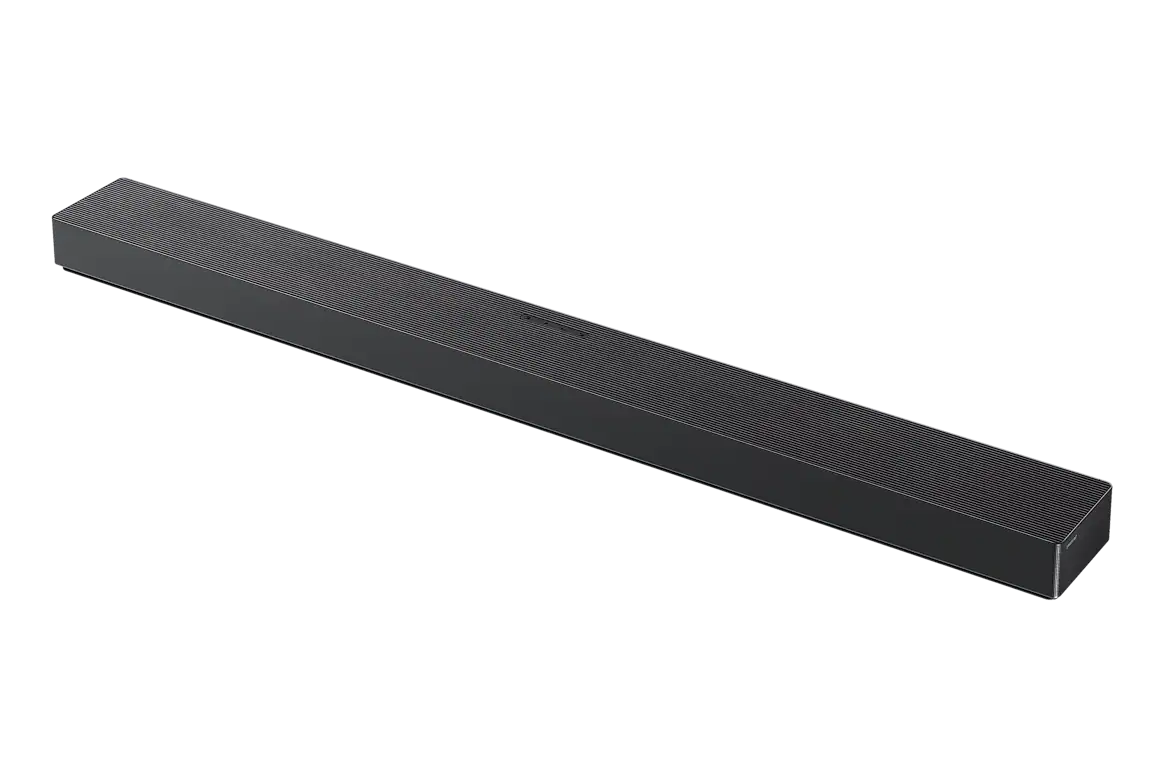
The hardware explanation for that capability is straightforward. The QS90H houses 13 drivers, up from 8 in the previous year's QS700F. Nine of those are wide-range drivers, and four are built-in woofers distributed around the unit (Engadget; Samsung). To accommodate the larger driver count, Samsung widened the chassis by roughly 3.5 inches compared to the QS700F. The system is configured as a 7.1.2-channel array, meaning it can simulate seven speakers around the listener, a dedicated bass channel, and two overhead channels for height effects in surround sound.
The physical design carries over the horizontally-striped top grille from the prior generation, with dotted panels wrapping the sides and front. Onboard controls are center-mounted: a microphone mute button that also activates Bluetooth mode, two volume buttons, and a Multi button on the far right. The Multi button pulls double duty, waking the soundbar from Standby and cycling through inputs when the unit is active.
The feature set reads like a checklist of Samsung's current audio engineering stack. The QS90H supports wireless Dolby Atmos (a surround-sound format that adds height channels for a more immersive dome of sound), Q-Symphony audio expansion (which synchronizes the soundbar with a Samsung TV's built-in speakers), SpaceFit Sound Pro room calibration, AI Dynamic Bass Control, Adaptive Sound, Active Voice Amplifier Pro, Sound Elevation, Game Mode Pro, and a design feature called Convertible Fit. Notably, SpaceFit Sound Pro works with any TV because the QS90H has its own internal microphones for calibration, an improvement over the QS700H, which required a Samsung TV to perform the same function. Wireless Dolby Atmos and Q-Symphony, however, both require a compatible Samsung TV.
That ecosystem dependency is one of three caveats Engadget flagged. The review also noted the QS90H is underpowered for larger rooms and carries a premium price tag at $1,000. For buyers outside the Samsung TV ecosystem, the effective feature set narrows considerably, since two of the headlining audio technologies are gated to Samsung displays.
The broader context here is Samsung's 2026 audio strategy, which the company laid out in announcements beginning in late 2025. The QS90H sits below the flagship HW-Q990H, a true 11.1.4-channel system, in a lineup that also includes new Wi-Fi music-studio speakers (Samsung Newsroom). The unifying theme across the lineup is multi-device sound, immersive audio formats, and designs that integrate into domestic spaces rather than demanding a dedicated listening room.
The QS90H's no-subwoofer configuration fits that design-first philosophy. Whether the approach scales acoustically depends heavily on room size and placement, and Engadget's finding that the unit struggles in larger rooms sets a clear boundary on the trade-off. For apartment-scale living rooms or media nooks, the equation is different: a single chassis that handles bass, mids, and height channels without a floor-standing box is a genuine simplification, and $1,000 is not trivial but sits well below the flagship tier.
The all-in-one soundbar is not a new concept, but the combination of 13 drivers, on-board calibration that works regardless of TV brand, and the outright removal of the subwoofer from the bill of materials makes the QS90H one of the more aggressive bets on the form factor in recent memory. The 8.8 score suggests Engadget found the execution sound. The caveats suggest the ceiling is real.