Ford's Fathom: A Sub-$30K Electric Pickup Built on a New Parallel-Assembly Platform

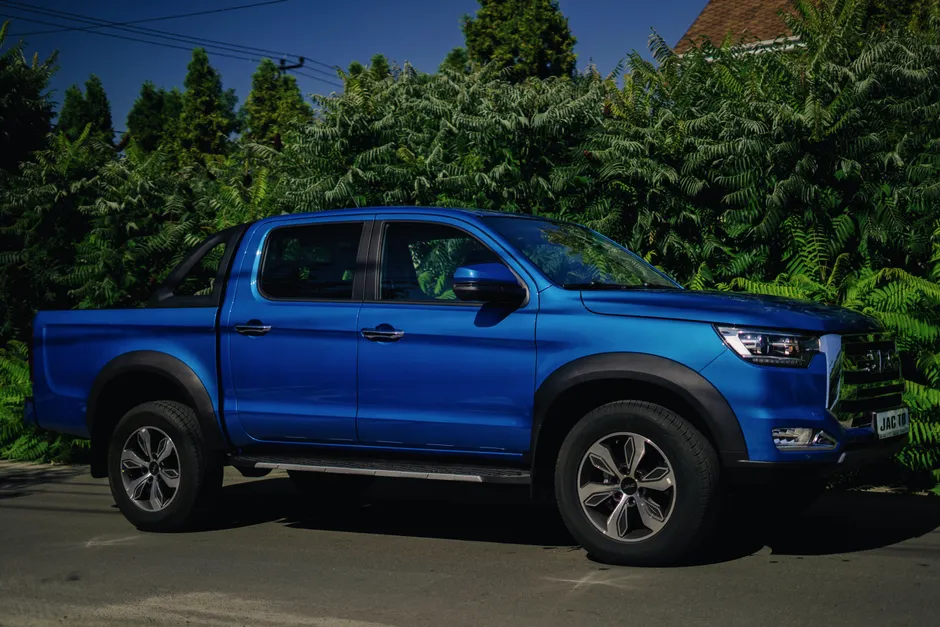
Ford has unveiled the Fathom, a midsize electric pickup with a starting price of $28,350 — the automaker's first entry in the sub-$30,000 EV segment. The Fathom will be built on Ford's new Universal Electric Vehicle (UEV) platform and will enter production at the updated Louisville Assembly Plant next year, with deliveries before the end of 2027. Pre-orders open early next year. The Verge
That starting price places the Fathom at roughly half the cost of an F-150 Lightning. It also undercuts the approximately $30,000 target that Reuters had previously reported for Ford's first affordable EV. Ford had signaled its intent to pursue smaller, more affordable models as it delayed two next-generation electric vehicles — a pickup and a van — to 2028, and pushed the F-150 Lightning successor to the second half of 2027. Reuters
The Fathom is positioned as a fully featured vehicle rather than a stripped-down compliance car — the kind of minimal EV built mainly to satisfy regulatory requirements. The base model includes a large, high-resolution touchscreen running integrated Apple Maps, and supports both Android Auto and Apple CarPlay. Ford's decision to retain both smartphone projection standards is notable at this price point, particularly as some competitors have moved to drop CarPlay in favor of proprietary infotainment systems.
On the hardware side, the base Fathom aims for interior volume exceeding that of a Toyota RAV4, packaged with an open bed and a frunk (front trunk, the storage space under the hood where an engine would sit in a gas vehicle). All sensors required for Ford's hands-free Blue Cruise driving system are included on the base model, though activating the feature costs extra. Blue Cruise is priced at $2,495 as a one-time purchase or $495 annually, which would bring a fully optioned Fathom with hands-free driving to roughly $30,845.
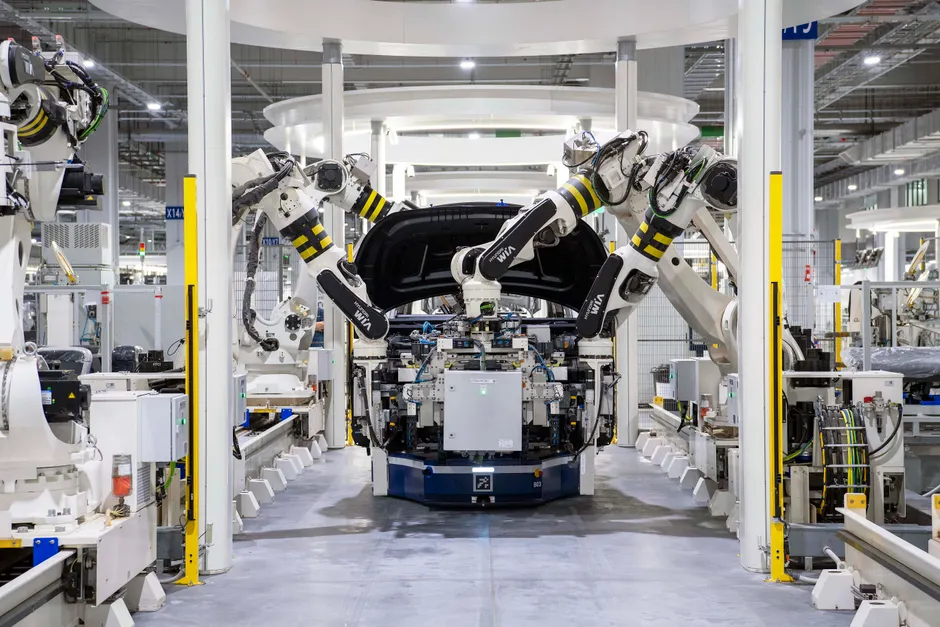
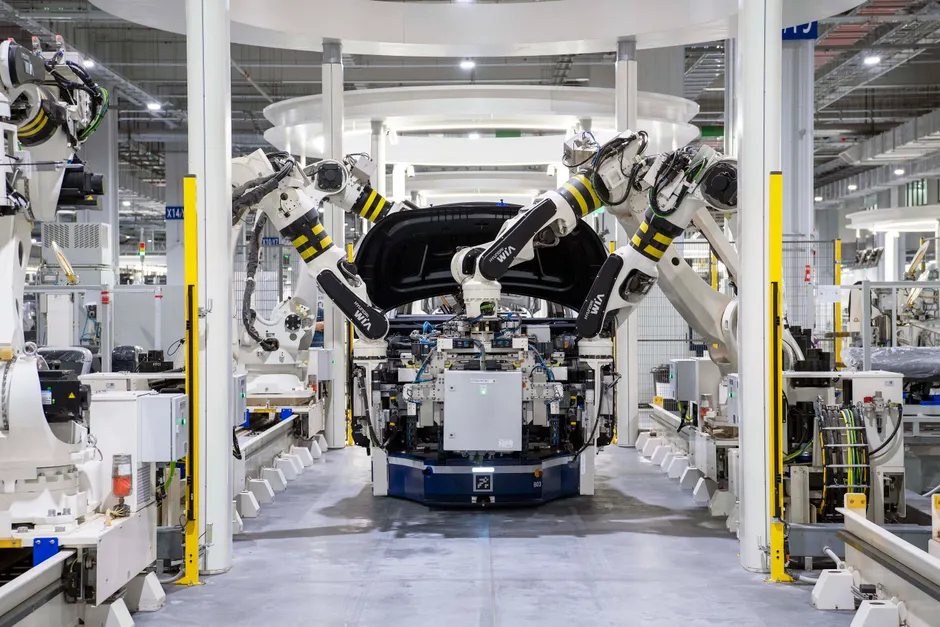
The manufacturing approach is where the UEV platform diverges most sharply from conventional EV assembly. Rather than a single sequential line, vehicles on the UEV platform will have their front, rear, and middle sections built in parallel on multiple assembly lines and then joined at the end. This parallel architecture is designed to reduce assembly time and allow different vehicle segments to be swapped or updated independently — think of it like modular furniture assembled in sections rather than built start-to-finish on one bench. Ford has not yet detailed specific throughput targets or model variants beyond the Fathom that will share the platform.
The broader context here matters. Ford took a $19.5 billion charge as it retreated from EVs amid Trump administration policy shifts, and had planned to price the first model from its low-cost EV team at about $30,000 with sales beginning in 2027. Reuters The Fathom, at $28,350, comes in below that internal target and ahead of the 2027 sales window — albeit marginally, with deliveries scheduled before the end of that year.
For the EV market, the Fathom brings a full-size-feature electric truck into the price band currently occupied by mainstream compact crossovers and mid-tier trims of combustion vehicles. The RAV4 comparison is apt not just for interior volume but for the buyer Ford is targeting: someone cross-shopping a $28,000–$30,000 gas vehicle who has not previously considered electric. Whether the parallel-assembly UEV platform can deliver the unit economics to sustain that price point at volume is the open question, and one that won't be answered until production ramps at Louisville next year.
Ford's decision to bundle Blue Cruise sensors on the base trim while gating the software behind a paywall mirrors the hardware-preload strategy common in consumer electronics: ship the silicon, monetize the feature later. Whether buyers at this price point will pay an additional $495 per year or $2,495 up front for hands-free driving is untested in a segment where every dollar of margin is contested.
What the Fathom ultimately enables is a credible EV option in the price tier where EV adoption has been slowest to penetrate. The parallel-assembly platform, if it works at scale, could also give Ford a structural cost advantage that extends beyond this single model. Those are large ifs, hinging on a plant that is still being retooled and a platform that has yet to build a single production vehicle. The timeline — pre-orders early next year, production next year, deliveries before the end of 2027 — leaves narrow margin for slippage in an industry where delays have been the norm.