Iran-U.S. Escalation in the Gulf: Missiles, Radar Strikes, and a Fractured Ceasefire

The Flashpoint
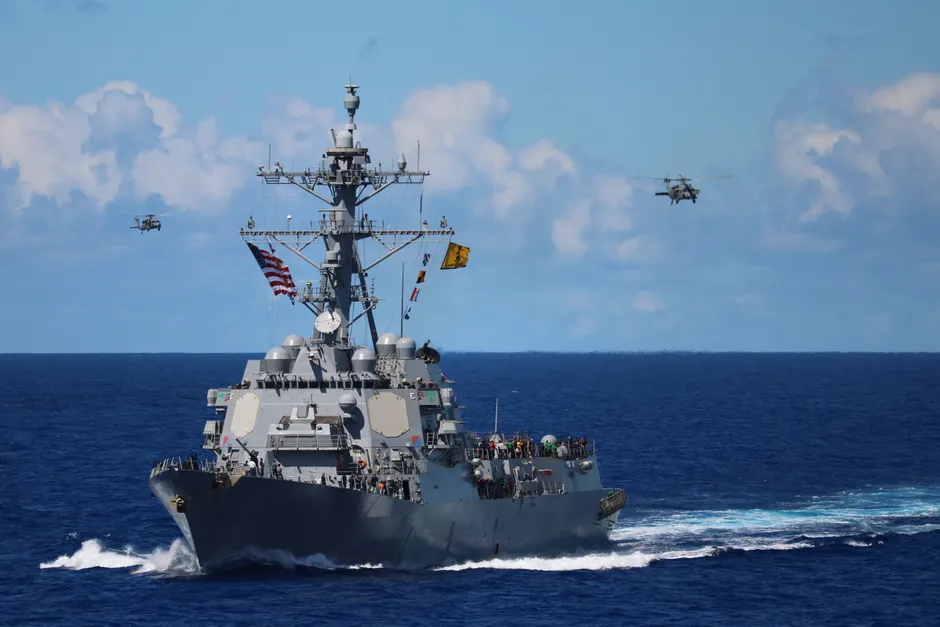
Iran fired seven ballistic missiles toward Kuwait and Bahrain, according to U.S. Central Command, which said its forces intercepted six of them; the seventh failed to reach its target. CENTCOM separately confirmed that two of those ballistic missiles were specifically targeting American forces based in Kuwait. Kuwait's own air defenses opened fire early Monday morning to intercept drone and missile fire originating from Iran, the Kuwaiti government said. Bahrain was likewise in the target envelope.
In response, the U.S. military conducted what it characterized as self-defense strikes, hitting Iranian coastal surveillance radar sites, drone control infrastructure, and additional installations on Qeshm Island and near the city of Geruk — strikes that unfolded across Saturday and Sunday before the Monday missile salvo. The sequence: Tehran shot down an American MQ-1 Predator drone over the weekend, the U.S. responded with strikes on Iranian radar and drone control sites, and Iran then launched the ballistic missile barrage at Kuwait and Bahrain.
U.S. Central Command characterized Iran's missile attack on Kuwait as an "egregious ceasefire violation," a phrase that carries explicit operational and diplomatic weight — signaling that a pre-existing agreement to halt hostilities was in place, that Iran broke it, and that the U.S. reserves the right to respond accordingly.
Anatomy of the Exchange
The timeline matters for understanding escalation mechanics. The MQ-1 Predator shootdown by Iranian forces was the initial kinetic trigger in this sequence. The U.S. retaliation focused on Qeshm Island — a strategically significant site in the Strait of Hormuz corridor — and the Geruk area, targeting specifically the surveillance radar and drone command-and-control nodes that Iran relies on for maritime domain awareness and UAV operations. Destroying radar infrastructure degrades Iran's ability to track naval movements and coordinate further strikes; hitting drone control sites disrupts the command chain for IRGC Aerospace Force UAV operations.
Iran's subsequent response — the seven-missile volley at Kuwait and Bahrain — marked an escalation in both geographic scope and weapons class. Ballistic missiles carry different escalatory signaling than drones or cruise missiles: their re-entry velocities stress even advanced missile defense architectures, their use against Gulf Cooperation Council capitals invokes GCC collective defense considerations, and their targeting of U.S. forces in Kuwait directly implicates Article 51 of the UN Charter's right of self-defense frameworks that Washington habitually invokes.
The intercept rate — six of seven, with the seventh a self-defeating failure — reflects a layered defense architecture almost certainly involving THAAD and Patriot PAC-3 batteries, coordinated through the Combined Air and Missile Defense operations center in the region. A near-perfect intercept record is operationally reassuring but does not remove the political and escalatory weight of Iran choosing to fire at GCC capitals hosting U.S. forces.
The IRGC Aerospace Force and the Drone-Missile Doctrine
The centrality of the IRGC Aerospace Force in this exchange is not incidental. According to the U.S. State Department's Country Reports on Terrorism 2024, in 2024 Iran increasingly relied on the IRGC Aerospace Force to conduct direct and brazen attacks against its adversaries, including in coordination with broader IRGC elements. That doctrinal evolution — from proxy-mediated pressure to direct state-on-state kinetic action — is the strategic backdrop against which the current exchange must be read.
The IRGC Aerospace Force commands Iran's ballistic missile arsenal, its domestic drone program, and the suite of UAV variants that have become Iran's most exported military product. The U.S. Department of Defense's FY2026 budget justification documents note that Iran has supplied Russia with significant quantities of drones, guided aerial bombs, and artillery ammunition — a transfer relationship that has simultaneously battle-tested Iranian designs in Ukraine and generated hard currency and tactical feedback for Tehran's own programs. The platforms now being fired at Kuwait and Bahrain are, in part, refined through that operational loop.
The Ceasefire Question
The U.S. accusation of a ceasefire violation raises a question that the available sourcing does not fully resolve: what were the terms of that ceasefire, who brokered it, and when did it take effect? CENTCOM's public language is explicit — Iran violated it — but the existence of a ceasefire agreement between the U.S. and Iran in a conflict this acute is itself a significant diplomatic fact that warrants scrutiny. Ceasefire agreements between adversaries without formal diplomatic relations are typically mediated through third parties; Oman has historically played that role in U.S.-Iran back-channel communications, as has Qatar to a lesser degree.
If a ceasefire was in place and Iran fired anyway, the explanatory possibilities divide into several tracks: hardline IRGC elements acting with or without Supreme Leader authorization; a deliberate Iranian decision to test the ceasefire's enforcement; or a calculated escalation designed to extract negotiating leverage before any diplomatic process consolidates. Each reading implies a different Iranian decision-making structure and therefore a different set of appropriate responses.
We have seen this pattern before. In the months leading up to and following the January 2020 killing of Qasem Soleimani, Iran and the U.S. engaged in a sequenced exchange of strikes, proxy attacks, and rhetorical de-escalation signals that ran in parallel, with neither side able to fully control the timing or optics of each move. The structural dynamic — direct Iranian action, U.S. kinetic response, Iranian escalation, ceasefire rhetoric, Iranian violation — rhymes closely with the current sequence. Then as now, the GCC states found themselves simultaneously hosting U.S. forces and exposed to Iranian retaliation for doing so, a position that strains Gulf multilateral cohesion and puts monarchies in Riyadh, Manama, and Kuwait City in an impossible public posture.
Stakes for the Gulf and Beyond
For Kuwait and Bahrain, the immediate security calculus is stark. Both countries host U.S. military infrastructure — Camp Arifjan and Ali Al Salem Air Base in Kuwait, Naval Support Activity Bahrain as the home of the U.S. Fifth Fleet — that makes them primary targets in any Iranian escalation ladder. Bahrain is also the host of the Combined Maritime Forces headquarters. Iranian strikes on these facilities, even intercepted ones, carry coercive messaging to GCC governments: the cost of hosting American forces is direct exposure to Iranian ballistic missiles.
For Washington, the challenge is sustaining deterrence credibility without triggering a broader regional war. The strikes on Qeshm Island and Geruk were bounded — radar and drone control nodes, not nuclear facilities, not oil infrastructure, not regime leadership targets. That boundary is deliberate. Proportionality in the jus in bello sense keeps escalation rungs visible and preserves off-ramps, but it also communicates limits that adversaries can probe.
The broader context here is that Iran's simultaneous exposure on multiple fronts — economic pressure from sanctions, degraded proxy networks in Lebanon and Gaza, and a domestic legitimacy deficit — creates both incentive for escalation as a distraction and incentive for negotiated relief. Which impulse dominates in Tehran's internal deliberations is the critical variable that outside observers, including policymakers in Washington and Brussels, are trying to read in real time.
The coming days will reveal whether the ceasefire framework can be reconstituted, whether third-party mediators are engaged, and whether either side's military posture shifts from reactive to deliberate. For the moment, the Gulf's missile defense batteries remain on full alert, and the diplomatic architecture holding this short of open war is under acute strain.