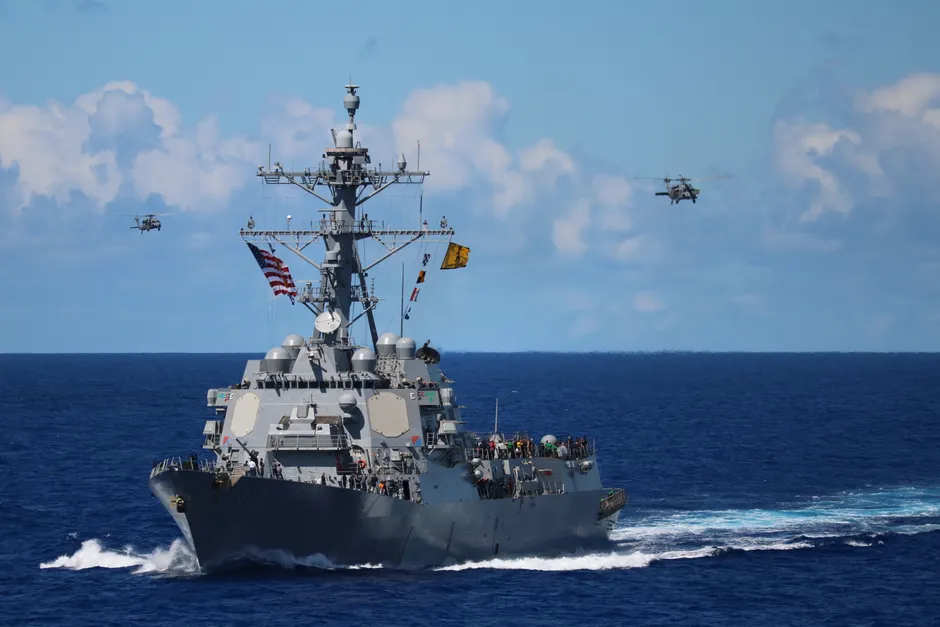
Hammer Drops on Iran: U.S. Strikes Nuclear Sites, Presses Militia Networks Across the Region

The Hammer Falls
The United States military has executed a sustained campaign of precision strikes targeting Iran's nuclear infrastructure and the broader constellation of Iran-backed proxy forces operating across the Middle East — a campaign that, as of early June 2026, encompasses multiple theaters, multiple target sets, and a diplomatic channel that Secretary of State Marco Rubio said in late May was still close enough to resolution that a deal could materialise within "a few days."
That diplomatic window, however, has remained open while the strikes have continued — a posture that reflects a deliberate U.S. calculation: maintain maximum military pressure while leaving space for a negotiated off-ramp. Whether that dual-track holds is the central question for every regional security planner watching this unfold.
What Has Been Hit, and Where
The operational record across recent weeks covers three distinct target sets.
In Iraq, U.S. Central Command conducted strikes against five weapons sites associated with Kata'ib Hezbollah, the Iranian Revolutionary Guard Corps-linked militia whose rocket attack on U.S. forces triggered the response. Kata'ib Hezbollah — designated a Foreign Terrorist Organization by the U.S. State Department — has long served as one of the IRGC's most capable instruments for harassing American forces and logistics in the Iraqi theater. The five sites were selected for their role in storing and staging the rocket systems used in the triggering attack.
In Yemen, U.S. and partner forces struck a range of Houthi military targets, including an underground storage facility — a target category that signals intelligence sufficient to locate hardened, concealed infrastructure — and additional positions associated with Houthi force disposition. The Houthis, formally Ansar Allah, have maintained an active anti-shipping and anti-U.S. posture in the Red Sea corridor, and the inclusion of an underground storage site in the target package indicates a deliberate effort to degrade their strategic depth, not merely their surface order of battle.
Most consequentially, U.S. Central Command conducted a precision airstrike against a key command and control facility operated by Iran-backed forces — a node whose destruction is designed to fragment coordination between Tehran and its regional proxies rather than simply attrit their hardware.
Taken together with the strikes on Iran's nuclear program detailed in the Department of Defense's own weekly summary, these operations constitute an integrated pressure campaign rather than a series of discrete retaliatory episodes.
The Nuclear Dimension
The strikes on Iranian nuclear sites represent the most strategically consequential element of this campaign. Iran's nuclear program has operated across a layered set of facilities — uranium enrichment at Natanz and Fordow, weaponisation-adjacent research at Parchin, and associated logistics and command infrastructure. Precision strikes against this architecture, even without guaranteed destruction of deeply buried components, impose a real cost: they set back timelines, destroy equipment with long procurement lead times, force reconstitution efforts under international scrutiny, and — critically — signal that the U.S. is willing to bear the escalatory risk of direct military action against sovereign Iranian territory.
That last signal is the one Tehran's strategists will be processing most carefully. For years, the working assumption in Iranian strategic planning was that the U.S. would prosecute proxy confrontations but stop short of direct kinetic engagement with Iranian territory. That assumption has now been tested.
Rubio's Diplomatic Track
Against this backdrop, Secretary of State Rubio's statement in late May 2026 — that a deal to halt the conflict could be reached within days — carries significant interpretive weight. The formulation is careful: Rubio did not say a deal was imminent or guaranteed, only that the timeline for negotiation was compressed. The statement was made concurrent with fresh U.S. strikes, which places it squarely in the category of coercive diplomacy: the credible threat, and active use, of force to shape an adversary's negotiating calculus.
The precedent for this posture is not obscure. We have seen this pattern before — most sharply in the 1999 NATO air campaign over Yugoslavia, where strikes continued through negotiation rather than pausing to enable it, and where the coercive pressure of ongoing bombardment was explicitly used to accelerate Serbian compliance. The logic is straightforward: a cessation of strikes before a deal is signed removes the primary lever. Whether Iran reads this the same way NATO's adversary eventually did remains to be seen.
The Proxy Network Under Pressure
The simultaneous targeting of Kata'ib Hezbollah in Iraq and Houthi infrastructure in Yemen reflects an understanding that Iran's strategic depth lies not only in its own territory but in the distributed network of armed groups it has cultivated across the Levant, Iraq, and the Arabian Peninsula. Degrading that network in parallel with strikes on Iranian territory serves two functions: it limits Iran's capacity to retaliate through proxies while direct negotiations proceed, and it imposes costs on the proxies themselves — groups whose continued relevance to Tehran depends partly on their demonstrated operational utility.
For Baghdad, this presents a familiar and uncomfortable dilemma. The Iraqi government has consistently sought to maintain equidistance between Washington and Tehran, and U.S. strikes on Iraqi soil — even against non-state actors — generate domestic political pressure that Iraqi Prime Minister Mohammed Shia' al-Sudani must manage carefully. The presence of Kata'ib Hezbollah within the Popular Mobilization Forces umbrella, which has formal status under Iraqi law, further complicates any clean diplomatic resolution.
What Comes Next
Three variables will shape the next phase of this campaign.
The first is Iranian resilience. How much of the nuclear program's critical infrastructure survived the initial strikes — and how quickly Iran can reconstitute — will determine whether U.S. pressure achieves its stated objective of preventing a nuclear breakout or merely delays it.
The second is the negotiating channel's durability. Rubio's "few days" timeline, made in late May, has already stretched into June without a reported agreement. Each day of continued strikes that passes without a deal makes the diplomatic track more fragile, as domestic constituencies on both sides harden.
The third is allied coherence. The inclusion of partners in the Yemen strikes matters: coalition participation broadens the political legitimacy of the campaign and distributes the burden of Red Sea security. Whether European partners — already managing NATO commitments, Ukrainian aid fatigue, and their own economic exposure to a disrupted Strait of Hormuz — sustain that participation will be a live question in the weeks ahead.
The operational record is clear. The strategic outcome is not.