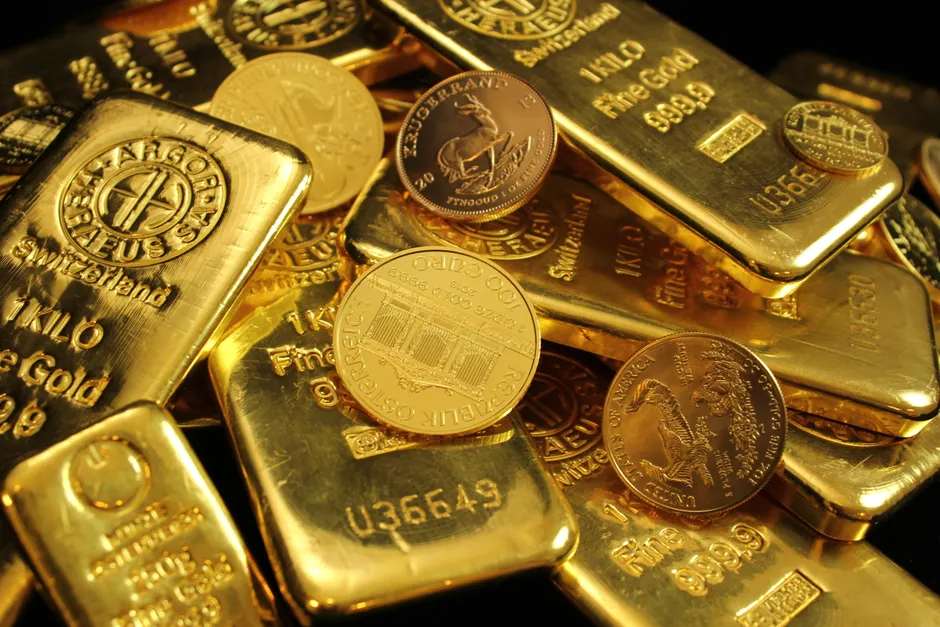
Gold at $4,000: The Geopolitical and Macro Currents Behind a Historic Threshold

The Number That Matters
Gold crossed $4,000 per troy ounce for the first time on record, according to The Wall Street Journal (October 2025). That milestone capped a run in which the metal gained 27% across the full calendar year of 2024 — a performance that was not luck or momentum-chasing. It was the arithmetic output of a specific, traceable set of macro and geopolitical inputs that have been compounding for the better part of three years.
Understanding why gold is here, and what sustains it at these levels, requires working backward through those inputs rather than simply extrapolating the chart.
The Geopolitical Kindling
The immediate catalyst layer is the Middle East. In early October 2024, the U.S. Department of Defense confirmed that American assets in the Mediterranean were actively engaged in defending Israel against Iranian ballistic missile attacks — a direct kinetic involvement that moved the U.S. from a logistics-and-intelligence posture to active air defense. Later that same month, Israel conducted a targeted strike against military installations inside Iran in retaliation, a development the Pentagon characterized at the time as something that "should mark the end of tit-for-tat" escalation between the two nations.
It did not mark the end. The sequence of strike and counter-strike, U.S. asset deployment, and forward basing in the Eastern Mediterranean established a persistent risk premium in energy and safe-haven assets. Gold, which has no sovereign counterparty, no yield, and no exposure to the credit risk of any particular state, is the canonical hedge for exactly this variety of open-ended geopolitical uncertainty. Sovereign wealth funds, reserve managers, and institutional allocators all have mandate language that routes capital toward gold when the probability distribution of outcomes widens in this way.
The Macro Substrate
But geopolitical flare-ups alone rarely sustain multi-year bull markets in gold. The deeper substrate here is structural inflation uncertainty.
Russia's invasion of Ukraine, beginning in February 2022, delivered a large, persistent commodity-price shock to global supply chains. As Federal Reserve Governor Adriana Kugler noted in October 2024, the invasion directly exacerbated sharp increases in commodity prices, producing a global escalation of inflation that central banks across the developed world were forced to confront with aggressive rate-hiking cycles. That episode repriced the market's understanding of what "tail risk" in commodity supply looks like when a major energy and grain exporter is at active war.
The aftershocks of that repricing are still present. A Federal Reserve research note published in January 2025 identified multiple concurrent sources of ongoing global inflation uncertainty, including volatile commodity prices and geopolitical tensions, and documented how that uncertainty transmits across borders. Crucially, the analysis framed this not as a temporary dislocation but as a regime of elevated variance — a structural condition rather than a cyclical one.
Gold performs well in precisely this regime. The metal is not simply an inflation hedge in the naive sense that it rises when CPI prints hot. It is a hedge against inflation uncertainty — against the probability that central banks lose the plot, that supply shocks re-accelerate, that real rates turn meaningfully negative again. When the dispersion of outcomes around the inflation path widens, gold's option value increases, and that is reflected in the spot price.
Layers of Demand
The demand composition behind this move is worth disaggregating. Central bank buying has been structurally elevated since 2022, driven in part by the de-risking of USD reserve concentration following the freezing of Russian sovereign assets — a policy action that sent an unambiguous signal to every reserve manager outside the G7 about the conditions under which dollar-denominated reserves could be rendered inaccessible. That calculation did not reverse when the acute phase of the Ukraine shock passed.
Simultaneously, retail safe-haven demand in markets facing currency depreciation — most notably in China, Turkey, and several EM economies — has added a persistent bid at the margin. And Western institutional flows, which lagged early in the gold rally as nominal yields on Treasuries remained attractive, have rotated more aggressively into the metal as the rate cycle turned.
The confluence of these three demand streams — official sector, EM retail, and Western institutional — is what makes a $4,000 price defensible as a reflection of fundamentals rather than a purely speculative overshoot. That does not mean $4,000 is a floor. It means the demand is structurally diverse.
A Pattern Worth Noting
I have watched gold make these kinds of threshold breakthroughs before — $1,000 in 2008, $2,000 in 2020 — and the pattern is consistent: round numbers that seemed absurd in advance become anchors in retrospect. The $1,000 break in the wake of the Lehman collapse was dismissed by many as crisis-induced hysteria. Within a decade, $1,200 was the floor. The $2,000 crossing in the COVID era drew similar skepticism. What these episodes share is that the price level reflected a genuine, durable shift in the macro risk environment — not merely sentiment. The current crossing to $4,000 lands in the context of simultaneous geopolitical escalation, structurally elevated inflation variance, and a multi-year central bank accumulation cycle. That combination has historical precedent for persistence.
What the Chart Doesn't Tell You
The WSJ's coverage of gold's current trajectory flags that technical analysts are examining the continuation or reversal of the prevailing trend. That framing is worth receiving with appropriate skepticism. Trend-following frameworks are descriptive, not predictive, and gold's price history is full of violent mean-reversions that arrived precisely when the trend looked most unambiguous.
What the chart genuinely cannot tell you is whether the geopolitical risk premium embedded in the current price is correctly sized. The Middle East situation — U.S. assets engaged in active missile defense of a regional ally, Iranian ballistic missiles in flight, an Israeli strike inside Iranian territory — represents an open tail that defies clean probabilistic assignment. If the escalation cycle that the Pentagon hoped had ended in late October 2024 instead resumed and broadened, the current price would look conservative. If a durable de-escalation framework emerged and commodity supply chains normalized, the unwind could be sharp.
The honest position for anyone managing exposure here is that the macro case for gold is structurally sound, the near-term price is priced for a world that remains volatile, and no chart pattern resolves that uncertainty.
The Inflation-Uncertainty Nexus
One thread that deserves more attention in coverage of gold's move is the Federal Reserve's own framing of inflation uncertainty as a cross-border, multi-source phenomenon. The January 2025 Fed note is not a market document — it is a research publication — but its substance matters for gold allocators. It identifies commodity price volatility and geopolitical tension as co-determinants of global inflation uncertainty. Those are precisely the variables that have been elevated since 2022 and remain elevated into mid-2026.
If the Fed's own researchers are characterizing the current environment as one of structurally wide inflation uncertainty with global transmission mechanisms, the implicit message for gold's role in a portfolio is clear — even if the Fed would be the last institution to frame it that way explicitly.
Where This Leaves the Market
Gold is at $4,000. It got there via a traceable sequence: a commodity price shock from Russia's invasion of Ukraine feeding a global inflation episode, central bank rate cycles that reconfigured real rate expectations, structural de-dollarization in official reserves, and an active Middle East conflict that has kept the geopolitical risk premium continuously refreshed. The 27% gain in 2024 was the acceleration phase. The question now is whether the underlying conditions sustaining the metal at this level are durable or whether the market has pulled forward returns that belong to future years.
That question does not have a clean answer. The conditions are real. The price is the market's aggregate bet on their persistence.