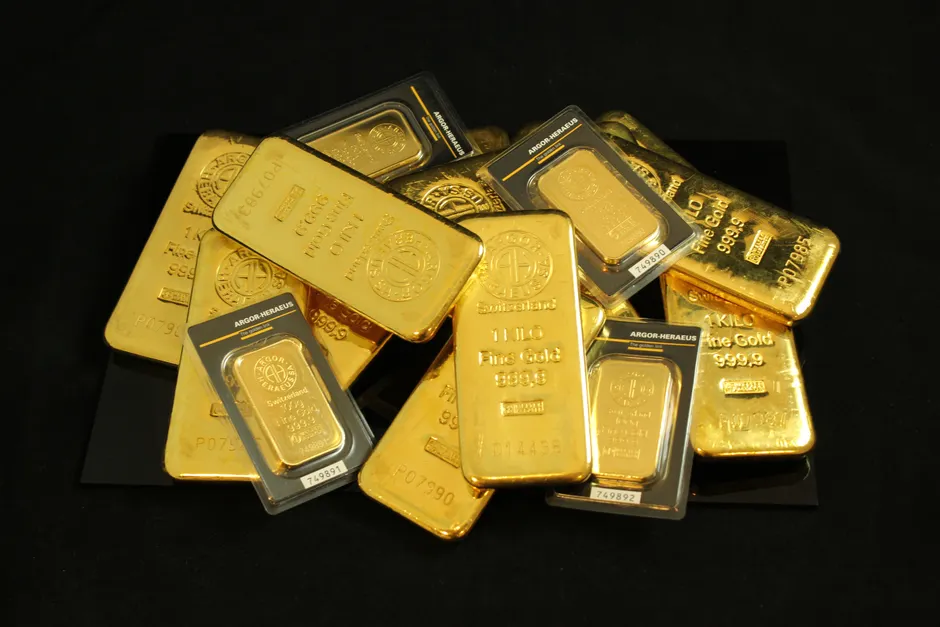
Gold Breaks $5,000 for the First Time as Fed Rate Uncertainty Triggers a Pullback

Gold Crosses a Historic Threshold
Gold futures settled at $5,035.50 per troy ounce — down 0.5% on the session — while spot prices recovered to $5,019.10, according to Yahoo Finance. The numbers confirm what would have seemed implausible to most market participants even two years ago: gold has now traded above $5,000 per troy ounce for the first time in recorded history. The intraday pullback that accompanied the milestone is itself instructive, and it tells a more nuanced story than the headline figure alone.
What Drove the Move — and Why It Paused
The proximate cause of the softness around the $5,000 level is straightforward: Federal Reserve rate expectations. The Fed was widely anticipated to hold the federal funds rate in the 3.50–3.75% target range at its next meeting, and that posture — higher-for-longer by any reasonable measure — is mechanically bearish for a non-yielding asset like gold. When real yields rise or remain elevated, the opportunity cost of holding gold increases; capital rotates toward Treasuries, money-market instruments, and other yield-bearing alternatives. That dynamic has not changed simply because gold crossed a round number.
The broader macro backdrop is more ambiguous. Nominal rates in the 3.50–3.75% corridor are not extreme by historical standards, but they are elevated relative to the post-GFC decade that conditioned a generation of asset allocators. Inflation expectations, fiscal trajectory, central bank reserve diversification, and geopolitical risk premium have all been pulling gold higher for an extended period. The Fed's hold posture creates a ceiling of sorts — but the floor has been rising too.
The Rate Sensitivity Equation
It is worth being precise about the mechanics here, because the gold-rates relationship is often stated too simply. Gold does not respond to nominal interest rates per se; it responds to real rates — the nominal policy rate minus inflation expectations. When the Fed holds rates at 3.50–3.75% while inflation remains sticky, real rates may be less punishing to gold than the nominal figure implies. Conversely, if the Fed signals a prolonged hold and inflation expectations decline, real yields move higher and the headwind intensifies.
The current configuration appears to be one where nominal rates are elevated but market participants are not fully convinced the disinflationary story is complete. That ambiguity is part of what has allowed gold to remain above $5,000 even as futures softened on the day.
Institutional Positioning: UOB's Overweight Call
On the institutional side, United Overseas Bank moved to an Overweight rating on gold from Neutral in its Q4 2024 Quarterly Outlook Report, citing retail demand and an expectation of falling yields as the primary support factors. UOB's outlook reflects a view that has become increasingly mainstream among Asia-based wealth managers: that gold's structural bull case — anchored in central bank accumulation, de-dollarisation flows, and retail physical demand across emerging markets — is durable enough to withstand episodic rate-driven pullbacks.
UOB's pivot from Neutral to Overweight is notable not because one bank's rating moves markets, but because it is representative of a broader institutional repositioning. When sell-side analysts who spent years underweight gold formally upgrade the asset class, it typically signals that the institutional consensus has already moved — the upgrade is lagging the trade, not leading it.
We have seen this pattern before. In the early 2000s, gold languished below $300 per troy ounce and was widely dismissed as a relic by institutional allocators. The subsequent rally to $1,900 by 2011 was accompanied by a wave of belated institutional upgrades — each arriving well after the structural turn was established. The current cycle rhymes: a prolonged period of institutional indifference, followed by a momentum-driven capitulation into Overweight ratings as prices set successive records. That does not make the trade wrong, but it is a reason for professional investors to be clear-eyed about where in the positioning cycle they are entering.
What the $5,000 Level Means Structurally
Round numbers in commodity markets matter less than they do in equity indices, where passive flows and options structures create genuine clustering. In gold, $5,000 is primarily a psychological and media threshold. The more relevant technical question is whether spot prices can consolidate above $5,000 with adequate volume, or whether the level marks a short-term exhaustion point.
The intraday recovery in spot to $5,019.10 — even as futures closed lower — suggests that physical demand or short-covering provided support after an initial sell-off. That is a marginally constructive signal, but a single session's price action in a thinly traded period is not a reliable indicator of medium-term direction.
The Opportunity Cost Framework at $5,000
For portfolio construction purposes, the $5,000 print materially changes the conversation around position sizing. At $1,000 per ounce — where gold traded in 2009 — a 5% allocation to gold in a $10 million portfolio represented a manageable, low-volatility hedge. At $5,000, the same notional allocation carries five times the dollar drawdown risk in an adverse scenario. Risk managers working in VAR or CVaR frameworks will need to revisit gold position limits accordingly, particularly given that implied volatility in gold has historically spiked during Fed decision windows.
The yield-bearing alternatives argument is also sharper at current rate levels than it has been for most of gold's recent bull run. A 3.50–3.75% Fed funds rate translates into front-end Treasury yields that are genuinely competitive with gold's zero nominal yield. For institutions with liability-matching requirements or fiduciary constraints, the case for reducing gold exposure in favour of short-duration fixed income is not unreasonable — even if the structural bull narrative remains intact.
The Fed as the Pivotal Variable
The near-term trajectory for gold hinges almost entirely on what the Federal Reserve signals about the path of rates over the next two to four quarters. A pivot toward cuts — even a modest 25 basis points (a quarter of a percentage point) — would reduce real yields and remove the primary headwind that caused the $5,035.50 futures print to come in below spot. A signal of extended hold, or worse, a hawkish tilt suggesting further tightening, would likely push gold back below $5,000 as real yields climb.
The market's current positioning — with futures slightly below spot and prices consolidating near the round number — reflects genuine uncertainty about that Fed path. That uncertainty is the correct state of affairs. Anyone claiming to know with confidence whether gold will be at $4,500 or $5,500 in six months is selling something.
The Bigger Picture
Gold at $5,000 is a data point in a longer structural story about the dollar's reserve currency status, sovereign debt sustainability, and the willingness of central banks — particularly in Asia and the Middle East — to diversify away from US Treasuries. None of those forces has been resolved by the Fed's current rate posture. The rate-driven pullback that coincided with the $5,000 milestone is a reminder that even structurally supported assets are not immune to cyclical headwinds. For practitioners managing gold exposure, the discipline right now is distinguishing between the structural thesis, which remains intact, and the tactical entry point, which deserves more scrutiny at five-thousand dollars an ounce than it did at four thousand.