NASA JPL's ERNEST Rover Prototype Covers 16 Miles in Desert Field Test
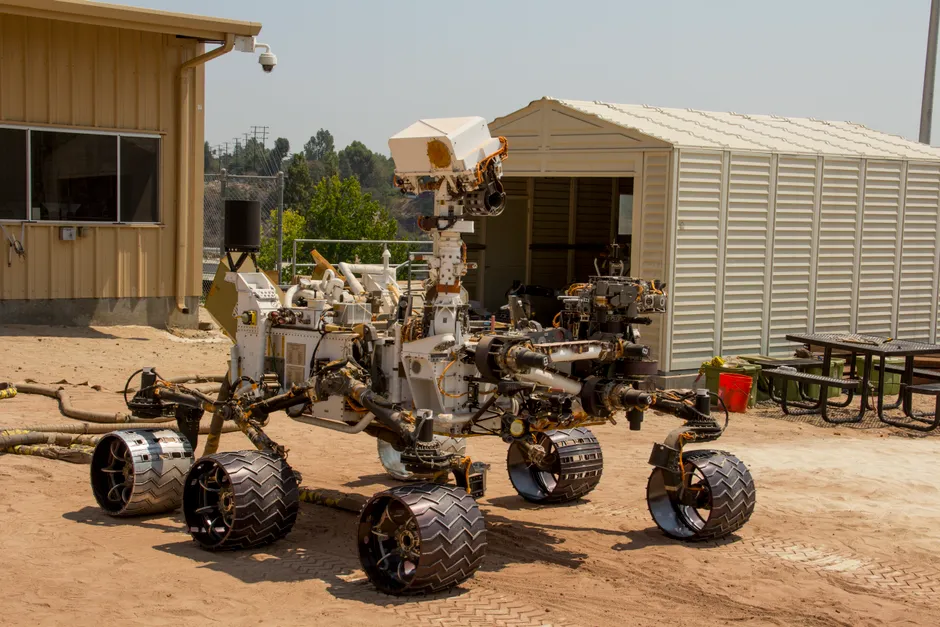
NASA JPL's ERNEST Rover Prototype Covers 16 Miles in Desert Field Test
Engineers at NASA's Jet Propulsion Laboratory have completed a desert field test of ERNEST — Exploration Rover for Navigating Extreme Sloped Terrain — during which the 4-foot (1.2-meter) prototype logged approximately 16 miles over 37 hours of drive time, at speeds more than 10 times faster than typical rover operations. NASA JPL
The result puts a concrete number on what JPL has been building toward: a rover testbed capable of covering the kind of ground that future lunar and Martian surface missions would actually need to traverse. Current operational rovers move at a deliberate crawl — Curiosity averages around 100 meters per hour under autonomous navigation — because the communication latency between Earth and Mars makes real-time teleoperation impractical and terrain hazards demand conservative speed governors. ERNEST is designed to push well past those constraints.
The field test, published June 18, 2026, was conducted in a desert environment chosen to approximate the loose regolith, uneven gradients, and slope conditions the rover would face on the Moon or Mars. ERNEST's mobility architecture is specifically aimed at extreme sloped terrain — a persistent challenge for planetary rovers, where wheel-slip on loose inclines has historically limited where missions can go and how efficiently they get there.
Sixteen miles may not sound exceptional in isolation. Scale it to a lunar context and the number shifts considerably. The Apollo 17 astronauts covered roughly 22 miles total across three days of EVAs on the lunar surface — the farthest any human crew has ranged on another world. ERNEST matched most of that distance in a single continuous test run, without a human in the loop.
That autonomy dimension is the technical core of the project. At lunar distances, one-way communication latency runs to roughly 1.3 seconds — manageable but not imperceptible. At Mars, it ranges from 3 to 22 minutes each way. Neither environment supports the kind of reactive, joystick-driven control that planetary rover coverage at this speed would require. ERNEST is built to make navigation decisions onboard, interpreting terrain and adjusting trajectory without waiting for a round-trip command cycle.
JPL unveiled a dedicated Rover Operations Center for Moon and Mars missions in December 2025, signaling a broader institutional investment in next-generation surface mobility. ERNEST fits within that architecture as a hardware testbed for the autonomy and mobility software that would eventually run on flight-qualified systems.
Worth flagging: the path from a 4-foot desert prototype to a flight-ready planetary rover is long, expensive, and uncertain. JPL has run successful field campaigns with Earth-analogue testbeds before — the Rocky series and FIDO rover were instrumental in shaping the Spirit and Opportunity mission profiles — and those programs still took years before their lessons surfaced in hardware that left the ground. ERNEST's field performance is a data point, not a delivery schedule.
That caveat aside, the 10x speed figure is the kind of benchmark that reshapes mission planning assumptions. Faster autonomous traversal changes the calculus on how far a lander's companion rover can range, how many sites a single mission can sample, and whether a rover can serve as a logistics relay to a crewed surface team rather than just a remote science instrument. The Artemis program's lunar surface objectives — and any crewed Mars scenario further out — depend heavily on surface mobility that current operational systems cannot deliver at the required range. ERNEST is one attempt to close that gap in capability.