Meta Pushes Ray-Ban Display Toward Calling and Contextual Navigation
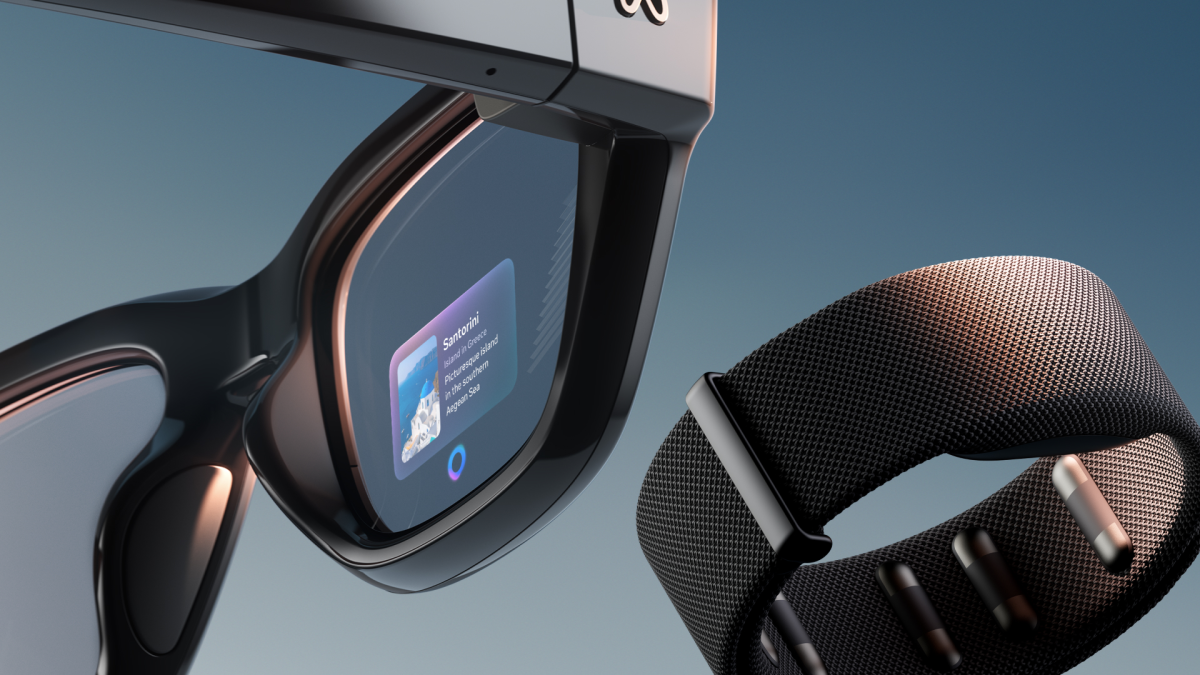
Meta announced a batch of feature updates for Ray-Ban Display at Meta Connect 2026, one year after introducing the glasses at the same conference. Engadget
The update centers on calling, navigation and platform expansion, alongside wider geographic availability. The glasses use in-lens display technology and are controlled by an EMG wristband, also described as a neural band. The display automatically adjusts contrast based on surrounding lighting to keep content visible indoors or outdoors.
Ray-Ban Display first went on sale in the United States on September 30, with initial brick-and-mortar distribution limited to retailers including Best Buy and LensCrafters. The Connect 2026 announcements build on that base rather than replacing the hardware.
Voice-driven holographic calling
The most technically ambitious addition is holographic avatar support during calls. The feature uses the Meta AI app to generate a photorealistic hologram that appears instead of the wearer's face.
Meta said the hologram is driven entirely by voice, with the model inferring expression from what the user says and how they say it. That approach avoids reliance on inward-facing cameras for facial tracking. It shifts the problem to speech-to-expression inference, with latency, prosody modeling and identity preservation as the obvious engineering constraints.
The feature will be available in early access in fall 2026 for WhatsApp users in the US. Meta has not detailed resolution, frame rate or compute placement for the hologram generation in the disclosed materials.
For a tech-literate audience, the design choice is notable. Audio-driven facial animation removes a sensor dependency on a thermally and power-constrained glasses form factor. It also introduces failure modes familiar from neural voice and avatar systems, including mismatched affect, over-smoothed expressions and artifacts under noisy input or overlapping speech.
Navigation, audio and system software
Meta expanded heads-up navigation on Ray-Ban Display to support cycling and public transit directions requested by voice command. Users in the US and Canada will receive that expansion first.
Navigation can now give directions based on surroundings, such as turn left at the yellow house, rather than only street names. That moves the system from map-graph instructions toward vision-grounded or semantically anchored guidance. For cycling and transit, where glance time is limited and street signage is often missed, landmark referencing can reduce cognitive load if localization is accurate.
A new Explore app is coming to both the glasses and the Meta AI app to browse compatible apps. The dual placement matters. Discovery lives on the phone, execution lives on the face. That split is consistent with how companion-app architectures have evolved for wearables.
Meta is also adding Dolby Atmos to capture and playback, on-display photo editing, a more detailed calendar, mirrored phone notifications and Threads for Community Feeds. Taken together, the list fills gaps expected of a heads-up companion device: richer scheduling context, fewer phone pulls for notifications, native social feed access and higher-fidelity spatial audio for captured clips.
Mirrored notifications and calendar depth are unglamorous but operationally important. They determine daily retention. Photo editing on-display is the more open question, given input constraints. The EMG band provides fine-grained control without touch, but precise edits remain difficult without a large canvas.
Availability and pricing
Ray-Ban Display is expanding to five new markets: the UK, Canada, France, Italy and Germany. The glasses will be available to order online in those markets as well as in the US.
Meta set the starting price at £749 in the UK and CA$1,149 in Canada. In France, Italy and Germany, the base price is €899, with pre-orders starting on the announcement day and availability on October 13.
The broader context here is a shift from proving the form factor to scaling its software surface. Year one established in-lens display plus EMG input as a viable interaction loop. Year two is about call presence, contextual navigation and app discovery, all areas where glasses can differentiate from phones and watches rather than duplicate them.
In this author's view, the holographic calling experiment is worth watching less for photorealism than for social acceptability. My kids adopted video filters instantly and abandoned them just as fast when they felt artificial. Voice-inferred avatars will live or die on whether call recipients tolerate inferred expressions during consequential conversations. If Meta constrains early access to WhatsApp in the US, it can gather data on that tolerance without broad rollout risk.
Looking at what this means for builders, the Explore app plus landmark-based directions point to a more developer-addressable glasses stack. Worth flagging: persistent heads-up systems succeed when third-party apps can hook into location, messaging and audio pipelines without breaking power budgets. Dolby Atmos capture suggests Meta wants user-generated spatial content to flow back into its apps, which would give developers and creators a reason to treat the glasses as a capture endpoint as well as a display.