Caterpillar Crosses $1,000 as Industrials Rally Meets AI Tailwind
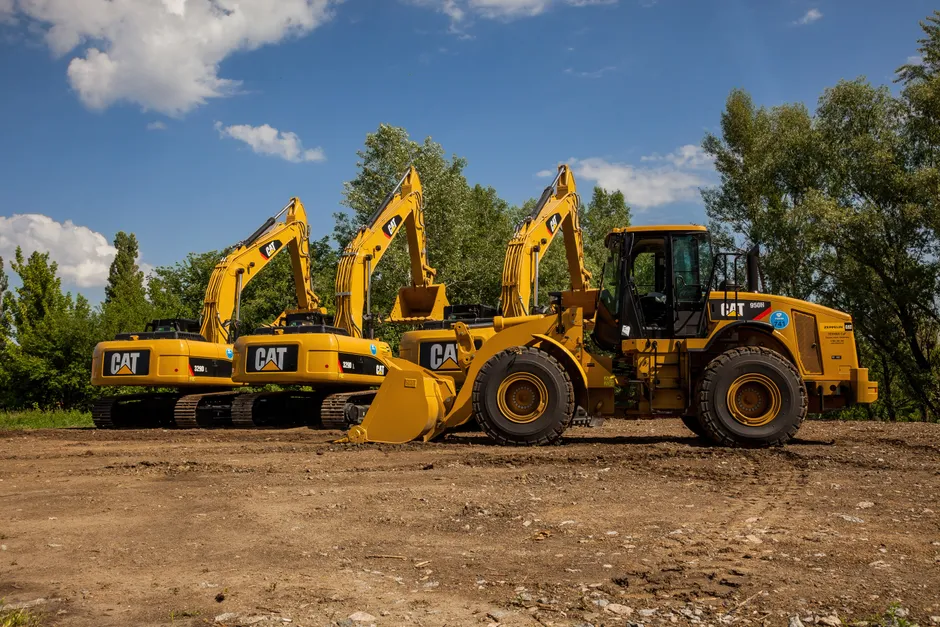
Caterpillar's share price crossed $1,000, making it one of just two constituents of the Dow Jones Industrial Average trading above that threshold, MarketWatch reported on 22 June 2026. The milestone lands as a broad industrials rally sweeps equities and as Caterpillar's own earnings narrative pivots toward AI-driven demand.
The backdrop on the index level is constructive. Wall Street closed at record highs as recently as 27 May 2026, with the Dow carried higher by healthcare and consumer stocks even as the AI-led momentum paused. The index has since extended gains, and Caterpillar — a price-weighted Dow component — carries outsized mechanical influence on the index simply by virtue of its high nominal share price.
The Earnings Foundation
Caterpillar posted 2025 full-year sales and revenues of $67.6 billion, holding its position as the world's largest manufacturer of construction and mining equipment. The trajectory through the year was uneven: Q3 2025 EPS came in at $4.88, down from $5.06 in the year-ago period, a compression that reflected softer end-market demand in parts of the construction cycle.
The Q4 print told a different story. Reuters reported on 29 January 2026 that fourth-quarter sales were lifted by surging AI-related spending — specifically demand for power generation equipment feeding data center build-outs. That pivot matters structurally: Caterpillar's large diesel and gas generator sets, turbines, and switchgear are direct infrastructure plays on the energy-intensive compute cycle. The machine that digs the mine and pours the foundation is now also the machine that backs up the hyperscaler.
The NVIDIA Collaboration
The AI angle is not purely a demand story. On 7 January 2026, Caterpillar and NVIDIA announced an expanded collaboration targeting on-board AI features and autonomous agents for heavy equipment. Two days earlier, Caterpillar had confirmed a CES 2026 keynote and live demonstrations centered on what it called the next era in industrial AI and autonomy.
The partnership frames Caterpillar not simply as a beneficiary of AI capex but as an integrator of it — embedding inference at the machine level for applications like autonomous haul trucks in open-pit mining and semi-autonomous grading on construction sites. These use cases are capital-intensive, long-cycle, and operate in environments where GPS reliability and safety margins make on-board compute meaningful rather than cosmetic. That said, the commercial scale and revenue contribution of the NVIDIA collaboration remain unquantified in public disclosures; the distinction between a strategic announcement and a material revenue line matters for valuation.
What the $1,000 Level Means — and Doesn't
The four-digit share price is arithmetically notable in the context of the Dow, which is price-weighted rather than market-cap-weighted. A $1,000 Caterpillar share moves the index roughly ten times more per dollar of price change than a $100 component. That mechanical quirk has nothing to do with the company's fundamental worth, but it does mean institutional index managers tracking the Dow watch CAT's nominal price closely.
More substantively, the $1,000 crossing reflects a re-rating of the industrial complex as a whole. The market is pricing Caterpillar not solely as a cyclical exposed to construction and mining capex — where the Q3 earnings dip was a warning sign — but increasingly as an infrastructure and energy-systems play with a technology overlay. Whether that re-rating is durable depends on whether AI-related power demand stays elevated and whether the autonomy collaboration converts from partnership press releases into recurring software and services revenue.
The gap between Q3's EPS miss and Q4's AI-lifted recovery illustrates exactly the tension an analyst has to sit with here: the core construction cycle was losing momentum even as the data-center adjacency was accelerating. Both things are true simultaneously, and the stock price at $1,000 is, among other things, a bet on which force dominates through the capital expenditure cycle ahead.