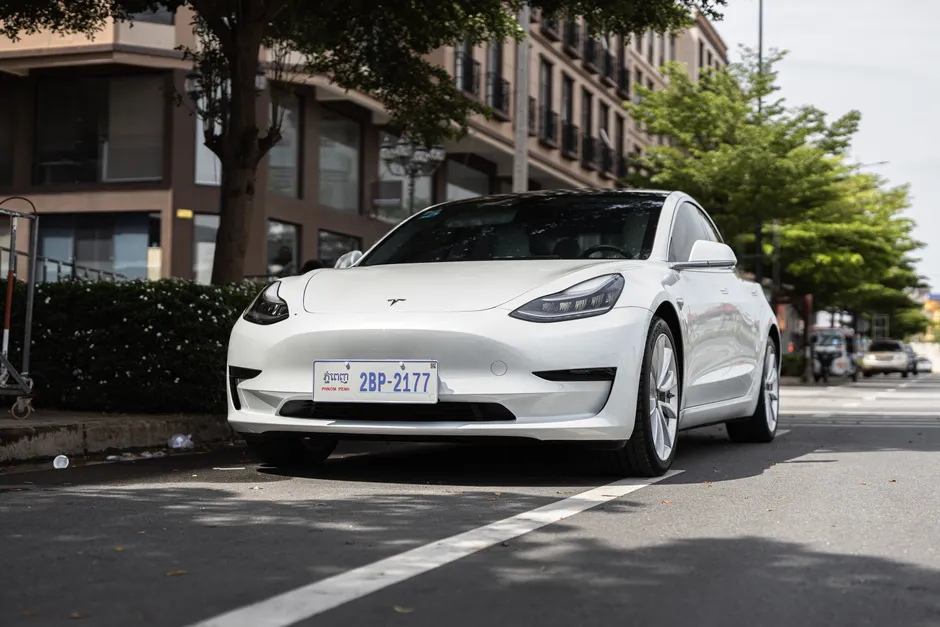
Tesla Expands Robotaxi Operations to Dallas and Houston Markets

Tesla Expands Robotaxi Operations to Dallas and Houston Markets
Tesla has launched its autonomous robotaxi service in Dallas and Houston, marking the company's first major expansion beyond its initial test markets as the electric vehicle manufacturer accelerates deployment of its Full Self-Driving (FSD) technology for commercial passenger transport.
The Texas expansion follows Tesla's gradual rollout strategy that began with limited pilot programs in select California cities. The company's robotaxi fleet will operate across designated zones in both metropolitan areas, utilizing Tesla's proprietary neural network architecture and camera-based perception system rather than the lidar-equipped approaches favored by competitors like Waymo and Cruise.
Operational Framework and Fleet Composition
Tesla's robotaxi service in Texas will deploy Model 3 and Model Y vehicles equipped with the company's Hardware 4 (HW4) compute platform, featuring the custom-designed FSD computer with dual redundant neural processing units. The vehicles rely entirely on Tesla's vision-based approach, processing input from eight surround cameras, twelve ultrasonic sensors, and forward-facing radar.
Unlike traditional ride-hailing services, Tesla's robotaxi operates without safety drivers, representing a Level 4 autonomous deployment where the system handles all driving tasks within defined operational design domains. The service integrates with Tesla's existing Supercharger network for autonomous charging, addressing one of the key operational challenges for unmanned fleet management.
The company has established remote operations centers to monitor fleet performance and provide intervention capabilities when vehicles encounter edge cases or require assistance with complex scenarios. These facilities employ trained safety operators who can assume remote control when the autonomous system requests human oversight.
Market Entry Strategy and Regulatory Positioning
Tesla's Texas expansion leverages the state's relatively permissive regulatory environment for autonomous vehicle testing and deployment. Unlike California's more stringent permit requirements and mandatory disengagement reporting, Texas allows companies to operate autonomous vehicles with fewer bureaucratic constraints, provided they meet basic safety and insurance requirements.
The company obtained necessary commercial transportation permits and established partnerships with local authorities in both cities to ensure compliance with municipal regulations. Tesla's approach contrasts with competitors who typically engage in extensive regulatory dialogue before market entry, reflecting the company's preference for rapid deployment followed by iterative improvement.
Technical Architecture and Differentiation
Tesla's robotaxi implementation represents a significant departure from industry-standard approaches. While competitors like Waymo utilize high-definition maps and precise localization systems, Tesla's solution relies on real-time perception and path planning derived from its neural network training on millions of miles of driving data collected from its consumer vehicle fleet.
The FSD Beta software powering the robotaxi service incorporates Tesla's latest advances in occupancy networks, which predict the probability of space occupation around the vehicle rather than relying on traditional object detection and classification. This approach enables the system to handle novel scenarios and edge cases without requiring pre-programmed responses.
Tesla's end-to-end neural network processes raw sensor inputs directly to steering, acceleration, and braking commands, eliminating the traditional robotics pipeline of perception, prediction, planning, and control modules. This architecture reduces system complexity but requires extensive training data and computational resources to achieve reliable performance.
Competitive Landscape and Market Dynamics
The Texas launch positions Tesla in direct competition with established robotaxi operators, though the competitive landscape remains fragmented. Waymo operates limited services in Phoenix and San Francisco, while Cruise suspended operations following safety incidents in late 2023. Amazon's Zoox continues testing in California and Nevada, but has not announced commercial deployment timelines.
Tesla's consumer vehicle production provides inherent advantages in fleet scaling and operational cost structure. The company can repurpose existing manufacturing capacity and service infrastructure for robotaxi deployment, while pure-play autonomous vehicle companies must build these capabilities from scratch.
The timing coincides with renewed investor and regulatory scrutiny of autonomous vehicle progress, particularly following high-profile incidents involving other operators. Tesla's deployment represents a significant test of vision-only autonomous systems at commercial scale, potentially validating or challenging the company's controversial decision to exclude lidar and high-definition mapping.
Economic Model and Revenue Implications
Tesla's robotaxi service operates on a ride-hailing model with pricing competitive to traditional services like Uber and Lyft. The company retains full control over fleet operations and revenue streams, contrasting with partnership approaches pursued by other manufacturers working with established ride-hailing platforms.
The autonomous operation eliminates driver compensation, potentially enabling lower consumer pricing while maintaining higher margins than human-operated alternatives. However, the service incurs costs for fleet maintenance, insurance, cleaning, and remote operations support that traditional ride-hailing companies transfer to individual drivers.
Tesla projects that successful robotaxi deployment could significantly alter the company's revenue model, shifting from one-time vehicle sales to recurring transportation services. CEO Elon Musk has previously indicated that robotaxi revenues could eventually exceed automotive manufacturing income, though such projections remain speculative pending large-scale operational validation.
Operational Challenges and Scalability Considerations
The Texas expansion tests Tesla's ability to manage autonomous fleet operations across diverse urban environments. Dallas and Houston present different challenges than Tesla's initial test markets, including varied weather conditions, traffic patterns, and road infrastructure that may stress the vision-based perception system.
Fleet management at scale introduces logistical complexity around vehicle positioning, charging coordination, and maintenance scheduling. Tesla must demonstrate that its operational systems can handle peak demand periods and geographic distribution challenges while maintaining service reliability and safety performance.
The company faces ongoing scrutiny regarding FSD safety performance, with federal regulators continuing to investigate incidents involving Tesla's autonomous features. The robotaxi deployment provides real-world validation of the system's capabilities while potentially exposing the company to additional liability and regulatory oversight.
Strategic Implications and Industry Impact
Tesla's robotaxi expansion represents a critical inflection point for both the company and the broader autonomous vehicle industry. Success could validate vision-only approaches and accelerate Tesla's transition from automotive manufacturer to mobility service provider. Failure could undermine confidence in the company's FSD technology and autonomous vehicle timeline projections.
The deployment also tests consumer acceptance of fully autonomous transportation services, particularly in markets without prior exposure to such offerings. User adoption rates and safety performance in Texas will likely influence regulatory attitudes and competitive strategies across the industry.
For Tesla shareholders and industry observers, the Texas launch provides concrete data on the commercial viability of autonomous vehicle technology after years of development investment and regulatory preparation. The results will inform broader industry deployment strategies and timeline expectations for autonomous transportation adoption.