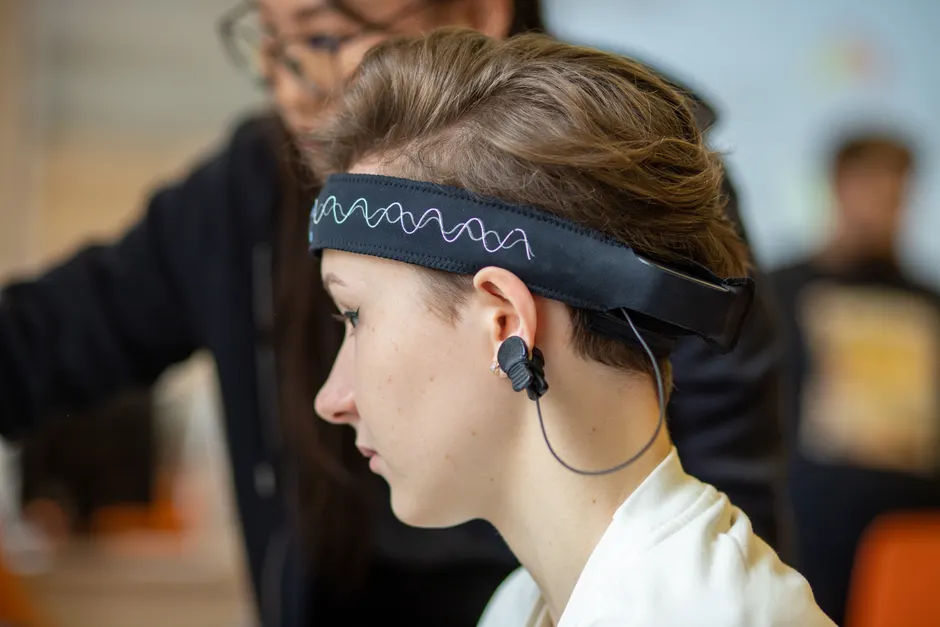
Columbia Engineers Identify the Neural Circuit Linking Cognition to Visual Perception

Columbia Engineering published research on July 2, 2026, identifying a specific neural circuit that connects higher-order cognitive processes to visual perception — the mechanism by which what a person thinks actively shapes what their eyes, or more precisely their visual cortex, register as seen. The work is cross-posted on the Columbia Biomedical Engineering department site, and Assistant Professor Nuttida Rungratsameetaweemana is connected to the research.
The broader question this work addresses is one neuroscience has circled for decades: how do top-down cognitive signals — attention, expectation, memory — modulate the ostensibly bottom-up stream of sensory input arriving from the retina? The visual system is not a passive camera feeding raw pixel data upward through V1 and into higher cortical areas. Feedback projections outnumber feedforward ones in the visual hierarchy, a structural asymmetry that has long implied the brain is doing far more active prediction and filtering than a naive read of the anatomy suggests. Pinning down a specific circuit responsible for that modulation is considerably harder than observing the general phenomenon.
Columbia's earlier related work, published in April 2025 under the title "How Thoughts Influence What the Eyes See", appears to have laid conceptual groundwork for this latest finding. The July 2026 piece, "The Circuit that Lets Your Brain Think and See", is featured on the Columbia Engineering homepage, indicating the institution considers it a flagship result rather than incremental output.
For those working in neural engineering, computational neuroscience, or brain-computer interfaces, the significance of characterizing this circuit lies in its potential translational reach. If the pathway through which cognition biases visual processing can be specified at a circuit level — meaning discrete neuronal populations, projection targets, and the likely neurotransmitter dynamics involved — it becomes a tractable target. That matters for at least three areas: neuroprosthetics that aim to restore or augment visual function, psychiatric conditions where perceptual distortions track with altered top-down signaling (schizophrenia and certain anxiety disorders are the canonical examples), and the design of more biologically plausible artificial vision systems.
The AI angle here is not superficial. Convolutional architectures — the workhorses of modern computer vision — are predominantly feedforward. The field has spent years bolting on attention mechanisms and recurrent connections to approximate what the biological visual system does natively, with partial success. A well-characterized biological circuit that implements cognitive modulation of perception is, in principle, a blueprint worth examining. Whether that translates into architecturally useful priors is a question for researchers closer to the implementation, but the existence of the circuit as a discrete, identifiable structure is a more useful starting point than the prior state of "we know feedback exists."
Worth noting is the institutional framing. Columbia BME's official Instagram account amplified the July 2 publication the same day, and the work sits at the intersection of the engineering school and the biomedical engineering department — a joint positioning that reflects the increasing pressure on neuroscience to produce engineerable outputs rather than purely descriptive ones. Rungratsameetaweemana's lab appears to operate squarely in that translational space.
The verified facts available at this stage — publication date, institutional affiliation, the connected researcher, and the thematic link to the April 2025 predecessor piece — do not yet include the specific circuit anatomy, the experimental model used, or the methodology. Those details, once available from the primary paper, will determine how broadly the findings can be interpreted. A circuit identified in a rodent model using optogenetic dissection carries different implications from one mapped in human participants via high-density electrocorticography, for instance.
What is clear is that Columbia has been building toward this result systematically, with at least one prior publication establishing the phenomenology before the circuit-level paper landed. That sequencing — behavioral or observational finding followed by mechanistic identification — is standard practice in systems neuroscience, and it suggests the July 2026 result is not a standalone claim but the product of a sustained research program. The fuller picture of what that circuit does, and what can be done with the knowledge, will depend on the primary literature.