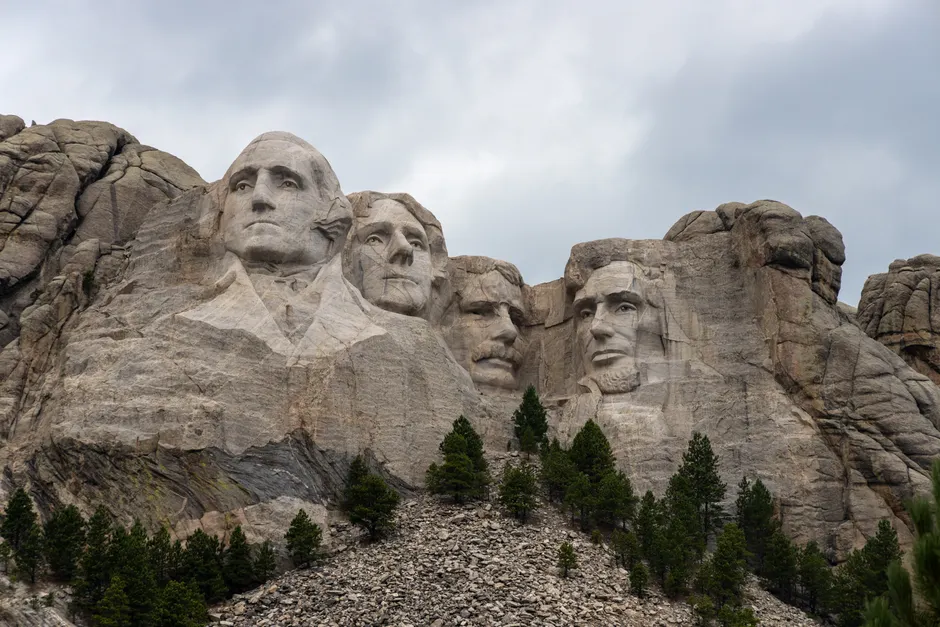
Trump Opens America's 250th Birthday Weekend at Mount Rushmore with Anti-Communist Broadside

President Donald Trump delivered a 30-minute address at Mount Rushmore on the evening of July 3, 2026, launching America's semiquincentennial weekend with rhetoric that drew a sharp ideological line four months before the November midterms. The crowd chanted "USA! USA!" as F-16s swept overhead — a tableau the White House had been planning since a January 2025 presidential action formally inaugurated the 250th anniversary program.
Trump praised each of the four presidents carved into the granite behind him — Washington, Jefferson, Theodore Roosevelt, and Lincoln — and lauded the US Army. But the rhetorical center of gravity was not commemoration. "There is now a resurgence of the communist menace in our land," Trump told the crowd, per a full transcript published by Roll Call's Factbase. He went further, framing communism as a graver threat to American liberty than World War I, World War II, and the September 11 attacks combined. "Communism is the exact opposite of life, liberty and the pursuit of happiness," he said. "It's death, tyranny and the pursuit of evil."
Trump knotted that anti-communist framing to immigration, referencing "newcomers to our country who embrace ideas totally opposed to our way of life" and telling an overwhelmingly white crowd, "We are going to give our country its identity back." The pairing of ideological and demographic threat — both attributed to the same unnamed adversary — was consistent with language Trump has used since his first term, but the Mount Rushmore setting, chosen for its iconographic weight, sharpened the contrast he was drawing.
The political backdrop
The speech did not occur in an ideological vacuum. Hours earlier, Zohran Mamdani, New York City's mayor and a self-described democratic socialist, delivered a pro-immigrant address that The Guardian described as widely read as a direct rebuke of Trump. The counterprogramming was hard to miss: two politicians, on the same national holiday, offering antithetical answers to the question of what America at 250 means.
Mamdani's address came against a broader electoral current. In the week before the July 4th weekend, four progressive candidates — including three democratic socialists — won Democratic primaries in New York and Colorado. Progressive candidates have also claimed victories in Kentucky, New Jersey, Ohio, Pennsylvania, and Texas ahead of the midterms. The left flank of the Democratic Party, long treated as a liability by party strategists, has been demonstrating primary-election muscle across geographies that stretch well beyond its coastal strongholds.
Trump's decision to cast that movement as a "communist menace" and frame its adherents as "the enemy of July 4th 1776" is, at its core, a midterm framing exercise. With the House and Senate maps competitive, the White House is betting that a culture-war valence — communism versus Americanism — can consolidate the Republican base and peel off persuadable voters who may be queasy about the socialist label, even if they support some of the underlying policies. The 250th anniversary provides a ready-made patriotic stage that no challenger can book on the same night.
The immigration thread in Trump's speech is similarly strategic. The administration's enforcement posture has been a defining second-term issue, and tying it to a philosophical — rather than purely logistical — argument about who belongs in America shifts the debate from operational questions (deportation rates, court backlogs) to identity ones, where polling has historically been more favorable to restrictionist positions.
Worth noting separately: Trump has never publicly ruled out having his own likeness added to Mount Rushmore. His choice of venue on the nation's 250th birthday, with a transcript entered into the public record, ensures that the symbolic association is documented whether or not the idea ever advances.
The fireworks and the flyovers will dominate the weekend's imagery. The political architecture beneath them — a president using a constitutionally neutral holiday to define the coming election as a civilizational choice — is what practitioners of this craft will be tracking through November.