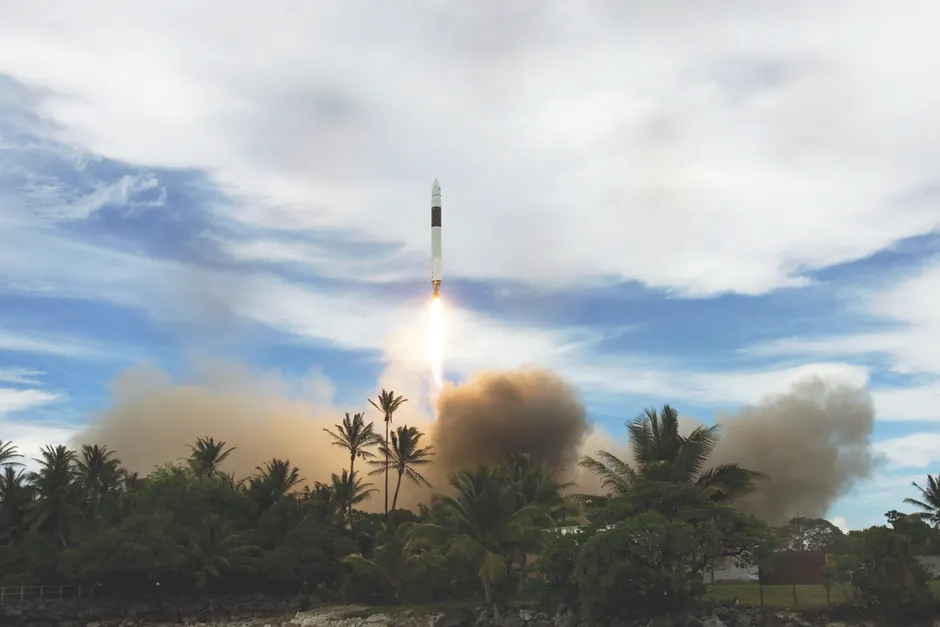
China Lands Long March 10B Booster at Sea, Advancing Reusable Rocket Race

China recovered the first stage of a Long March 10B carrier rocket at sea off Hainan on July 10, 2026, catching the booster in a net attached to a floating platform during the vehicle's maiden flight China Global Television Network. Bloomberg described it as China's first successful sea landing of an orbital-class reusable booster Bloomberg. Reuters, citing state media, characterized the retrieval hardware as an experimental system Reuters.
The mechanics matter for anyone pricing launch-services capacity. Rather than a propulsive tail-first landing on a drone ship deck — the SpaceX approach — the Long March 10B stage was caught in a net rigged to a sea platform, a passive-capture method that trades guidance precision for structural simplicity on the recovery hardware side. State broadcasters framed the flight as the booster's debut mission, meaning the net catch was validated on the very first attempt rather than after a series of expendable shakedown flights.
Context here is that this was not China's first attempt at reusability. Beijing's first orbital rocket recovery attempt came in December 2025, according to SpaceNews reporting published at the end of that year, which also disclosed plans to debut a Long March 10-derived reusable vehicle in the first half of 2026 SpaceNews. The July 10 flight lands inside that window, on the later end of it. CASC, the state contractor behind the Long March family, had signaled as early as March 2024 that it intended test flights of two large-diameter reusable rockets across 2025 and 2026 SpaceNews, so the timeline has held up reasonably well against a two-year-old public roadmap — worth noting given how often aerospace schedules slip.
The Long March 10 architecture is doing double duty. Beyond commercial and national-security payload lift, it is tied to China's crewed lunar ambitions: a Mengzhou spacecraft in-flight abort test was conducted in February 2026 as part of preparations to land astronauts on the Moon before 2030 SpaceNews, and China had already unveiled a dedicated recovery ship for the program by December 2025 SpaceNews. A reusable heavy-lift stage that also serves crewed lunar architecture changes the unit-economics calculus differently than a purely commercial reusable rocket would, since the government demand floor is effectively guaranteed regardless of commercial launch pricing.
State-owned CASC is not the only Chinese entity chasing sea recovery. LandSpace's privately developed Zhuque-3 has already reached orbit but failed a recovery or landing attempt on a prior flight, per SpaceNews reporting from late May 2026 SpaceNews. The company said in December 2025 it hoped to complete a booster recovery by mid-2026 Reuters, and by late February 2026 it was already planning a follow-up recovery test for later in the year, with the Zhuque-3 first stage fitted with a reaction control system to manage attitude during descent Macau Business. LandSpace has also said it intends to refurbish and refly a successfully recovered Zhuque-3 first stage on a subsequent launch People's Daily — the step that actually converts a recovery demonstration into a cost reduction, since a booster that is caught but scrapped delivers reputational value without the economics.
A third program, Hyperbola-3 from iSpace, has taken a more conservative path toward the same goal: its sea-recovery landing system completed full-profile ground verification, including a full-scale drop and shock test, according to SpaceNews's late-May 2026 roundup SpaceNews. Ground-testing the shock loads before flying them is the more conventional sequencing and suggests iSpace is still some distance from its own maiden recovery attempt.
For markets, the relevant question is less whether China can catch a booster once and more whether it can do so repeatedly, cheaply, and with turnaround times that undercut expendable pricing. A single successful net catch on a maiden flight is a milestone in flight-test terms, but SpaceX's own Falcon 9 program took years and multiple failed landing attempts before recovery became routine and refurbishment costs fell enough to move launch pricing. Nothing in the current disclosures quantifies refurbishment cost, turnaround time, or how many flights the recovered Long March 10B stage is rated for — the figures that would actually let anyone in launch procurement or satellite-insurance underwriting reprice risk. Until CASC, LandSpace, or iSpace publish reuse cadence and cost data, the July 10 recovery is best read as a capability proof point for a competitive field, not yet a pricing signal for the launch market.