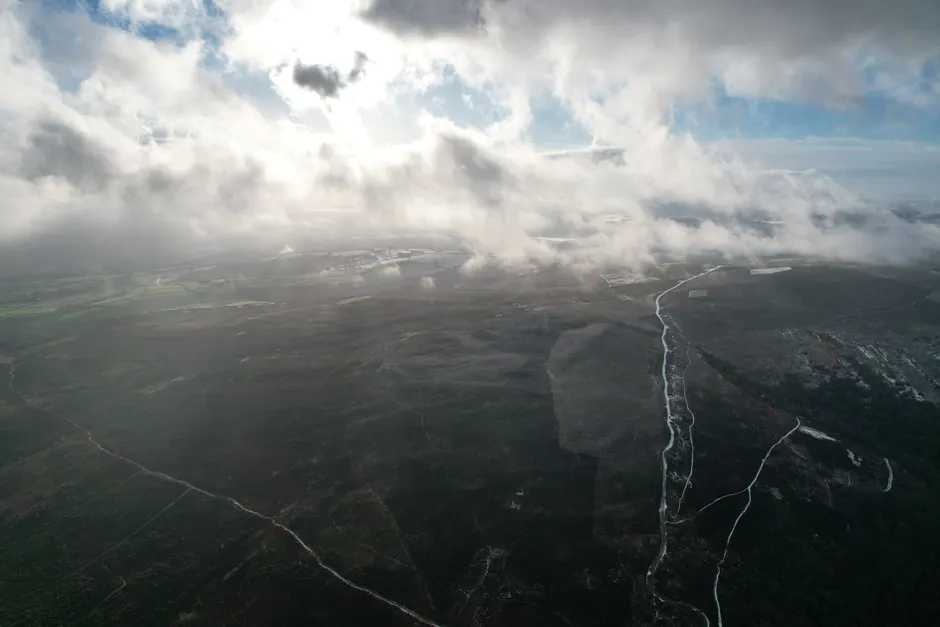
Police Scotland Declares Major Incident as Cairngorms Wildfire Burns Across Multiple Days

Police Scotland declared a major incident on 15 July 2026 in response to a wildfire near Nethy Bridge in the Cairngorms, triggering a multi-agency emergency response that has now spanned more than a week of active firefighting operations across the national park.
The initial declaration, published by Police Scotland, confirmed that emergency services were responding to a wildfire in the Cairngorms area near the village of Nethy Bridge. A "major incident" designation under UK emergency-management protocols signals that an event's scale, complexity, or potential consequences require coordinated command and control across multiple responding agencies, typically authorising enhanced resource deployment and inter-agency liaison beyond standard operational thresholds.
Over the course of the fire, more than 500 firefighters were mobilised cumulatively, according to Traffic Scotland and Fire Scotland's social media updates. That figure represents the aggregate personnel committed across the full duration of the incident, not a concurrent deployment at any single point in time.
The BBC reported on 24 July that the major incident declaration was linked to a wind change that increased wildfire risk in the area, a meteorological shift that complicated containment efforts and elevated the threat to surrounding communities. The BBC's coverage, published the same day, framed the wind shift as the proximate trigger for escalating the response posture.
The fire's trajectory across the following days proved dynamic. BBC News reported on 16 July on early response and containment efforts. By 21 July, the BBC was documenting significant hot spots still active within the fire perimeter. A flare-up on 23 July prompted further coverage, indicating that containment had not been stabilised. By 24 July, BBC reporting noted that smoke from the Cairngorms blaze had traveled as far as Aberdeen, roughly 90 kilometres northeast of the fire zone, underscoring the atmospheric reach of a large-scale upland fire.
The chronology matters for understanding the operational picture. The fire ignited on Wednesday, 15 July, according to Fire Scotland's public updates. The major incident declaration followed on the same day. The subsequent arc of the response, as documented across the BBC's successive articles, tracked the classic phases of a complex wildfire: initial attack, perimeter stabilisation attempts, hotspot persistence, and secondary ignition events driven by shifting weather conditions.
For context, the Cairngorms National Park is the largest national park in the United Kingdom, encompassing approximately 4,528 square kilometres of Highland landscape. Its terrain includes extensive heather moorland, Scots pine forest remnants of the Caledonian Forest, and peat deposits that, when ignited, can sustain deep-seated smouldering combustion long after surface flames are suppressed. These ecological features make wildfires in the region particularly challenging to manage; peat fires can burn subsurface for extended periods, resist direct attack, and reignite surface fuels when conditions shift.
The operational scale is notable. A cumulative mobilisation exceeding 500 firefighters places this incident among the more resource-intensive wildfire responses recorded in Scotland in recent years. The SFRS operates with a total establishment of roughly 3,800 wholetime and retained personnel, meaning a deployment of this magnitude, even phased over time, would have drawn heavily on stations well beyond the immediate Highlands operational area, likely requiring mutual-aid arrangements and relief crew rotations to sustain frontline capacity.
Smoke transport to Aberdeen also carries implications beyond the immediate fire zone. Particulate dispersal at that distance suggests a significant plume height, consistent with intense combustion in fuel-heavy moorland and the kind of convective column development that can complicate aerial suppression tactics by reducing visibility and creating localised downdrafts.
The broader context here is the increasing frequency of large wildfires in the UK's upland regions during sustained dry and hot periods. Scotland's fire season, traditionally concentrated in spring, has shown signs of extending into mid-summer months. Heather-dominated moorland, particularly when unmanaged or following dry spells, provides fine fuel loads that support rapid fire spread under wind-driven conditions. The wind change cited by the BBC as escalating risk is consistent with the operational challenge of frontal-system transitions, which can shift fire direction unpredictably and place previously unaffected flanks under active threat.
As of the most recent reporting on 24–25 July, the fire remained an active incident with containment efforts ongoing. The multi-day timeline, the sustained commitment of personnel, and the atmospheric reach of the smoke plume together point to a wildfire event of substantial operational complexity, one that tested Scotland's multi-agency emergency-response architecture across an extended engagement window.