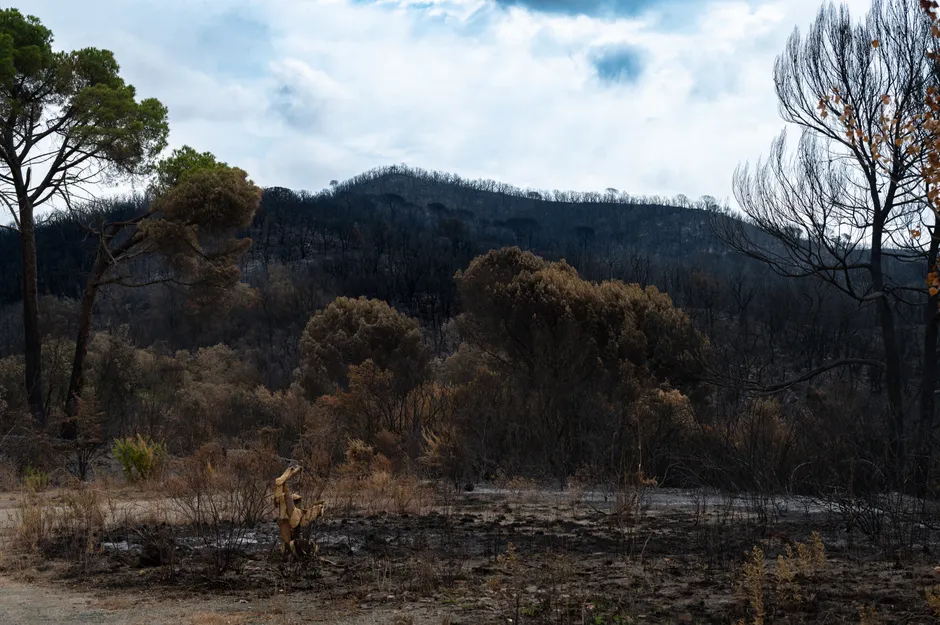
Gironde's Saumos Fire Stabilized After Burning 42,000 Hectares and Driving 220,000 From Their Homes

As of July 28, 2026, the Saumos fire in Gironde remained stabilized following a calm night, after having burned an estimated 42,000 hectares and necessitating the evacuation of nearly 220,000 people across 23 communes. The fire, which prompted French President Emmanuel Macron to convene a crisis meeting of the Cabinet on July 27, has tested state capacity and threatened the Bordeaux wine-growing region.
The escalation began earlier in the month. Gironde was placed on orange alert for forest fires on July 7, 2026, and elevated to red alert on July 21, 2026. As of July 25, the fire had consumed 32,700 hectares and driven 167,000 evacuations, according to TF1 Info. A violent flare-up on the evening of July 26 accelerated the fire's advance toward Bordeaux, leading to an additional 55,000 evacuations that day and pushing the total displaced population in the Bordeaux region past 220,000, according to local officials cited by The New York Times. Sensitive sites within the Bordeaux agglomeration were placed under high surveillance as the blaze approached.
The response has been substantial. As of July 27, 2,750 firefighters, 1,500 military personnel, and 18 aerial assets were deployed against the Saumos fire. Firefighters battled the wildfire throughout the night of July 26-27 to slow its progress toward the city. The previous day, 500 firefighters and 300 gendarmes had been mobilized for fires across Gironde and the neighboring Landes department.
The human cost became apparent on July 23, when two firefighters died during a forest fire intervention in Gironde. The initial response where the deaths occurred involved 120 personnel, 60 vehicles, and 3 aerial assets. The broader emergency has also strained medical infrastructure. On July 26, the hospital emergency plan, known as "plan blanc," was triggered due to the fires in Gironde and Landes. Air quality was degraded and transport was disrupted in the affected departments.
The economic stakes extend into the agricultural sector. Le Point reported that thick smoke from the Gironde fire could pose a risk to future wines by affecting the vines. French workers built firebreaks between the towns of Marcheprime and Blagon to prevent wildfires from reaching the Bordeaux wine-growing region directly. Max Saltman, a Bordeaux wine expert, stated on July 25 that the 2026 vintage was "safe for now." Le Monde described the fire on July 27 as an "economic thunderbolt" justifying state mobilization.
As of July 27, the fire situation in Gironde was described as "very unpredictable" ("très imprévisible"). While the fire remained stabilized after a calm night on July 28, authorities had not yet authorized the return of evacuees.
The broader context here is a test of state crisis management under compounding environmental and economic pressures. The sequential escalation from orange to red alert, followed by the massive deployment of firefighters and military personnel, illustrates the resource strain that large-scale wildfires impose on regional governance. The deployment of 1,500 military personnel alongside civil firefighters indicates a shift toward securitized disaster response, a posture reinforced by the Cabinet's crisis meeting.
The threat to the Bordeaux wine region introduces a specific economic dimension. The construction of firebreaks between Marcheprime and Blagon shows a targeted effort to protect a high-value agricultural sector. The concern over smoke taint affecting the vines, as reported by Le Point, adds a layer of risk that could persist even if the flames are held at bay. Le Monde's characterization of the fire as an "economic thunderbolt" underscores the potential long-term commercial consequences for a region heavily dependent on viticulture. The stabilization of the fire on July 28 offers a tactical pause, but the unpredictability cited by authorities suggests the situation remains contingent on weather conditions.