Gironde Wildfire Stabilized but Not Fixed as 220,000 Evacuees Await Return
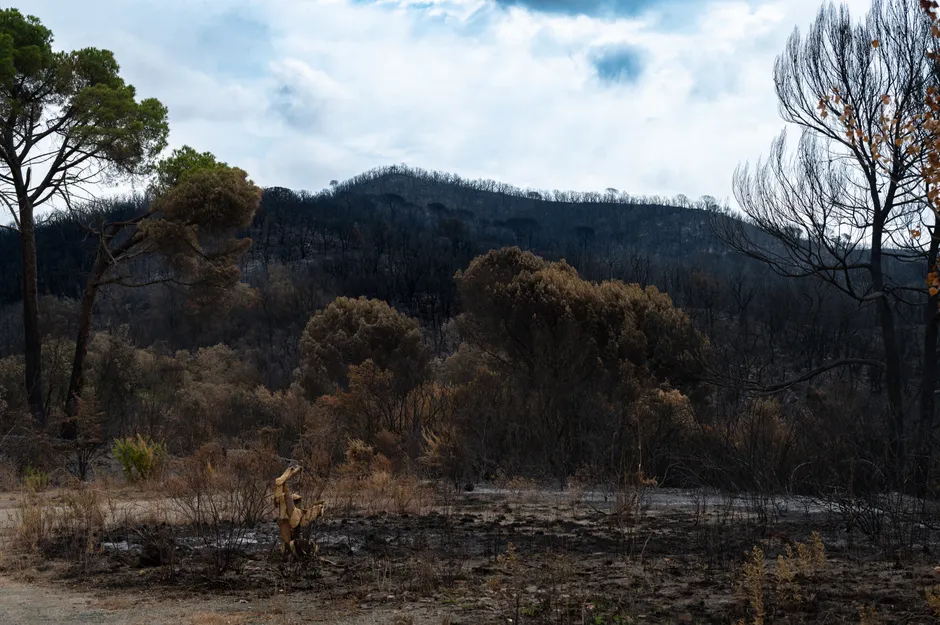
The Saumos wildfire in Gironde, southwestern France, burned an estimated 42,000 hectares as of July 27, 2026, and was described as "stable" on July 28 after a calm night, though local authorities caution the blaze is "not yet fixed" and no return of evacuees is possible until it is. Nearly 220,000 people have been preventively evacuated across 23 communes, making this one of the largest peacetime evacuations in modern French history. French authorities began ordering evacuations on July 22, with an additional 55,000 people displaced overnight as the fire advanced, according to Associated Press reporting cited by ABC News. The Préfecture de la Gironde had elevated the department to red alert (vigilance ROUGE) for wildfire risk on July 21.
The fire experienced a violent resurgence on the evening of July 26, reversing earlier progress. By that point, the operational footprint was substantial: 2,500 firefighters (sapeurs), 1,500 military personnel, and 18 aerial assets (moyens aériens) were deployed, according to the prefecture's July 26 situation update. By July 27, 500 firefighters and 300 gendarmes remained mobilized, a drawdown reflecting the partial stabilization even as the fire continued to defy full containment. France's interior minister characterized the blaze as "stabilized" but not yet contained, an important distinction in wildfire terminology: stabilization means forward spread has slowed or halted in key sectors, while containment requires a complete control line around the fire's perimeter.
Smoke from the wildfires covered the Bordeaux skyline on July 26, and air quality across Gironde and the neighboring Landes department was degraded. Transport networks were disrupted in both departments. The "plan blanc" hospital emergency protocol was triggered in Gironde on July 26, enabling health facilities to surge capacity, cancel non-urgent procedures, and redeploy staff. Sensitive sites on the Bordeaux agglomeration were placed under high surveillance on July 27 as the advancing fire perimeter brought the urban edge into play.
Firefighters constructed firebreaks between the towns of Marcheprime and Blagon to halt the wildfire's advance toward the metropolitan area, Reuters reported. The fire also encroached into wine-growing areas, threatening vineyards in a region where viticulture is both an economic anchor and a cultural touchstone. The Gironde and Landes departments together account for a significant share of France's forest cover, and the dual-department footprint of these fires underscores the transboundary nature of the crisis.
The return of hot weather on July 28 raised fears of a new aggravation, according to Sud Ouest. Fire behavior in pine-dominated Landes-Gironde forests is highly sensitive to wind shifts and temperature spikes: the same stands that burned in the 2022 Landiras fires demonstrated how seemingly stabilized perimeters can reactivate under renewed heat and low humidity. The current fire's violent resurgence on July 26 is a case in point.
The operational and political dimensions here are intertwined. The deployment of 1,500 military personnel alongside civil firefighting forces signals the scale at which national-level assets were committed. The preventive evacuation of 220,000 people across 23 communes reflects a doctrine that prioritizes civilian protection over property defense, a posture France has refined since the 2003 and 2022 fire seasons. The trade-off is enormous displacement: tens of thousands remain in temporary shelter, and authorities have been explicit that return is contingent on the fire being "fixed," a term denoting a perimeter where no active flame remains and no reactivation is expected under forecast conditions.
What comes next depends on meteorology and fuel moisture. If the returning heat wave persists without significant rainfall, the stabilization achieved overnight could unravel. The red alert issued July 21 remains in effect, and the "plan blanc" activation suggests authorities are preparing for health impacts beyond fire itself, including smoke inhalation and heat-related casualties among the displaced population.


