Western Europe Just Had Its Hottest Summer Ever. Here's What That Means.

Western Europe just went through its hottest June and July on record. The average temperature across those two months hit 21.62°C (70.9°F), which is 2.79°C warmer than what used to be normal for this period, beating the previous record set in 2022, according to the Copernicus Climate Change Service (C3S) Al Jazeera. July 2026 was the third month in a row of extreme heat in the region, according to Samantha Burgess, strategic lead for climate at the European Centre for Medium-Range Weather Forecasts (ECMWF).
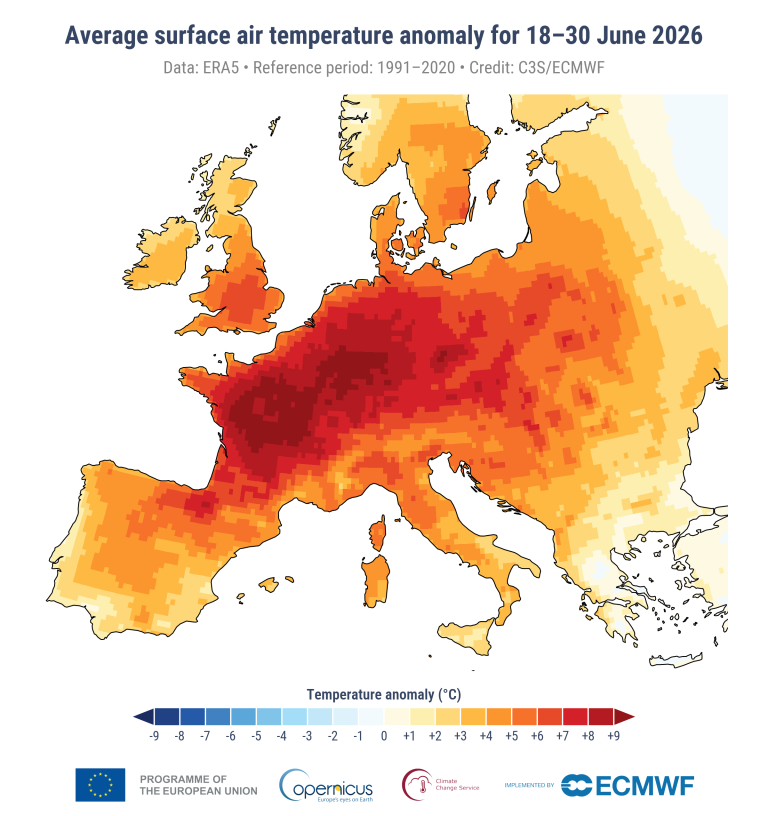
The heat actually started before summer. Western Europe had an unusually early and intense heatwave in the second half of May 2026, mostly between 21 and 30 May. During that stretch, daily average temperatures across western France, England, and Wales were more than 10°C above what would normally be expected for that time of year, according to ERA5 reanalysis data cited by C3S Copernicus Climate Bulletin. May 2026 was the world's second-hottest May on record, behind only May 2024. Global temperatures were 1.42°C above pre-industrial levels — the baseline scientists use to compare against the era before human-caused warming began Reuters. June 2026 was the hottest June on record for western Europe, at 1.39°C above the estimated 1850–1900 average, and the second warmest June globally Copernicus.
C3S said the main cause was persistent high-pressure systems. Think of these as giant invisible lids of warm air that sit over a region and trap heat underneath, blocking cooler weather from moving through. Dry soil made the problem worse. Normally, moisture in the ground and in plants evaporates into the air, and that process has a cooling effect, similar to how sweating cools your skin. When soil dries out, that natural cooling fades away and temperatures climb even higher. C3S reported that soil moisture in Western Europe in 2026 was significantly lower than in July 2022, when the last major drought hit the region Al Jazeera. This cycle of heat drying out the land, and dry land making the heat worse, is well known in climate science, and its effects this summer were severe.
River flows fell to extremely low levels across the dry parts of Europe in July 2026, with impacts across many sectors, C3S reported Copernicus Climate Bulletin. The Seine, Rhine, and Danube all had exceptionally low water levels, affecting water supplies and irrigation. The problems even reached power generation: Hungary and Slovenia had to run their only nuclear power plants at reduced capacity because nuclear plants need river water to cool themselves, and regulations require them to scale back when river water is already warm and low.
France and Spain had record drought levels in 2026, which led to devastating wildfires. In southwestern France's Gironde department, a massive fire burned nearly 42,000 hectares (103,785 acres) and forced more than 220,000 people to evacuate in late July. Spain's largest wildfire in recent history scorched almost 44,000 hectares (108,725 acres) in Avila province near Madrid Al Jazeera.
The rest of the world was also feeling the heat. July 2026 was the joint-second warmest July globally, tied with July 2024 Copernicus Climate Bulletins. C3S reported the highest sea surface temperatures on record outside the polar regions for July 2026, with an average of 20.96°C (69.7°F), slightly above the previous record of 20.89°C set in 2023. The agency partly blamed this on developing El Niño conditions — a natural warming of Pacific Ocean waters near the equator that shifts weather patterns around the world — and noted record-breaking ocean surface temperatures in the tropical Pacific during the early European heatwave period Copernicus.
Polar ice also reflected the warming trend. Arctic sea ice extent in July 2026 ranked sixth lowest for the month, with particularly low cover in the northern Barents Sea around Svalbard and Franz Josef Land. Antarctic sea ice extent ranked fifth lowest for July, with below-average cover in most areas except the Amundsen Sea Copernicus Climate Bulletins.
Drier-than-average conditions in July 2026 were not limited to Europe. Parts of northern Canada, the central United States, the Maghreb, the Horn of Africa, Siberia, south-central Asia, inner China, Argentina, Uruguay, and Bolivia also had below-average rainfall, according to C3S Copernicus Climate Bulletins.
The broader context here is that regional and global climate signals all converged into one summer. Western Europe's record heat fits a global pattern that has now produced the second-warmest May, the second-warmest June, and the joint-second-warmest July of 2026, each just below earlier records from 2023 and 2024. The developing El Niño in the Pacific, record ocean temperatures outside the polar regions, and low polar sea ice all suggest a climate system running at or near its historical limits across several measures at the same time.
For European policymakers and the people who run infrastructure, the impacts this summer carry real lessons. When Hungary and Slovenia had to cut nuclear power output, it showed how a lack of water can become an energy problem. Low water levels on the Rhine and Danube disrupted shipping and farm irrigation at the same time. The megafire in Gironde forced the evacuation of more people than live in many European cities, stretching emergency response systems while Spain's fire in Avila was burning at the same time. The fact that soil moisture was even lower than during the 2022 drought suggests these conditions are not just repeating but getting worse, leaving less recovery time between one extreme event and the next.