Europe Is Burning Through Its Hottest Summer Yet — Here's Why It Matters

Record heat and wildfires are devastating Europe this summer, with scientists warning that the climate crisis is speeding up rather than leveling off, according to a New York Times report published July 29, 2026 (NYT).
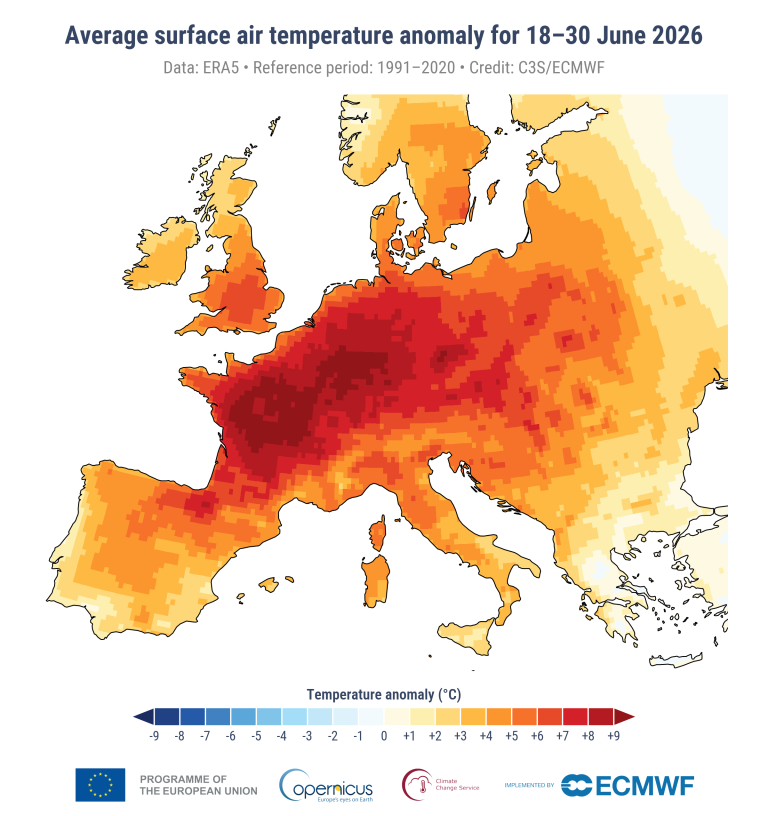
The numbers behind that warning have been building for months. In June 2026, the average temperature over European land reached 19.14°C, which was 1.78°C above the 1991–2020 period that scientists use as a reference point for what temperatures used to be (Copernicus). June 2026 was the second-warmest June on record for European land temperatures and the second-warmest June for the whole planet, according to the World Meteorological Organization (WMO). For western Europe, it was the hottest June ever recorded (WMO).
The trouble did not start in June. Western Europe went through an unusually early and intense heatwave in the second half of May 2026, mostly between May 21 and 30, according to Copernicus monitoring (Copernicus). That heat carried into June, when another intense heatwave swept across much of the continent and set new monthly temperature records in the west (Copernicus).
Western Europe's June heat was made worse by the highest ocean surface temperatures ever recorded for that time of year, the WMO reported (WMO). Normally, the ocean helps cool coastal Europe by sending cool, moist air inland. But when the ocean itself is unusually warm, that natural cooling effect weakens, and heat over the land builds up faster.
Another factor may be making things worse. In June 2026, the WMO said there was an 80% chance that an El Niño event would develop between June and August 2026 (WMO). El Niño is a natural warming of waters in the central and eastern Pacific Ocean that happens every few years and tends to bump up global temperatures for a period on top of the long-term warming caused by human activity. Reuters reported that the WMO warned the combination of climate change and El Niño could make 2027 the hottest year since records began (Reuters.
The broader context here matters. The pattern we are seeing — an early heatwave in May, record June temperatures, and widespread wildfires in July — is exactly what scientists who study the link between climate change and specific weather events have been predicting for years. As overall temperatures rise from greenhouse gases in the atmosphere, extreme heat events become more frequent, more intense, and start earlier in the season. What is striking about the current situation is that several things are happening at the same time: unusual land heat, record-warm oceans, and the likely arrival of El Niño. When these forces stack up together, there is less time between disasters for nature, infrastructure, and emergency teams to recover.
The WMO's 80% El Niño probability also points to something beyond this summer. If El Niño develops and lasts, its biggest impact on global temperatures usually shows up the year after it begins, which fits the WMO's warning that 2027 could set a new global record. For governments and international organizations, that means the current crisis is probably not a rare event. It is more likely a sign of what the new normal looks like. Planning based on past climate conditions — including the 1991–2020 reference period that June 2026 already exceeded by 1.78°C — will keep underestimating how bad and how frequent these overlapping disasters will be. Emergency response systems, farming, and power grids all face challenges that current infrastructure may not be built to handle.
The NYT report describes the situation as a breaking point. The data from Copernicus and the WMO, published separately and covering different time periods, backs up that view with hard numbers. What is not yet clear is whether governments across Europe will respond at the speed and scale the science is pointing to, or whether they will fall further behind.