Russia Strikes a Nuclear Site Near Chornobyl. Here's Why It Matters

A Drone Hits Nuclear Storage, Leaders Meet
On the morning of June 7, 2026, at around 2am, a Russian Shahed drone struck a reception building at a spent nuclear fuel storage facility about 15 kilometers from the Chornobyl power plant in Ukraine. The Guardian reported that the building was empty of fuel containers at the time and that radiation levels nearby remained normal. The International Atomic Energy Agency was informed by Ukrainian authorities and noted that large amounts of nuclear material are stored at the broader site.
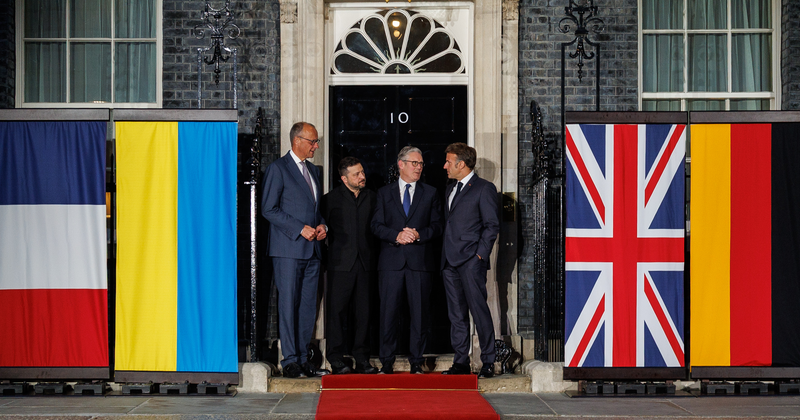
Hours later, Ukrainian President Volodymyr Zelenskyy sat down with the British Prime Minister, French President, and German Chancellor — leaders of Europe's three largest economies. They had scheduled this meeting before the drone strike, but the attack now shaped everything they discussed. UK Government
What This Strike Actually Targeted
To understand what happened, you need to know what's at Chornobyl.
The site holds spent nuclear fuel — material that has already been used in reactors and removed. It's stored in dry casks, which are metal containers designed to hold the material safely. Unlike an active reactor running at full power, spent fuel won't cause an explosion if hit. A breach could scatter radioactive dust into the air, but it can't trigger a nuclear detonation.
The building that was hit was a reception and intake facility — essentially a logistics hub where fuel containers are processed when they arrive. It wasn't a storage vault. Ukrainian authorities confirmed that no radiation spike was detected after the strike.
The fact that the International Atomic Energy Agency publicly noted the large volume of nuclear material at the site reflects standard practice: they keep detailed records of what's where during wartime, so if something goes wrong, the world knows what happened. The IAEA doesn't typically dramatize these statements. When it flags nuclear material near a strike, it's documenting the situation.
Whether Russia deliberately aimed for the reception building to send a message without causing a radiation disaster, or simply didn't hit its intended target, isn't clear from public information. Russia hasn't publicly commented on the strike.
Russia's Escalating Weapons
The Chornobyl strike wasn't Russia's only recent move. In late May, Russia launched a major attack on Kyiv with missiles and drones that included use of a weapon called the Oreshnik. Reuters reported on May 24 that Russia announced it had deployed this missile.
The Oreshnik is a long-range missile that flies at extremely high speed — fast enough, according to Russian claims, to outpace current Ukrainian air defenses. Russia fired it as part of a layered attack: many Shahed drones, conventional cruise missiles, and these hypersonic missiles all launched together. The strategy is to overwhelm Ukraine's defenses with volume and different types of weapons traveling on different paths.
This pattern matters beyond the immediate damage. Russia faces a problem: Ukraine has Western military support that it's hard to match. One way to push back against this is to raise the cost of supporting Ukraine — to make Western countries reluctant to keep sending weapons and money. Launching expensive advanced missiles sends a message: supporting Ukraine will be costly for the West.
What Europe Is Doing About It
The meeting between Zelenskyy and the three European leaders on June 7 focused on coordinating their support for Ukraine. They planned to use three upcoming major summits as moments to announce increased military and economic support together.
The first will be a G7 summit at Evian, then a separate Coalition of the Willing meeting (a group of countries outside NATO who want to help Ukraine), and finally a NATO summit in Ankara. By spacing these announcements out and building momentum through each one, Europe aims to show unified, sustained commitment.
On military support, they discussed announcing increased weapons and defense aid at the NATO summit in Ankara. Announcements made at NATO summits carry extra weight because NATO is a formal alliance, and commitments made there are taken very seriously by all members.
On the economic side, they discussed tightening sanctions on Russia's war economy. The focus here is on third countries — companies in the Gulf, Central Asia, and Southeast Asia that have been sending Russia parts and materials needed to keep its military and defense factories running. Cutting off those supplies is meant to slow down Russia's ability to make weapons.
Why the Sequencing Matters
The decision to announce support at three different summits, spread across weeks, is deliberate. Each announcement locks in commitments before the next summit. When leaders stand together at a summit and make a pledge, it's harder for them to back away later. The NATO summit in Ankara will be the biggest and most formal — that's where the alliance will officially state its long-term position on supporting Ukraine.
For Zelenskyy, meeting with the British, French, and German leaders right after being hit with advanced missiles and having a nuclear site attacked matters for optics too. It shows he's not isolated and that Europe's most powerful countries are standing with him.
The real question isn't whether these summits will happen — they will. It's whether Western countries can coordinate support fast enough to keep pace with Russia's willingness to use new weapons and take bigger risks. Russia is clearly testing boundaries. How the West responds at Ankara will help answer whether the current strategy is working.