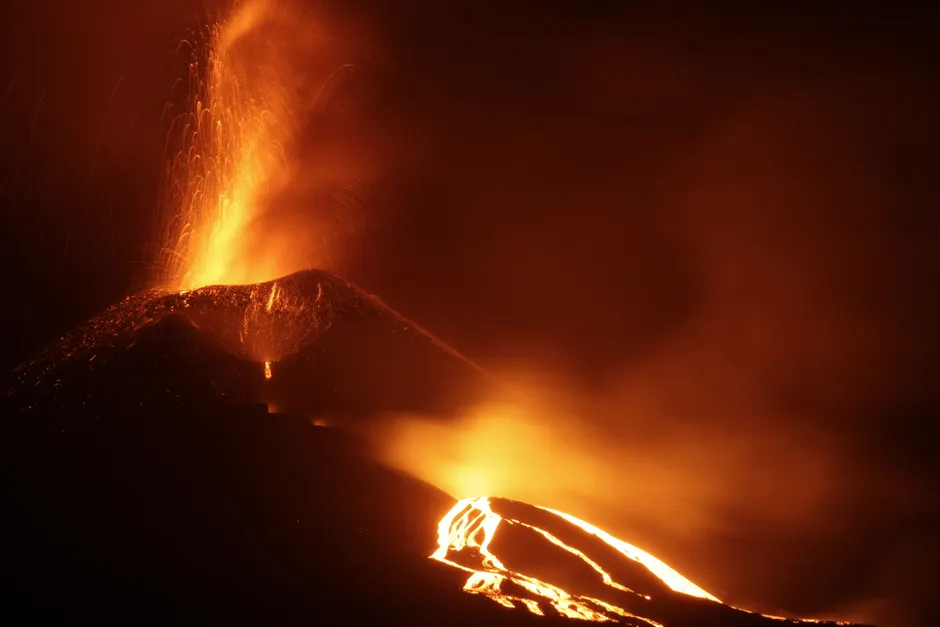
A Volcano in Italy Stopped Flights for Days — Here's What Happened

Mount Etna, a large volcano in Sicily, Italy, started erupting in early August 2026. The ash clouds it produced were thick enough to force Catania International Airport to stop incoming flights on 10 August, and the disruption spread as far as Malta the next day.
Reuters reported that arrivals at Catania, the main airport in eastern Sicily, were suspended until 1500 GMT on Monday, 10 August. Deutsche Welle, publishing on 13 August, said the suspension lasted until at least 4 p.m. local time (1400 GMT) because of fresh ash from the eruption. The small difference in the reported end time reflects how the airport kept adjusting its decisions as the ash cloud moved.
The disruption went well beyond Sicily. On Tuesday, 11 August, Reuters reported that 19 flights to and from Malta had been cancelled by mid-afternoon, with several other flights significantly delayed. Reuters also noted on social media that Etna's ash and smoke cloud had disrupted flights in Sicily the previous Sunday. Taken together, this was a multi-day event that affected air travel across the central Mediterranean.
Behind the airport closures was a real increase in volcanic activity. INGV Osservatorio Etneo, the Catania branch of Italy's National Institute of Geophysics and Volcanology, published its weekly bulletin for Mount Etna on 11 August 2026. The bulletin reported "very sustained strombolian activity" at a crater called the Voragine, which then escalated to a lava fountain. Strombolian activity means the volcano throws glowing chunks of rock into the air in bursts, like a pot occasionally boiling over. These bursts can quickly intensify into sustained fountains that shoot ash and gas high into the sky, which is dangerous for airplanes.
The 11 August bulletin was part of INGV's regular monitoring programme. The observatory publishes weekly bulletins covering volcanic activity, gas emissions, and seismic data for both Etna and the island of Vulcano, with a Vulcano bulletin dated 4 August also available on the INGV website. The institute monitors three volcanic systems from its Catania base: Mount Etna, the Aeolian Islands, and Pantelleria. Its real-time surveillance includes volcanic activity bulletins and VONA notices, which are alerts specifically designed to warn aviation authorities about volcanic ash in the air.
This eruption follows earlier activity this year. INGV documented an explosive event at Etna on 4 March 2026 at 13:12 local time, recorded in the institute's news archive. The March event and the August escalation fit Etna's well-known pattern of bursts of activity broken up by quieter periods, occasionally spiking into more powerful phases.
Catania International Airport's official website provides real-time flight tracking, allowing travellers to check operational status during such events. The airport sits about 25 kilometres south of Etna's summit craters, putting it directly in the path of ash clouds carried by prevailing winds.
The broader context here is how closely volcanic monitoring and air travel are connected in this part of the world. Etna is one of Europe's most active volcanoes, and its eruptions regularly affect flights through Catania, Sicily's busiest airport. The VONA alert system, used by volcano observatories worldwide under international aviation rules, is the official channel through which ash warnings reach airlines and air traffic controllers. When INGV issues a VONA, it sets off a series of assessments that can result in airspace closures or flight rerouting.
What makes this event unusual is how far the ash travelled. The disruption to Maltese flights suggests the ash cloud rose high enough to be carried by winds far south of the volcano. The 19 cancellations in Malta, combined with the multi-day suspension of arrivals at Catania, make this one of the more disruptive Etna eruptions in recent years for air travel.
For now, INGV's bulletin of 11 August is the most recent official assessment, showing that the volcano's activity had already intensified to lava fountaining. Whether the activity continues to build or dies down will determine whether more flight disruptions follow. The next weekly bulletin, along with any new VONA alerts, will provide the key information for that judgement.