Waymo's New Self-Driving Taxi Is Now Available to Everyone in Three Cities

Waymo has opened its newest self-driving taxi, called the Ojai, to all riders in Los Angeles, Phoenix, and San Francisco TechCrunch. Until now, only Waymo employees and invited guests could ride in the Ojai during testing that started in February.
The Ojai (pronounced oh-hi) is an electric minivan made by Zeekr, a car brand owned by China's Geely Holding Group. Waymo and Zeekr teamed up in 2021 to build self-driving vehicles for U.S. ride-hailing. The vehicles arrive without any Chinese internet-connected car software, and Waymo installs its own self-driving technology at its factory in Arizona. The Ojai is the first to use Waymo's sixth-generation self-driving system, which the company says can handle snowy weather, something that has limited earlier self-driving cars mostly to warm-weather cities Waymo.
Inside, the Ojai has a new passenger screen and uses Google's Gemini AI as a helper you can talk to. The car was designed from scratch as a taxi rather than modified from a regular passenger car, which changes how the seats are arranged, how you get in and out, and means there is no steering wheel or pedals.
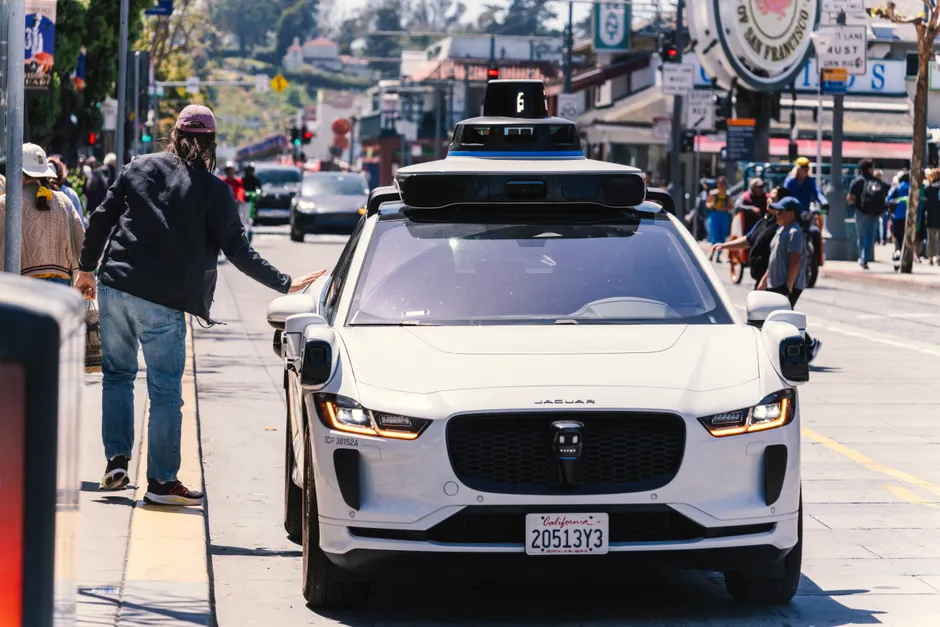
As of the announcement, Waymo had about 300 Ojai taxis in service, and that number is growing fast. According to the research firm MoffettNathanson, 725 Ojai vehicles arrived in the United States in July 2026 alone. The firm estimates Waymo is on track to bring 5,000 Ojai vehicles to the U.S. by the end of 2026, more than double its current fleet of Jaguar I-PACE self-driving cars. Waymo also plans to launch the Ojai in Denver, Las Vegas, and San Diego later in 2026, on top of the 11 U.S. cities where it already operates.
Because the vehicles are built in China, U.S. tariffs add to the cost of each one. Waymo has not said publicly how much extra it pays per vehicle after tariffs. But the pace at which it is importing the cars suggests the company considers the added cost worth it for the scale it wants to reach.
The broader context is that Waymo is replacing its older fleet with a cheaper-to-build car and a new version of its self-driving software at the same time that its safety data has grown large enough to compare directly with human drivers. UMTRI Research Professor Carol Flannagan has said Waymo is driving enough miles to make that comparison meaningful Waymo.
Waymo's safety report covers more than 220 million miles driven without a human behind the wheel, through the end of March 2026. Compared with human drivers in the same cities over the same period, the Waymo Driver had 94% fewer crashes causing serious or fatal injuries, 82% fewer crashes where an airbag went off, and 82% fewer crashes with any reported injury. The company also reports 93% fewer injury crashes involving pedestrians, 84% fewer involving cyclists, and 84% fewer involving motorcyclists. Waymo now drives more than 4 million miles every week and estimates that its service prevents one serious-or-worse crash every eight days. Over its lifetime, Waymo calculates 47 fewer serious-or-fatal crashes, 305 fewer airbag-deployment crashes, and 707 fewer injury crashes of any kind than human drivers would have been expected to cause over the same distance.
A separate look at Atlanta, covering more than 5.4 million self-driving miles, found the Waymo Driver had 94% fewer airbag-deployment crashes and 86% fewer injury crashes than the human benchmark. A typical human driver covering Waymo's Atlanta miles would have been expected to have about 1.2 crashes causing serious or fatal injuries. The Waymo Driver had none.
Waymo has published its full safety dataset and methods at waymo.com/safety/impact, and a research paper on how it decides the system is ready for public use is available at arxiv.org/abs/2505.09880.
Waymo riders have taken more than 20 million fully driverless trips across more than 11 cities Fox News. The company is also bringing fully driverless service to five more cities: Miami, Dallas, Houston, San Antonio, and Orlando Waymo.
Going from employee-only rides in February to full public availability in three cities within six months is fast for the self-driving car industry, where testing has typically taken longer than the yearly upgrade cycle most people know from phones and laptops. If Waymo reaches its 5,000-vehicle target by year-end, it would have enough cars to noticeably increase ride availability in the cities where it operates. The partnership with Zeekr, despite the tariff costs, looks like the way Waymo can reach that scale, which its older Jaguar-based fleet could not.
Two questions will get answers as the Ojai moves into Denver and other colder cities: whether the new self-driving system can really handle snow, and whether the Gemini AI assistant inside the car is something riders actually find useful or just a gimmick.