How NASA's Mars Rover Curiosity Keeps Going 13 Years Beyond Its Original Plan

NASA's Curiosity rover has been exploring Mars for 13 years — far longer than anyone expected when it landed in August 2012. The rover was originally designed to operate for just two years. Today, engineers at NASA's Jet Propulsion Laboratory are still updating its software to keep it working and collecting new science, even as its power supply slowly weakens over time.
A Robot That Has Lasted Much Longer Than Planned
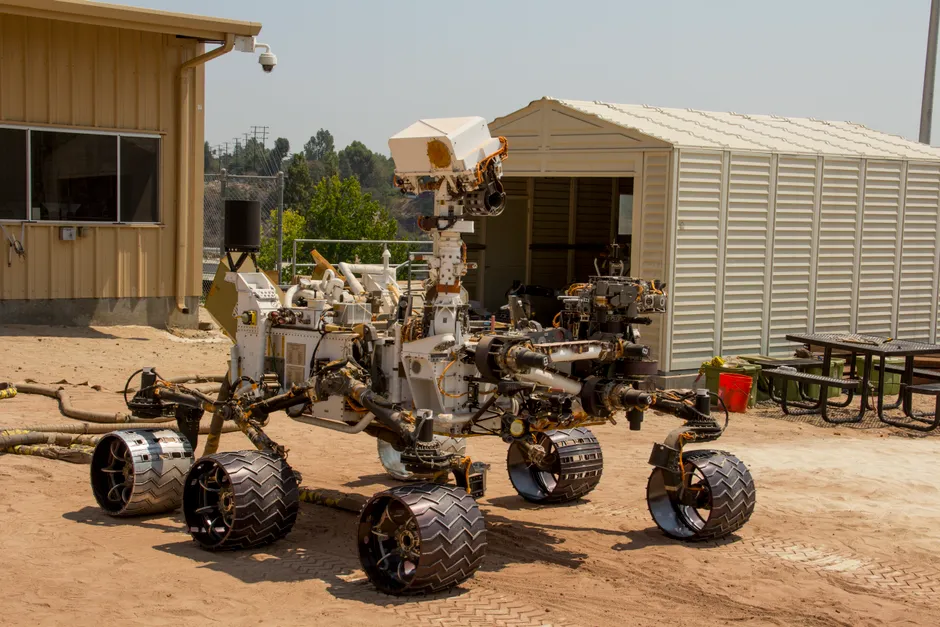
Curiosity touched down in Gale Crater in 2012. It was the biggest and most sophisticated rover NASA had ever sent to Mars — about the size of a car, weighing one tonne, with ten different instruments for science, a drill mounted on a robotic arm, and a laser that could fire at rocks from a distance. The goal was to see whether Mars once had conditions suitable for life.
That was 13 years ago. Curiosity is still moving, still drilling, and still sending information back to Earth from a planet more than 225 million kilometers away.
This long life did not happen by accident. Teams at NASA continuously update the rover's computer code and its plans for how to use its energy. They adjust what the rover does each day to match the way its hardware is wearing out.
The Power Problem That Changes Everything
Curiosity does not run on solar panels like most rovers would. Instead, it uses a radioisotope thermoelectric generator — essentially a small nuclear battery. Inside this device, heat from radioactive plutonium decays into electricity. This design means the rover does not depend on sunlight or the dust storms that can block the sun on Mars.
But there is a cost: plutonium naturally breaks down over time. The radioactive material loses half its strength every 87.7 years. Each year, the rover's power output drops by about 4 to 5 watts.
When Curiosity landed, its power generator produced roughly 110 watts — enough to run multiple experiments every day. Now, thirteen years later, that number has fallen significantly. The rover needs longer to recharge its batteries, which means less time each day to do science work. Every task — driving, drilling, taking pictures, sending data home — must fit into a smaller energy budget than the rover's designers originally planned.
This is the main challenge facing Curiosity now: not a broken part or a computer glitch, but simple math. The plutonium has less power to give.
Making the Rover Smarter to Use Less Power
NASA's answer is to make Curiosity smarter about how it uses its remaining power. The updates announced for the rover's 13-year milestone are all about doing more science while using less energy.
The changes include updates to how the rover plans its own movements without waiting for commands from Earth, improvements to how it stores and prioritizes data before sending it home, and adjustments to its driving routines that reduce wasted movement. The goal is to recover time for actual science work that otherwise gets eaten up by routine tasks like charging batteries, managing temperature, and checking that all systems are healthy.
This is not a new approach for NASA. A few years ago, engineers uploaded improved navigation software to Curiosity that let it explore more complex terrain on its own, without needing approval from Earth for every single wheel placement. The new updates follow the same idea: give the rover more independent thinking, and let it accomplish more with what it has.
Why the Rover Is Still Worth Keeping Alive
The reason to keep Curiosity working is clear. Scientists think that if life ever existed on Mars, it would have been 3 to 4 billion years ago, when liquid water flowed on the surface and underground. Gale Crater, where Curiosity is exploring, contains a tall central mountain called Aeolis Mons — also known as Mount Sharp — with layers of rock that tell the story of that ancient period. Each time Curiosity drills into the rock, analyzes it with a laser, or studies the mineral composition, scientists learn another detail about what Mars was like billions of years ago.
So far, Curiosity has traveled more than 21 kilometers and collected samples from ancient riverbeds, salty mineral deposits, and sand formations. The rover is currently climbing Mount Sharp, which means it continues to find new geological layers, each one younger than the one below it. There is still genuine scientific territory to explore.
This Is a Pattern in Space Exploration
There is something worth recognizing here if you follow space missions over the long term. The Voyager probes, launched in 1977, are still sending information back from deep space — nearly 50 years later — because engineers have gradually turned off unnecessary equipment and squeezed extra life from aging power systems. Earlier Mars rovers, Spirit and Opportunity, also received software updates mid-mission that made them last much longer and explore further than originally planned. In each case, the robots outlasted what engineers thought possible because the teams refused to give up on them.
Curiosity follows that pattern. Its nuclear battery will keep producing electricity — smaller amounts each year, but still some — for several more years. The real question is whether JPL can keep adjusting the rover's work schedule to match the power available.
There is a wider story here about how NASA approaches exploring other planets. Perseverance, Curiosity's sister rover in another part of Mars, also uses a nuclear battery and is in its fourth year of operation. The lessons that engineers are learning right now about how to operate Curiosity more efficiently on less power will probably be used to keep Perseverance and future rovers running longer too.
What Happens Next
NASA has not announced a final shut-down date for Curiosity. The operations team continues to plan the rover's daily activities, aiming to explore the layers of rock in the upper part of Mount Sharp that were identified as the highest priority targets when the mission was extended beyond the original two years.
The truth is that Curiosity is on borrowed time — but that borrowed time is the result of careful work, smart updates, and refusing to let good tools fall silent when they can still do good science. That is what 13 years of sustained, professional engineering actually looks like.