Why Iran Is Now Attacking US Allies in the Middle East

Iran has started firing missiles and drones at three countries that are allied with the United States: Kuwait, Bahrain, and Jordan. The attacks, reported on July 18, 2026, hit civilian buildings, oil facilities, and US military bases across the Gulf region. This widened the conflict beyond just the US and Iran and pulled neighboring countries into the fighting. The Guardian
The US military, through its Central Command (CENTCOM), said it had been striking Iranian territory for seven nights in a row as of July 17, 2026. The campaign is called Operation Epic Fury, and its goal is to weaken Iran's military and reopen the Strait of Hormuz. The Strait of Hormuz is a narrow strip of water between Iran and Oman through which about one-fifth of all the oil used worldwide passes. CENTCOM published statements on its website on July 16 and July 17 confirming the strikes. Iran said 38 people were killed and over 400 injured in the US attacks. France 24
Kuwait was hit the hardest. Iran was accused of targeting civilian sites including a plant that turns seawater into drinking water. Kuwait depends on this process, called desalination, for about 90% of its drinking water. Kuwait's national oil company said an oil facility was also hit, causing injuries and major damage. A satellite image in The Guardian showed smoke rising near an oil facility in the Ahmadi area on July 18. Kuwait temporarily closed its airspace while it intercepted Iranian missiles and drones. Several firefighters and a worker were injured while putting out fires caused by the strikes. Kuwait's foreign ministry said "the repeated targeting of vital facilities reveals a systematic hostile approach targeting civilian sites and vital infrastructure."
Bahrain sounded air raid sirens on Saturday, July 18, telling residents to take shelter after detecting possible incoming drones or missiles. Jordan's state news agency reported that Jordan's air defenses shot down Iranian missiles. CNN reported that four missiles fired from Iran were shot down. CNN
CENTCOM said Iran fired seven ballistic missiles toward Kuwait and Bahrain. Six were intercepted, and one missed its target. Iran said the attacks were retaliation for US strikes on civilian infrastructure inside Iran, including bridges and power facilities.
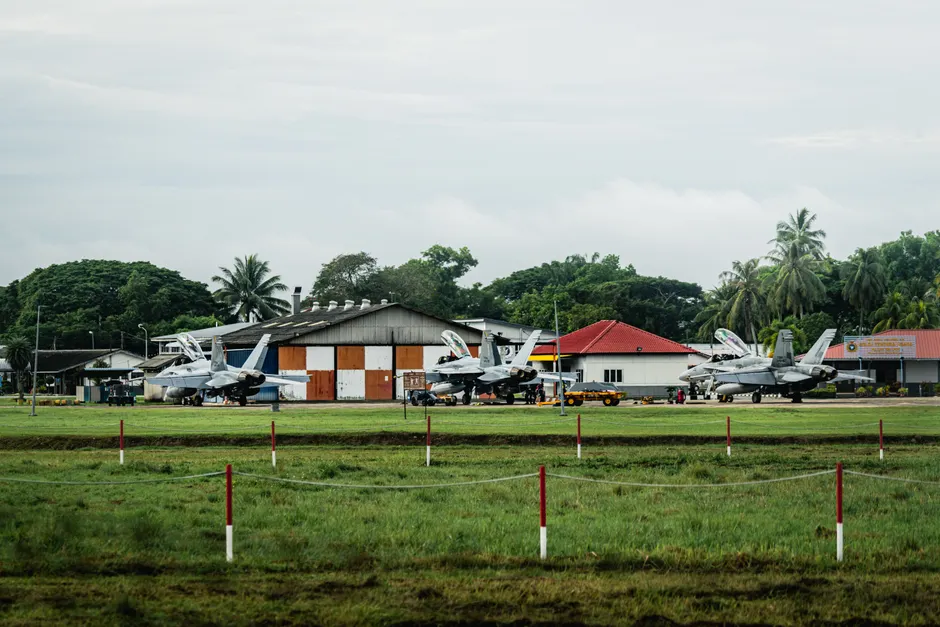
Iran's elite military force, the Islamic Revolutionary Guard Corps (IRGC), went on state television to claim a series of successes. It said it destroyed at least two US fighter jets and three other aircraft in an attack on a US base in Azraq, Jordan. It said it hit a US support center at Camp Arifjan in Kuwait and destroyed a US radar facility at Ali Al Salem airbase in Kuwait. It also said it targeted a base in Bahrain where US combat aircraft were gathered, along with an intelligence data center. The US military has not confirmed these claims. The IRGC has a history of making battlefield claims that are hard to verify independently.
The IRGC also claimed that two oil tankers exploded after hitting mines in the Strait of Hormuz and that it had stopped four ships from passing through. The US military said that claim was false. The Strait of Hormuz is the main reason the US launched its campaign: the military operation was meant to keep the Strait open, and Iranian interference with shipping there was given as a reason for the strikes.
A group of six Gulf countries called the Gulf Cooperation Council (GCC) condemned Iran's attacks. Its Secretary-General, Jasem Mohamed al-Budaiwi, said the strikes on civilian infrastructure "amounted to war crimes and a grave violation of international law and the UN Charter." By referring to the UN Charter, the GCC is treating this not just as a security problem but as a violation of international law, which could lead to action at the United Nations.
Iran had already started attacking US assets in Kuwait, Bahrain, and Jordan as early as July 16, according to Al Jazeera's liveblog. The strikes on US allies have now happened over multiple days and intensified over the weekend of July 18. Al Jazeera
The broader context here is that this conflict has crossed a line the Gulf states had long tried to avoid. By striking a desalination plant in Kuwait, where nearly all drinking water comes from such facilities, Iran turned a military exchange into a potential humanitarian crisis. The attacks on oil facilities put global energy supplies directly at risk. And the IRGC's claims about blocking ships in the Strait of Hormuz, even if denied by the US, create uncertainty at the world's most important shipping route for oil.
The competing claims are part of the conflict too. The IRGC's announcements about destroying US aircraft and bases, whether true or not, serve as propaganda and shape how people across the region understand the war. The US saying the tanker-mining claim was false shows that information warfare is happening alongside the actual fighting. For the Gulf states caught in the middle, calling these strikes war crimes suggests they are building a case for a wider international response. But the UN Security Council's ability to act on that case is limited because the US, one of five permanent members with veto power, is directly involved in the conflict.
The campaign entered its second week with no sign of stopping. Seven straight nights of US strikes, met with Iranian retaliation across three separate countries, has created a conflict that now touches civilians, critical infrastructure like water and power, energy markets, and global shipping all at once.