How Meta's AI Is Helping Scientists Process Mountains of Experiment Images

Meta has announced that two of its open-source AI models, called SAM 3 and DINOv3, are now being used to help scientists at U.S. national laboratories automatically process large volumes of experiment images. The project, called SYNAPS-I, is run by Lawrence Berkeley National Laboratory together with a group of other national labs.
SYNAPS-I stands for SYnergistic Neutron And Photon Science – Intelligence. It is part of a broader government effort called the Genesis Mission, launched by the White House in late 2025 and led by the Department of Energy. The project involves Argonne, Brookhaven, Oak Ridge, and other national laboratories.
The problem SYNAPS-I tackles is simple to describe but hard to solve. Scientists at these labs study materials using machines that produce extremely detailed images. To make sense of those images, a researcher has to outline the important structures within each one by hand, so they can be measured and analyzed. This is called segmentation. Doing it manually can take weeks of expert work for a single dataset.
The two AI models handle different parts of the job. DINOv3 learns to recognize visual patterns from images on its own, without needing a human to label examples first. SAM 3 then draws precise boundaries around individual objects in an image, doing what a scientist would otherwise do by hand. Together, the models can process image data far faster than a person could.
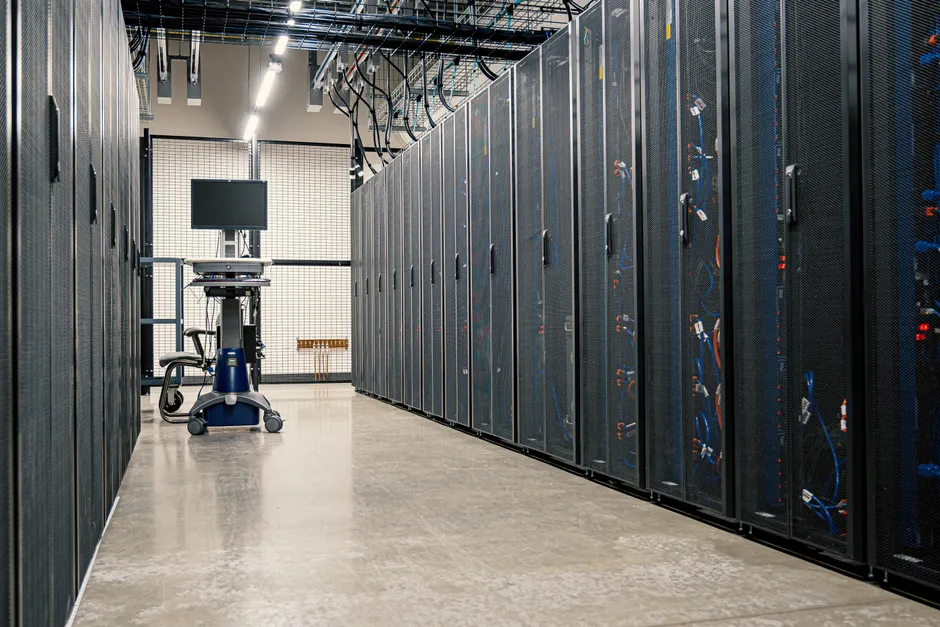
The reason this bottleneck exists comes down to how much data these labs now produce. A decade ago, the detectors at these facilities captured one image every six seconds. Today they capture 100,000 images per second. The facilities now generate tens of petabytes of data each year, roughly the equivalent of 2 million hours of HD video. Lawrence Berkeley's Advanced Light Source, a football field-sized machine that produces intensely bright X-ray beams for studying materials at the atomic level, is one such site. The sheer volume of data has long surpassed what any team of humans could review by hand.
The Genesis Mission is a national initiative to speed up scientific discovery using AI. The DOE announced funding for the mission in March 2026, bringing together national labs, industry, and universities to apply AI to problems in energy, science, and national security. The mission covers a range of projects, including "self-driving" labs that combine AI with robotics to automate experiments, AI tools for designing and operating buildings, and efforts to improve the computer chips and edge computing systems that AI relies on. SYNAPS-I is one project within that larger program.
Meta has made both SAM 3 and DINOv3 open-source, which means anyone can inspect, modify, and use the code and the models themselves without paying licensing fees. For government labs, that matters. It means researchers can run the models on their own computers without depending on a company's servers, they can verify results independently, and they can adapt the models to the specific kinds of scientific images their facilities produce.
There is a familiar pattern here. In the 2000s and 2010s, DNA sequencing technology got so fast that biology labs were flooded with genetic data, and an entire field of software tools grew up to handle it. The DOE's detector upgrades have created a similar problem in materials science. The open question is whether AI models trained on ordinary photos can also work well on the specialized images these labs produce, like X-ray patterns and neutron scattering images. Meta says SYNAPS-I is already using the models, which suggests they work at least reasonably well, though the company has not published detailed performance comparisons against human experts.
If the pipeline holds up, the payoff is clear. These facilities cost hundreds of millions of dollars to run, and every week a researcher spends tracing outlines in images is a week that experiment results go unanalyzed, findings go unreported, and the next experiment goes unplanned. The bet is that AI can match or come close to what a human expert does, but at a speed and scale no team of people could sustain. That bet is now being tested in real conditions at one of the country's premier light sources.
In my view, this is a use of AI that is easy to root for. The work it replaces is real and necessary, but it is also exactly the kind of repetitive, time-consuming task that machines are well suited to take on. The scientists I have known over the years, including my own kids when they were doing lab work in college, have generally been happy to hand off the tedious parts of their jobs to software. If SYNAPS-I works as intended, it means more time spent on discovery and less on drawing lines.