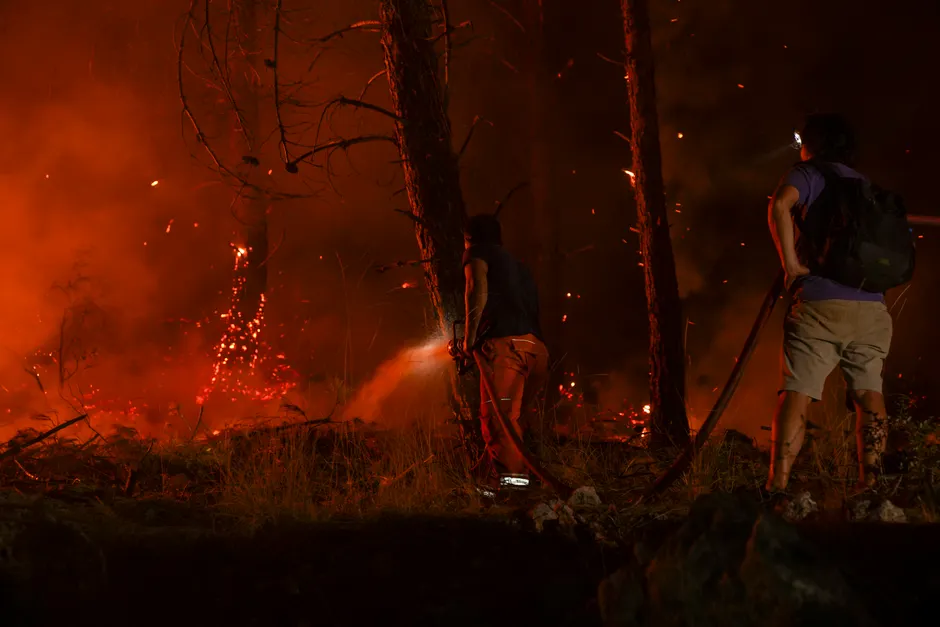
Thousands Flee as Wildfires Tear Through France's Atlantic Coast

French authorities ordered people to leave the Cap Ferret peninsula on July 24, 2026, as a huge wildfire that started two days earlier near the village of Saumos burned more than 10,000 hectares (24,700 acres) of forest and forced 40,000 people from their homes. Interior Minister Laurent Nuñez confirmed the numbers on Friday morning. The fire was still not under control, meaning firefighters had not yet managed to stop it from spreading. The Guardian
The fire started on July 22 near Saumos, about 40 kilometres from the city of Bordeaux. It moved northwest toward Le Porge and then headed for the Lège-Cap-Ferret peninsula. Local officials used France's emergency alert system, called FR-Alert, to tell people to leave village by village. They could leave by boat or by the single road that connects Cap Ferret to the mainland. Boats started carrying residents and visitors away from four piers early on July 23. Gironde Prefecture
About 800 firefighters and four planes that drop water from above were sent to fight the fire north of Arcachon Bay. Flames reached 10 metres high, pushed by strong winds across very dry ground. Eighty houses have been destroyed. A local government update at 21h30 on July 24 said that nearly 20,000 people had been evacuated from the areas of Le Porge, Saumos, Le Temple, and Lège-Cap-Ferret. Earlier, 600 residents of the Le Porge Lauros neighbourhood had been moved to Lège-Cap-Ferret. Gironde Prefecture
A second fire, burning near the town of Biscarrosse in the neighbouring Landes area, has burned more than 2,500 hectares and led to the evacuation of about 23,000 people, according to Landes official Gilles Clavreul. More than 600 firefighters were sent to that fire. The Guardian
President Emmanuel Macron turned on the EU civil protection mechanism. This is a system that lets European Union countries share emergency equipment with each other when one country faces a disaster too big to handle alone. Through this system, France received two aircraft from Croatia, two planes from Portugal, and two large helicopters from the Czech Republic and Slovakia. The Guardian
The evacuation of Cap Ferret is difficult because of how the land is shaped. The peninsula is a narrow strip of land between the Atlantic Ocean and Arcachon Bay, and only one road connects it to the mainland. When fire threatens that road, evacuation by boat becomes necessary rather than optional. The use of boats from four piers shows how many backup plans authorities needed to move tens of thousands of people during a fire driven by strong winds.
The Gironde and Landes areas have experienced large wildfires before. The ground there is a mix of pine forests and open heathland, which catches fire easily when it is dry and windy. Having two major fires burning at the same time in neighbouring areas puts a strain on France's emergency resources. That helps explain why Macron quickly asked the EU for help. The planes and helicopters from Croatia, Portugal, the Czech Republic, and Slovakia are the kind of equipment France cannot quickly produce more of on its own.
The numbers are worth paying attention to. Nuñez said 40,000 people had been or were about to be evacuated as of Friday morning. The local government's 21h30 update on the same day said nearly 20,000 for preventive evacuations across four areas. These numbers do not necessarily contradict each other. The local update covers specific areas, while the interior minister's number likely includes a broader zone with people already displaced or being moved. The gap between the two figures shows how fast the situation changes during a fire that is not yet under control, and how different officials at different levels can report numbers that overlap but are not identical within hours of each other.
The wider picture here is concerning. The loss of 80 homes means the fire has moved beyond burning trees and is now directly affecting people's lives. With the fire still not under control and strong winds continuing, the final count of burned land, destroyed buildings, and displaced people is not yet final. The timing makes things harder: Cap Ferret's population grows in summer with visitors, so there are far more people on the peninsula than usual.
France's wildfire season in the Landes de Gascogne forest has seen fires of similar size in recent years. The use of EU firefighting equipment shows how serious these fires are, and also shows the system that EU countries can now routinely use when facing emergencies at the same time. Whether the EU reinforcements arrive in time to help control either fire will depend on wind conditions and how fast the fires spread over the next few days.