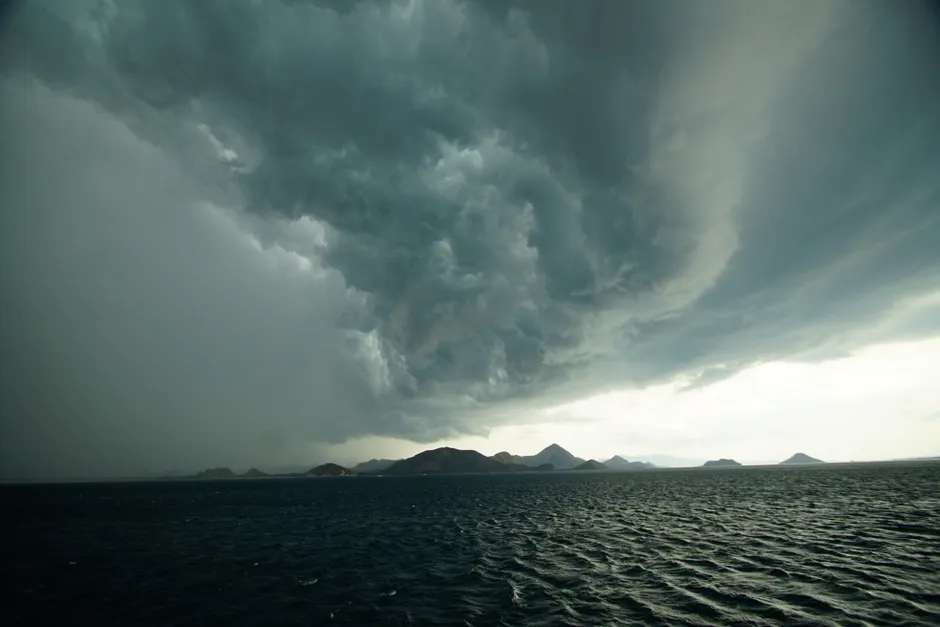
A Super Typhoon, Record Heat, and Weird Rain: What's Happening This Summer

Typhoon Dolphin, once one of the strongest storms on Earth this year, has weakened but is still heading toward Japan. As of Monday 3 August, the storm had sustained winds of 125 mph and was moving west toward Okinawa. At its peak, Dolphin reached 175 mph — making it the third-most powerful storm worldwide in 2026. It is expected to hit land as a weaker Category 1 or 2 storm, but winds of 80–100 mph could still cause serious damage. As Dolphin nears land, its winds are expected to spread out over a wider area, which means the biggest danger may shift from wind itself to storm surge — a rise in seawater pushed onto the coast by the storm. The Guardian
Two things made Dolphin unusual: how fast it grew and how small it was. It went from a regular tropical storm to a super typhoon in about 36 hours, fueled by ocean waters that were around 30°C (86°F). Its structure was very tight, with the strongest winds reaching only 52 miles from the center. Small storms like this pack a lot of destruction into a narrow area. But when they approach land, they often spread out — which is what forecasters are watching now. The Guardian
Halfway across the world, the town of Wieselburg, Austria hit 40.3°C (104.5°F) in July 2026. That is just 0.2°C below Austria's all-time hottest temperature, set in August 2003. That 2003 heat wave is seared into European memory because it was linked to tens of thousands of deaths across the continent. Coming within 0.2°C of that record in July makes 2026 one of the hottest months Austria has ever recorded. The Guardian
Meanwhile, Vancouver, Canada had its wettest July since 2016, with 33.6 millimeters of rain. That might not sound like a lot, but Vancouver's summers are normally dry. This unusually wet month also goes against long-term forecasts: Canada's climate agency projects that southern Canada will actually get less summer rain in the coming decades if emissions stay high. The Guardian ECCC Climate Scenarios
The broader picture is that these events are happening at the same time, and they are connected. Austria's near-record heat, Vancouver's unusual rain, and Dolphin's rapid growth over warm ocean water are all signs of a climate system that scientists have long warned would carry more energy. That extra energy means heavier rain in some places, more intense heat in others, and stronger tropical storms where the ocean is warm enough to fuel them.
For people in Japan, the storm's changing shape matters. Even if Dolphin arrives as a weaker storm, its spreading winds could push seawater onto a longer stretch of coast than expected. Emergency planners have to prepare for winds that, while not at peak strength, can still knock down trees, damage roofs, and cut power and transportation. The Guardian
In Canada, Vancouver's wet July raises a practical question for city planners. One rainy month does not cancel out a long-term trend toward drier summers. But it does test drainage systems, water reservoirs, and farming plans that are designed for a climate that is shifting under their feet. NR Canada
In Europe, Wieselburg's 40.3°C reading adds to a pattern: the temperature records set during the deadly 2003 heat wave are being approached or broken more often. The gap of 0.2°C is small enough that it could be closed in the next few years. That raises questions about whether cities are ready — with cooling centers, power grid capacity, and heat emergency plans — for a future where July can now rival the worst of August 2003.
Taken together, the summer of 2026 is showing a pattern of extreme weather hitting different parts of the world at the same time. Austria bakes. Vancouver gets soaked. The Pacific spins up another super typhoon. Each event has its own local causes. What connects them is the growing energy in a warming climate — and the fact that infrastructure, from Japan's coastal defenses to Vancouver's storm drains, is facing conditions that increasingly go beyond anything in the historical record.