Why Europe Wants a Seat at the Ukraine Peace Table

Why Europe Wants a Seat at the Ukraine Peace Table
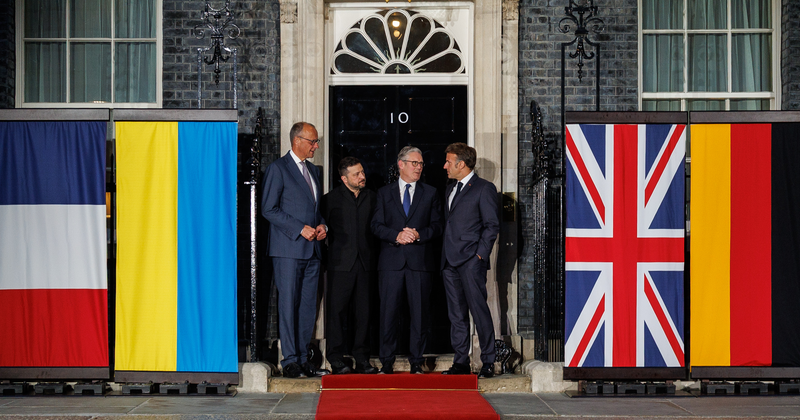
On June 8, 2026, President Volodymyr Zelenskyy met in London with the leaders of the United Kingdom, France, and Germany to tackle a crucial diplomatic problem: who gets a seat at the negotiating table if and when direct peace talks with Russia happen. The meeting followed a phone call between Zelenskyy and UK Prime Minister Keir Starmer on June 3, per the UK government, suggesting the London summit was meant to continue that conversation in person.
The main headline was that European leaders officially supported Zelenskyy's call for direct ceasefire talks with Russia, as France 24 reported. But the more important takeaway — and the one likely to last — was the discussion about format: how exactly would Europe be represented at any future peace negotiations, according to the Ukrainian presidency.
Zelenskyy's demand that Europe must be a full participant — not just an observer or someone waiting on the sidelines to guarantee any deal — is more than just political rhetoric. It reflects a deeper structural concern about how any peace agreement will actually work.
The Diplomatic Trail Since Late 2025
To understand what happened in London, you need to know the pattern of peace efforts over the previous six months, which have moved forward in stops and starts without reaching solid ground.
In December 2025, Zelenskyy described Ukraine's talks with the United States as "constructive but not easy," per Reuters. That careful phrasing — hopeful but with clear reservations — set the tone for what came next. In January 2026, Ukrainian and Russian envoys held trilateral talks in Abu Dhabi. Zelenskyy called these the first meetings of their kind, according to Reuters, and notably confirmed that territorial issues — how much land each side would control — were actually being discussed. This was significant because as recently as June 2025, Russia had insisted Ukraine must give up substantial new territory before any ceasefire could happen, as Reuters reported.
Geneva came next. In February 2026, Ukraine and Russia held talks in Switzerland amid what Reuters described as pressure on Kyiv, and Zelenskyy was not happy with how it went. He called the outcome insufficient, per the Ukrainian presidency. In March 2026, Zelenskyy proposed a temporary Easter ceasefire limited to halting attacks on power plants and asked Washington to pass the idea to Moscow; the Kremlin's response was lukewarm, Reuters reported.
What emerges from this timeline is a pattern of steady contact without actual agreement: each round of talks leads to the next round, but nothing fundamental shifts. Neither side has moved enough for real negotiations to begin.
We have seen this pattern in other conflicts — think of the warming between North and South Korea in 2018, or the early 2015 contacts before the failed Minsk agreement in Ukraine itself. In those cases, meetings created an appearance of momentum, but the parties were really just testing each other's limits rather than moving toward peace. The fact that negotiations keep changing locations and formats is itself a signal: when the parties cannot agree on who should be in the room or what they are trying to accomplish, they keep cycling through new venues instead of getting down to actual deal-making.
Building a "Coalition of the Willing" for Security
While diplomacy has been unfolding, the UK and France have been quietly assembling what they call a "coalition of the willing" — a group of countries that would commit to defending Ukraine after any peace deal, according to the BBC. This is different from NATO membership (which requires agreement from all alliance members and has been blocked) and from regular defence treaties. It is a flexible middle ground.
Why does this matter? Any ceasefire that leaves Ukraine defenseless against another Russian invasion is likely to fail, just as the situation before February 2022 proved Ukraine's vulnerability. The coalition of the willing is designed to solve that problem — to create a credible military guarantee. This is why the London summit's discussion of European involvement in peace talks connects directly to this security guarantee. European leaders are not fighting for a seat at the table just for political pride; they are trying to make sure that any security deal that comes out of negotiations is shaped by the people who will have to enforce it. They do not want to be asked to sign off on an agreement someone else has already made.
What Zelenskyy Really Wants From Europe
Zelenskyy's insistence that Europe must be at the negotiating table, not just nearby, has a practical logic. So far, most diplomatic contact has gone through Washington and, to some extent, through Gulf countries like the United Arab Emirates. Abu Dhabi hosted those January talks; the US has been the main channel for passing Ukrainian positions to Moscow. Geneva, which is in neutral territory in Europe, produced talks that Kyiv felt did not go anywhere.
The European demand for direct inclusion is meant to correct this imbalance. Leaders in Paris, Berlin, and London believe that a deal made without real European involvement will be harder to maintain and harder to enforce. After all, Europe will pay most of the cost of rebuilding Ukraine and faces the biggest risk if there is still instability on its eastern border.
For Germany and France specifically, there is also a matter of credibility on the line. Both countries have invested in past diplomatic efforts — the Normandy and Minsk frameworks from the previous decade — that ultimately failed. They have a reason to want to be directly involved in this process: they do not want the same mistakes repeated, and they do not want to be left out only to take blame later if things fall apart.
What Comes Next
The June 8 London meeting does not by itself change the military situation or suddenly shift how Russia and Ukraine view peace. There is no public sign that Russia has accepted the European participation that Zelenskyy and his European allies are demanding. What the meeting does achieve is clarity and alignment: the UK, France, and Germany are now formally on record supporting both direct ceasefire talks and the idea that Europe must have a real voice in any peace process.
Whether that alignment will actually translate into leverage depends heavily on what the United States is willing to back. The US remains the key player that Russia will likely listen to. European leaders pushing for inclusion are essentially asking Washington the same question: will you support our involvement, or will you oppose it? How the US answers will tell us a lot about the relationship between America and Europe in any future peace negotiations.
The next few weeks will show whether the London agreement leads somewhere or remains just a public statement of position. The diplomatic record since December 2025 shows that both sides can keep talking; the record since June 2025 shows they remain far apart on basic issues. What changed on June 8 is that Europe made its demand crystal clear — and Kyiv and its closest European partners are now speaking as one voice about the conditions any real negotiations must meet.